Coral reefs are entangled in trash, recruiting passionate divers to go into the sea to clean it up
Taiwan's coral reefs are spectacular, but although there are no fish, there is a pile of garbage. Take the Chenggong Jihui fishing port in Taitung as an example: earlier this month, nearly 20 volunteer divers cleared 1/10 of the underwater garbage. According to a survey by the Environmental Information Center, the local coral reef is very healthy, and in 2012 two new species of coral were discovered there, but unfortunately they are tangled in garbage, so the cleanup work can be said to be urgent.
The association will carry out reef check and garbage removal work at Jihui fishing port, but Lin Yuzhu, project manager of the Environmental Information Center, said they hope to recruit 8 divers who are passionate, willing to assist with the survey, and have used at least 50 oxygen cylinders, to work together for the ocean
Through divers working together, grasping the health of Taiwan's coral reefs
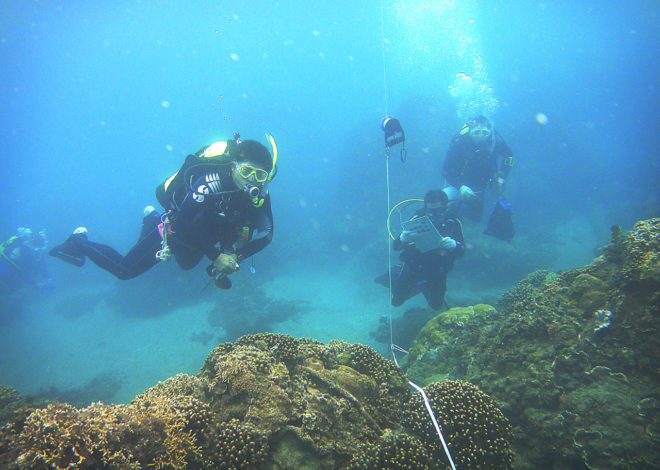
Flippering forward toward the sea surface, arriving at a spot more than 10 m offshore, looking at the vast ocean ahead, suddenly a splash of water is stirred up, and they begin to dive down with effort. Even though all around there is only the bubbling sound of oxygen turning into bubbles, with no verbal commands and no other sounds, the diver partners taking part in the undersea coral reef survey already have a tacit understanding
3 m, 5 m, 10 m, each stretch of descent is a test of the divers' endurance. Once at the seabed, the divers first unroll a 100 m long tape measure called a "transect (transect)," then rely on their own "imagination," imagining that the transect can open to a width of 5 m, becoming a hypothetical zone, and observe the corals and fish schools covered within the hypothetical zone, finally turning it into scientific data such as coral coverage rate and indicator fish.
Lin Yuzhu, a graduate of the Institute of Oceanography at National Taiwan University and currently project manager of the Environmental Information Association (abbreviated as Huanzi), said that reef check is a scientific survey method proposed by the international Reef Check Foundation, hoping to make divers in various countries into "citizen scientists," assisting with coral reef ecological surveys, while also adjusting suitable indicator fish according to each country's special environment.
The check process often takes 1 hour, after which they float up to the surface to rest, and finally carry out garbage collection and removal. In reality, however, the total amount that can be removed manually is very limited. The most numerous items are household garbage such as flip-flops, people's clothing, diapers, and sanitary pads, as well as discarded fishing nets, among which fishing nets are the most troublesome.


-660x495.jpg)