Amendment to the Act Governing Food Safety and Sanitation: compound additives still not regulated, industrial raw materials may continue to be mixed into food
From tainted starch to industrial preservatives, Taiwan, China's food safety problems are growing wider by the day. This time Liguang Nonggong's use of industrial-grade preservatives and EDTA to make compound agar powder is just the tip of the iceberg. Since the 89th year of the Republic of China (2000), compound additives in Taiwan, China have not required inspection and registration, and many unscrupulous traders routinely add industrial-grade raw materials to legal single-ingredient additives, calling it a "proprietary formula"; downstream food factories have no idea what raw materials are in the compound, and frontline inspectors have even less idea where to start checking, which is why problem foods keep flowing into your and my stomachs again and again.
Uni-President and its affiliated businesses are unwilling to disclose their raw material procurement process
On the 31st of last month, the Tainan District Prosecutors Office discovered that over six years, Liguang Nonggong had bought more than 40 metric tons of industrial preservatives and EDTA-2Na (disodium ethylenediaminetetraacetate, EDTA for short), mixing them into agar powder and aiyu jelly powder as food ingredients and selling them to Uni-President, AGV, Tachih Yang Hsin and others to make grass jelly, douhua, kanten and other products.
The Tainan prosecutors are now actively tracing where the ingredients went, but the downstream manufacturers that were implicated are all rushing to clear their names, saying in unison that "we are the victims." Uni-President Enterprises, the country's largest food manufacturer, even ran a notice in four major newspapers declaring that it absolutely never used the problem ingredients.
Uni-President's subsidiary Tachih Yang Hsin is suspected of using the problem agar powder this time to make douhua. Was the raw material procured by its parent company Uni-President? Uni-President public relations manager Tu Chung-cheng said three days after the incident that he was not clear about the company's procurement process and needed to look into it further. Tachih spokesperson Hsu Chuan-chuan responded discreetly that the matter was already being investigated by prosecutors and it was not convenient to disclose related information.
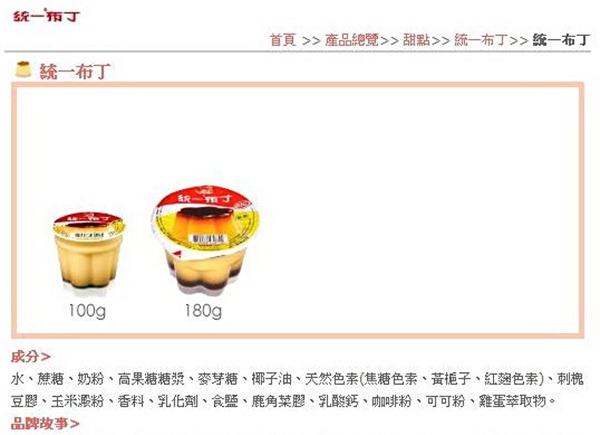
But neither the labels on Uni-President pudding nor Tachih's douhua list preservative ingredients. Even if they really did misuse problem raw materials, did they never suspect the secret to food that can be kept for so long? In response, Tu Chung-cheng and Hsu Chuan-chuan said coincidentally that the products are kept refrigerated at low temperature and can be preserved for 14 days without adding preservatives. But Wu Chia-cheng, a professor in the Department of Chemistry at National Taiwan Normal University, said bluntly that this is "simply impossible." He said that if the product is frozen, it will ruin the texture; low-temperature refrigeration cannot be completely sterile, and he suspected that "the manufacturer may have some things (referring to additives) that are not labeled."

The registration system is still insufficient Compound inspection and registration should be restored
Mandatory "registration" for compounds only requires businesses to register the ingredients of the compound; "inspection and registration," however, requires strict testing and obtaining a permit before they can be bought and sold.
Taking this incident as an example, if agar powder had to obtain a permit before it could be bought and sold, Tachih Yang Hsin would only have needed to ask the upstream manufacturer to show its permit, or check the manufacturer's information with the health authorities, and could at least have guarded the first door for consumers; if the health authorities found a problem with the douhua, by comparing it against the permit they could naturally know that an unknown substance had been added, and perhaps could have caught the lawbreaking manufacturer earlier, so consumers would not have had to eat this problem douhua.
In addition, inspectors said that inspection and registration requires strict scrutiny, and businesses would be even less daring to play tricks. "'Registration' is like taking an exam at home; 'inspection and registration' is taking an exam at school, so at least the opportunity and the nerve to cheat are smaller." Inspection and registration is time-consuming, and the central competent authority must bear greater management responsibility, which may be one reason the government has been unwilling to push it. Although inspection and registration still cannot fully block unscrupulous traders, it can at least reduce the chance of breaking the law and also make it easier for frontline personnel to conduct inspections.
In response to the Department of Health's repeated statements that there are more than two hundred thousand kinds of compounds and that foreign countries also do not have inspection and registration, one inspector questioned: "Setting up a food additive factory in Taiwan, China has no threshold at all. Have we learned foreign countries' management systems?" He believes that every country has different national conditions and different management systems, and that people in Taiwan, China are simply too good at exploiting loopholes, so the government should not keep comparing itself to foreign countries.
The question of who is responsible for the EDTA incident still needs to be clarified. Although food factories were negligent in failing to actively verify the single-ingredient raw materials in compounds, the fundamental reason is that the government has long failed to establish compound inspection standards. Although the amendment to the
The draft of the Act Governing Food Safety and Sanitation passes its third reading, and designated products must label the percentage of main ingredients
Amendment to the Act Governing Food Safety and Sanitation: illegally mixing in additives and causing death carries a maximum penalty of life imprisonment