Tracing the Origin of Rabies Virus: Could the Ferret Badger Be a Victim?
It has been nearly a month since the rabies outbreak among ferret badgers began, and today the Central Epidemic Command Center for human and animal epidemics will also hold a "Domestic Joint Consultation Meeting of Human and Animal Epidemic Prevention Experts." As of now, apart from one case in which a house shrew (Suncus murinus) was infected with the rabies virus and is presumed to have been infected after being bitten by a rabid ferret badger, all other individual animals infected with the rabies virus have been wild ferret badgers. The source of infection remains disputed, and it has also triggered unnecessary panic in society about wild animals, dogs and cats.
Current analyses of the ferret badger rabies outbreak mainly proceed from human medical or veterinary perspectives, and relatively lack the viewpoints of wildlife epidemiology and cross-border smuggling. Therefore, a NewsMarket reporter conducted an exclusive interview with Pei Chia-chi, a professor at the Institute of Wildlife Conservation at National Pingtung University of Science and Technology, asking him to offer his views on tracing the source of this ferret badger rabies virus.
Pei Chia-chi is an early domestic scholar who studied the reproductive behavior of wild ferret badgers. He has an in-depth understanding of ferret badgers, and based on his experience monitoring wildlife epidemiology, he explains that it cannot be ruled out that wild ferret badgers are victims of rabies virus infection. He believes that humans only need to keep their distance from wild animals and need not panic excessively. The following is the reporter's exclusive interview with Pei Chia-chi:
Ferret badgers are gentler than weasels yet still give farmers a headache
Q: This wildlife rabies outbreak has made people turn pale at the mere mention of ferret badgers. What kind of animal is a ferret badger, exactly?
Pei Chia-chi (hereafter Pei): Ferret badgers are widely distributed and highly adaptable to the environment. Apart from densely populated urban areas, ferret badgers can be seen in rural areas, secondary forests, primary forests and other places, and in considerable numbers.
Their habitat requirements are not that high, so they can be considered a broadly adaptable species, especially common at low to medium elevations. In rural areas, coastal areas, or low-density shallow mountain areas, reclaimed farmland, abandoned farmland, bamboo forests, hills and other areas of low human disturbance, ferret badgers are very common.
Although the ferret badger is a carnivore, it is not a strong hunter and cannot hunt rats or birds. Its food sources are all invertebrates, such as earthworms and snails. It occasionally eats dead birds and mammals, and also digs for insects and earthworms in the soil. It is good at digging soil, not at hunting, and even the smaller weasel beats it.
The ferret badger is nocturnal. Its anal glands are well developed and emit a strong odor. If human skin comes into contact with it, there is even a burning sensation. This is their self-protection mechanism.
The ferret badger is not a highly aggressive animal, and its range of activity is not large. The size of the range depends on the abundance of insects and food. We now know that its range of activity is roughly between 2 and 10 hectares, but its territoriality is not strong, and the ranges of different individuals overlap heavily. Usually, when local food resources are abundant, the ferret badger's range of activity is small; the scarcer the resources, the larger the range of activity.
Among reclaimed farmlands, dry-crop fields and vegetable plots are more attractive to ferret badgers. Many vegetable farmers quite dislike ferret badgers, because ferret badgers dig up the soil and dig out what the farmers have planted. They are not trying to eat the vegetables, but only to dig for things in the soil, so farmers find them a headache, because they damage vegetable fields and dry-crop fields.
Ferret badgers have no commercial value but were once passed off as cute little foxes and sold
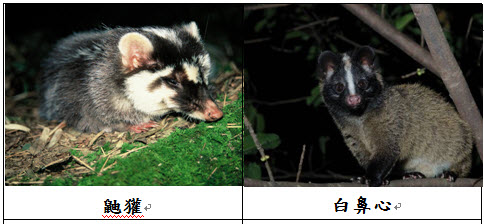
Ferret badgers actually have no commercial value, except that more than 20 years ago they were once mixed into the masked palm civet market. At that time, some people went into the mountains to hunt ferret badgers and pass them off as masked palm civets for sale, but this lasted only one or two years, because it was quickly discovered that the two look different.
I once saw in a Paiwan village on the South Link Highway that someone in the village hunted ferret badgers for sale. The villagers told me they caught them alive and sold them to passing tourists. Because ferret badgers are small, they tricked tourists by saying these were little foxes (masked palm civets), not-yet-grown masked palm civets, and they could surprisingly fetch a good price. But such a market was very short-lived.
Ferret badgers are also not that common in Taiwan's mountain produce markets. I rarely hear of anyone who likes to eat ferret badgers. Although indigenous people occasionally cook ferret badgers to eat, most of the time they eat them only when accidentally caught, and few people specifically catch ferret badgers to eat. This is different from the masked palm civet, which many people catch to eat. Taiwan even once developed a masked palm civet farming industry, though it was also a flash in the pan, popular for only about ten years.
The ferret badger's anal glands are well developed, so it smells very bad, few people keep it as a pet, and its meat is not that tasty either. Whether for food, medicine or fur, it has no value, so I have hardly ever heard of anyone specifically hunting ferret badgers; most are caught by accident.

For wild ferret badgers humans are the source that spreads disease
Q: Before this rabies outbreak, I heard that wild ferret badgers also suffered mass deaths from canine distemper infection?
Pei: Almost all carnivores can be infected with canine distemper, and the infection conditions differ somewhat among species. For mustelids, such as the ferret badger, the mortality rate can reach 100 percent. For some animals, such as dogs infected with canine distemper, the mortality rate is only 30 or 40 percent.
So dogs can easily become reservoir hosts of canine distemper, because the mortality rate is low. Of ten dogs, only about three will die from canine distemper, and the remaining seven may carry the virus around. Ferret badgers do not easily become reservoir hosts of canine distemper, because the mortality rate is very high; once infected, they die. We rarely see ferret badgers that do not die carrying the virus around and spreading it.
Canine distemper infecting Taiwan's wild animals is all transmitted from dogs. In particular, wild animals relatively close to human living environments are easily infected by dogs kept by people, which is also why ferret badgers are easily infected with canine distemper.
There is no seasonality in domestic dogs infected with canine distemper, and the infection rate is almost always high. This is related to the low vaccination rate. In addition, rural people mostly keep dogs free-range. As long as one dog carries the canine distemper virus, the dogs running around with it are also easily infected. So when we monitor domestic dogs in indigenous communities or villages, about 40 to 50 percent carry the canine distemper virus throughout the year.
But for wild ferret badgers it is different: first, the closer to human living environments, the higher the proportion infected with canine distemper, possibly as high as 50 or 60 percent; second, the infection rate everywhere is seasonal, high in winter and low in summer.
We analyze that in winter, dogs in rural areas easily enter the wild. When their owners are in the agricultural off-season, they follow them into wild activities and hunting, so dogs easily bring the virus into the wild. Therefore, in winter the canine distemper infection rate of wild animals is high. In summer, during the busy farming season, dogs less often follow their owners into the forest, so the infection rate of wild animals is low, or even nonexistent.
From the canine distemper cases, the source of the virus is dogs, and wild animals are not reservoirs. As long as dogs with canine distemper do not continuously carry the virus into wild animal environments, the virus disappears, so wild animals are almost never reservoir hosts of canine distemper.
There are several reasons why wild ferret badgers, unlike domestic dogs, do not become reservoir hosts of canine distemper: first, it is a difference between species; second, ferret badgers, unlike dogs, do not often move in groups and mostly act alone, so the chance of contact and mutual infection is low, and even if one is infected and dies, the virus is gone.
So from the example of canine distemper, we know that the virus does not persist long-term in wild animal populations, but comes from dogs, is seasonal, and shows no reservoir phenomenon. The ferret badger is a victim, is infected, is a sensitive species, and has a high mortality rate.
Tracing the source of the rabies virus internal and external are different and prevention strategies also differ
Q: What about ferret badger rabies, then? How should the source of infection be traced?
Pei: The source of the rabies virus infecting wild ferret badgers is still unclear. There are two possible explanations: one is that it was introduced from outside, and the other is that it already existed internally.
If the virus was introduced from outside, we need to clarify where the virus came from and what animal brought it in. How did it spread? At this point it becomes somewhat like the issue of controlling invasive alien species.
If Taiwan's wild animals themselves carried the virus, and it has only now broken out due to possible factors such as environmental change, then we need to investigate which other wild animals carry the virus and who the reservoir hosts are. These key questions must all be clarified.
We cannot yet say that ferret badgers are reservoirs; we can only say that deaths have occurred. Based on the experience with canine distemper, we also saw many ferret badger deaths, but there was no reservoir phenomenon.
Therefore, we have recently actively recommended conducting live screening of wild animal populations, which can clarify whether the ferret badger rabies virus was introduced from outside or already existed internally.
If it is determined that the rabies virus does not generally exist in Taiwan's wild animals, then the disease transmission pattern may be similar to that of canine distemper. The ferret badger is a victim infected with rabies, is relatively sensitive to the rabies virus, and has a relatively high proportion of deaths from it. At this point, controlling wild animals would not help much in suppressing the spread of the virus, because the source of spread is not wild animals.
If, through live capture, it is found that the rabies virus generally exists in Taiwan's wild animal populations and simply was not discovered in the past, then we need to guess who the reservoir is. After the reservoir is found, control measures should target it, so that it does not spread into human living environments.
If wild animals have been wrongly blamed and are victims of rabies virus transmission, and the virus was transmitted from human environments to the forest, then the prevention strategy should be to block the virus from being transmitted from human environments to wild animals.
The virus gene sequence comparison now being actively carried out will help us understand the possible source of the virus. When we are fortunate enough to clearly understand where the virus came from, we can determine through what channel it was brought in.
Wildlife smuggling is very common in Taiwan. Legal imports should all have quarantine certificates, and the chance of bringing pathogens in is not high; it should be brought in through smuggling. There is some information both domestically and abroad about what specific species come through specific smuggling channels in Taiwan, because smuggling is a transnational issue.
So if we know roughly what region the virus came from, for example Indochina? The Philippines? Or China? Then we can roughly determine what species brought it in.
Does not believe the rabies virus was brought in by smuggled ferret badgers
There is a claim that the rabies virus was brought in by smuggled ferret badgers. I personally am highly doubtful, because ferret badgers have no market in Taiwan, so why smuggle them? In the more than 20 years since our wildlife rescue center was established, we have never found a case of ferret badger smuggling, so I think the probability that smuggled ferret badgers brought in the rabies virus is relatively low.
If it is confirmed that the rabies virus was introduced from outside, I actually think the probability is higher that other smuggled carnivorous wild animals brought in the pathogen. So from the perspective of epidemic prevention, the government should clarify several possibilities from multiple angles, and at the same time carry out rabies virus gene sequence comparison to determine the species that brought in the pathogen, and conduct live monitoring of wild animals, so as to clarify these questions in the shortest time and formulate effective rabies virus prevention and eradication strategies. (First in the exclusive interview series.)
Please continue reading exclusive interview part two: "Human medicine and veterinary medicine lack an ecological perspective: a major flaw in epidemic prevention"
Recommended reading
PTS Our Island - The Great Canine Distemper Chase (Environmental Information text version)
Environmental Information Report - [Biodiversity Day] The Ferret Badger That Died from Being Fat