Sharing of new poetry creations themed around beach cleanups
Before the Beach Cleanup
When we walk by the sea, we all share a common feeling: there is always all kinds of trash piled up there. When I see the trash, I always wonder why this trash is here, where this trash comes from, and whether there is any way to keep trash from appearing on beautiful beaches.
Marine debris, also called ocean trash, is waste created by humans that intentionally or unintentionally becomes large floating debris in a lake, sea or waterway. Marine fragments tend to accumulate in the gyres at the center and along coastlines, and often pile up on beaches, where they are called beach litter. As plastic has recently come to be used more and more widely by humans, this problem has become more and more serious. Because many types of plastic cannot decompose, they seriously threaten fish, seabirds, marine reptiles, marine mammals, as well as vessels and coastal residential areas. Seawater intrusion, trash washing into drains, and wind-blown waste all contribute to this problem.
Long-term monitoring of beach waste simply means continuously going to the seaside to pick up trash, except that we add one more step: classifying and tallying this trash according to its source of use. Through long-term records, we can discover some problems and seek solutions.
International Coastal Cleanup, or ICC for short: the trash problem not only gives people living on land headaches, but more seriously, it pollutes the ocean without anyone noticing. For example, plastic pellets and plastic fragments absorb pollutants in the water, and organisms eat them without knowing it. After being ingested by organisms, this affects the structure and numbers of biological populations, and further affects the entire marine ecology. Besides looking dirty and messy, marine debris has fatal impacts on natural ecology, human health, and tourism. Precisely because this trash comes from you and me, we have a responsibility to stop using trash to continue harming the ocean, and beach cleanup monitoring is part of the solution.
In addition to calling on everyone to clean beaches, the ICC International Coastal Cleanup also publishes the data everyone collects in a unified way. Through public education, advocacy to public agencies, and corporate cooperation, it hopes to change everyone's existing behavior and habits and truly solve the problem of marine debris.
The ICC International Coastal Cleanup is currently the largest volunteer action in the world. In Taiwan, China, it is organized by the Clean Ocean Action Alliance, whose members include Tainan Community University, the Wilderness Protection Association, the Environmental Information Association, the National Museum of Marine Science and Technology, and the Kuroshio Ocean Education Foundation.
The marine debris monitoring site is the beach beside the landscape bridge behind Longgang Elementary School in Sikunshen. We use the monthly beach cleanup activity to tally the types of trash. Through long-term records, we trace the sources from the types of trash and solve the trash on the beach at its root.
Below is a poem we wrote before the beach cleanup:
The seawater gently pats
As if it could
Hear the lively dialogue of the past
Layer after layer
Flashing with white glimmers
In the distance, a vast blue silence
Is a deep, low lament
We are all good people
Whether white, black, or brown
All good people happy to share
At the zoo, there are always people happy to feed the animals
Stray dogs and stray cats will never starve
When we reach the seaside
We do not forget
This good habit
Styrofoam, plastic bags, straws, glass jars
These treasures
Naturally should be shared with the beach
No one sees these faces mixed in
No one hears your lament
Allow me
With my meager strength
To bend down and search for the wounds on your body, and pick up
A group of people polishing back and forth this beach where sunlight lingers
Under the vast clear sky
To give you back a patch of purity
The Beach Cleanup Process
Following the footsteps of Satoyama and Satoumi, a group of us came to the seaside. We imagined the beauty of the seaside and longed to play on the beach. Step by step, footprint by footprint, we slowly drew near, yet also grew farther and farther from the dream. At first, what we imagined was being able to stroll with a lover on the beach in that leisurely afternoon and romantic atmosphere; that cool sea breeze and the mood of the sea were all meant to transform the unpleasant state of my heart. But when I stepped onto the beach and looked out, my dream shattered. What I saw was no longer what I had imagined. The beach was dotted with trash beyond words, and listening to the sound of the sea and feeling the sea breeze amid the piles of trash, I could no longer feel the atmosphere I had originally pictured. I thought to myself, why is it like this, and how can we return to the beach as it first was?
Back to the purpose of coming to the seaside and the beach: we are here to clean the beach. We want to take away all that detestable trash, that annoying trash, that trash that does not belong on the beach. Unfortunately, the amount of trash is far too much, and it is impossible for us to pick it all up. There is even too much Styrofoam discarded after use from oyster racks; after being pounded by seawater for a long time, some of it has already broken into pieces, and those bits dance in the wind on the beach, but that is not beautiful at all. What I see is its damage to the beach and its disregard for environmental protection, and we are even more helpless. Those tiny bits of Styrofoam are simply impossible for us to pick up slowly by hand; that sounds so inefficient, and we humans are so insignificant. As a result, we have no countermeasures, which leads to more and more accumulated trash. Add to that ocean currents bringing more trash from foreign countries or other regions and leaving it near Tainan, so even though I heard that the community university carries out a beach cleanup once every month, the amount of trash still remains high. Not to mention after typhoon days, that miserable sight is not something we can generally imagine.
If there is so much trash that it can no longer be picked up one by one by human hands, then how should we solve it? Policy, reduction, and control are all things we can think of. I think "actually doing it" is what we must achieve. What counts as a good policy is that both the government and the people must find a balance. We need volunteer teams, and we need people willing to roll up their sleeves and join us in caring for the beaches of the Earth that you and I love, so that the slogan of environmental reduction is no longer just a slogan. And all these are things we must truly carry out properly; only then can we truly reduce year by year the trash running rampant on the seaside beaches.
Below is a new poem we wrote for the situation at the time when we went to clean the beach:
It is bottle caps, drink cups
It is wire, lighters
It is oyster racks, lunch boxes
It is straws, glass bottles
It is shoes, Styrofoam
Ah, bottle caps again
Ashore, their new habitat
Is again the vast, stretching beach
They migrate with the waves like schools of fish
And settle down with the coastal plants
Their personalities are utterly different
Some are happy to be seen
Some are shy about appearing
They come from everywhere
From other counties and cities
And also from the mainland and the Philippines
Perhaps we reject them
But at least
They also came because of us
After the Beach Cleanup, Interviewing Teacher Chao Jui-kuang
After three beach cleanups over these three months, we truly felt a great deal. After the cleanups, we found that many beaches are actually not as beautiful or clean as we imagined. More than ten people could pick up, in just over an hour, an amount equivalent to what a truck can carry. This is very astonishing, and it makes it even harder for us to imagine what Teacher Chao Jui-kuang meant when he said, "The trash we can see on the beach is only the tip of the iceberg." The amount of trash buried in the sand is absolutely something we cannot calculate! And the types of this trash are mostly items we use in daily life, such as PET bottles, straws, bottle caps, drink cups, lighters, lunch boxes, and other daily necessities. Teacher Chao's team holds a beach cleanup beside Longgang Elementary School every month, and it is not simply about picking up all the trash and hauling it away. After picking up the trash, they also sort it, separating different categories and then counting the quantities. After each cleanup, they tally the quantities of each type of trash, then trace the sources of this trash and solve the problem at the most fundamental level. But in this regard, Teacher Chao and his team seem to still be working hard, and the sources of many pieces of trash remain unknown.
After finishing the three beach cleanups, because we needed to make a documentary, we went to Tainan Community University on Gongyuan Road in Tainan City to interview Teacher Chao. During the interview, we also learned a lot about the marine debris problem in recent years, such as that the most serious trash on the seaside in the Tainan area is Styrofoam, and this Styrofoam almost all drifts over together with the oyster racks from floating-raft oyster farming. Large pieces of Styrofoam are not too troublesome to handle; what is troublesome is the Styrofoam fragments. Whenever a front or typhoon passes through, the beaches of Tainan are sure to be a miserable sight. Besides all kinds of trash, there are mountains of Styrofoam fragments. Teacher Chao and his team also call this scene the "white terror on the beach." The teacher also mentioned to us a feasible method, which is
to uniformly replace this Styrofoam with another whole plastic foam material. This material does not produce fragments, and its effect is the same as Styrofoam. Even if it drifts to other places, it will not cause the terrifying pollution that Styrofoam does.
The teacher also roughly calculated that if all floating-raft aquaculture in Tainan were switched to this material, although it would cost several million or tens of millions, this method is indeed feasible. The teacher and his team are also actively calling on the government, and it now depends on whether the government can notice this area and truly put this method into practice.
What is especially unique is that Teacher Chao and his team used all kinds of trash picked up during these beach cleanups to piece together various installation artworks, displayed in the corridor of Tainan Community University. There is a whale shark hung from hundreds or thousands of bottle caps, and there are works using oyster racks and wire to imitate the real appearance under oyster racks, and so on. It is very special! It also turns this picked-up trash into shining, astonishing works of art.
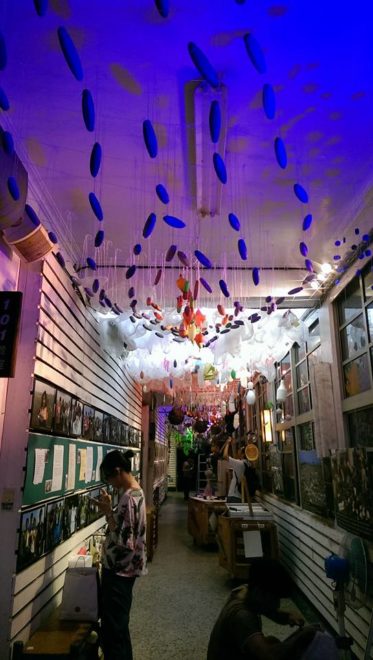
Taking trash turned into installation art as our starting point, we wrote the following poem:
Home
Ah, so hot.
Ah, so cold.
Home, I have none.
Support, I have never had.
Gazing at the passing crowds,
How I long for
A warm home with an embrace.
Ah, so hot.
Ah, so cold.
Day after day.
I have no home,
I also want to have a home,
Why can I only ever be like an orphan,
Wandering here endlessly.
The wind has risen,
Like flying,
I look down on this boundless orphanage,
And I can only return to the same place,
Now cold, now hot,
I wish I could leave quickly.
Is it a dream?
This time I really can soar freely,
Like a paradise,
And I am no longer just an orphan,
With your company,
Letting me shine even more brilliantly.
Watch the video: Marine Debris Monitoring on the Beach Outside Longgang Elementary School
Overview of the Zengwen River Basin & Planning and Practice of Satoyama and Satoumi
Writing and video production: Zhou Xinyu, Qiu Zhenyi, Wu Guoxiong, Wu Weizhe, Shi Zhongshan, Zhuo Yuliang
Copyright: Professor Lin Chaocheng, Department of Chinese Literature, National Cheng Kung University
For more articles, please see Zengwen River Basin Co-learning Community