Echigo-Tsumari Art Triennale Part 2: Realizing Art Through the Satoyama Initiative
Editor's note: The Echigo-Tsumari Art Triennale, held once every three years, is taking place right now in Niigata, Japan. The author of this article (Secretary-General of the Taiwan Historical Resources Management Association) has written this detailed account, especially for readers who cannot attend the event in person, of the context in which the Echigo-Tsumari Art Triennale and the Setouchi Triennale came into being and what they exhibit, as well as the impact such artistic actions have brought to the local areas and to Japanese society. To read other articles in the series, please see the appendix at the end of this article.
The Artistic Realization of the Satoyama Initiative
One of the major focuses of the Art Triennale is the restoration of Japan's "Satoyama", which refers to the rural or countryside areas between the city and the mountains, reflecting urban society's longing for the old way of life and a sense of crisis over the imminent disappearance of the original landscape. In Japan, the preservation of Satoyama is not only about preserving the original natural scenery, but even more actively about preserving the production and creative activities of the people who live within it and converse with nature.
The idea of Satoyama has inspired environmental concern in many places around the world. In January 2010, UNESCO held a global workshop on the Satoyama Initiative at its headquarters in Paris (Note 1). The core concept of the Satoyama Initiative is "Socio-Ecological Production Landscapes", referring to the interactive landscape of people and land use formed through long-term interaction between humans and nature, which also maintains biodiversity.
In an interview with the international art website Universes-in-Universe, Mr. Fram Kitagawa specifically mentioned the concept of Satoyama realized by the Art Triennale: "Satoyama is the scenery of daily life. The agricultural cultivation in harmony between humans and the land has created this space, blending in a long span of time, entirely different from today's standardized and homogeneous globalization system. Satoyama is the foundation of a region, and through the Art Triennale we can experience and observe it in depth."
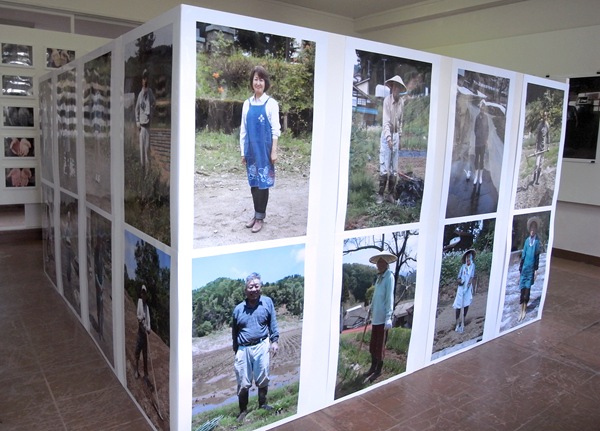
Farmer Kazuyoshi Sato, who takes pride in the Echigo-Tsumari region, farmed in his hometown for many years. After middle age he began to pick up a camera, eagerly using images to record his beloved hometown of Matsunoyama, making it his second career. In his photographic works he captured the Satoyama scenery of the Echigo-Tsumari region. His images, which truly care for the land, reveal a deep affection for his hometown, moving many visitors and showing people the strength of the residents of the Echigo-Tsumari region in protecting their hometown. In addition to holding an exhibition at the "Mori no Gakko" (School of Forest) (Note 2) in Echigo-Matsunoyama, Kazuyoshi Sato's photography exhibition also toured Tokyo, Osaka, Nagoya and other places in Japan, letting many people from elsewhere see his ongoing photographic works, come to know his hometown, and visit Echigo-Tsumari.

In Taiwan, China, many primary and secondary schools in remote mountain tribal and rural areas also face the same demographic structure problem. In response to the declining birthrate and changes in the urban-rural population structure, various counties and cities have carried out consolidation or closure of schools, school districts and branch schools with declining student numbers in remote areas. According to statistics compiled by the Ministry of Education from reports submitted by each special municipality, county (city) government in the 100th year of the Republic of China, 178 schools were closed due to consolidation by each special municipality, county (city) government. As of February 29 of the 101st year of the Republic of China, 123 schools had been guided into reuse, and 55 schools were still awaiting use and under controlled planning. The categories of school building revitalization uses were: culture and education (13.82%), tourism and leisure (6.50%), social welfare institutions (3.25%), use by agencies and organizations or maintenance by the schools themselves (54.47%), and land return or demolition (21.95%).
Fram Kitagawa reminded Taiwan, China: "If we do not pay attention now, more and more problems will keep appearing in the coming years. The problems of vacant houses and closed schools often suddenly increase over a period of time; that is exactly the situation in Japan." (6) From the school regeneration plan of the Art Triennale, we can learn that if government departments can cooperate with civil organizations and continue to give play to their educational significance and spirit, they can actually enable school building resources and spaces to be effectively used by the public again and expand their diverse uses.
The Art Triennale has prompted local residents to move from watching to participating. Also, in order to sustain the energy of the triennial Art Triennale and to match local festivals and the seasons of the four seasons, ingeniously paired with local ingredients, spaces and culture, a series of events have been held one after another: the "Echigo-Tsumari Festival of the Earth in Summer" and the "Echigo-Tsumari Festival of the Earth in Winter". Starting in 2008, Tsunan Town has held the Echigo-Tsumari Craft Fair every year. Just as Fram Kitagawa envisioned, the Echigo-Tsumari region has become a comprehensive source of artistic transmission, thinking deeply and over the long term about the future development of the region, rather than a dazzling fireworks display that flashes by once every three years.
Over the years the Art Triennale has received recognition from many regional culture and tourism awards. The Echigo-Tsumari Art Triennale Executive Committee also, for its contribution to introducing art to revitalize the region and to promoting the charm of Satoyama, received the Excellence Award at the 2nd JTB Exchange Culture Awards in 2006. (Series to be continued)
Series reading:
(Note 1) Co-hosted by the Japanese Ministry of the Environment (MOE-J) and the United Nations University Institute of Advanced Studies (UNU-IAS), and co-organized by UNESCO, the United Nations Environment Programme (UNEP) and the Secretariat of the Convention on Biological Diversity (SCBD).
(Note 2) One of the permanent main venues of the Art Triennale, a natural science museum built by Takaharu Tezuka and Yui Tezuka in Echigo-Matsunoyama that focuses on Satoyama conservation and advocates that "everyone is a scientist".
(Note 3) One of the permanent main venues of the Art Triennale, the "Snow Country Agricultural Culture Center - Nou Stage" built by the Dutch architectural team MVRDV in Matsudai, is a comprehensive cultural facility connecting agricultural culture and contemporary art, with an exhibition hall, canteen, shop and comprehensive information desk, etc.
(Note 4) Born in the former Yugoslavia in 1946, she practiced an art form using the body and movement as a medium and is hailed as the mother of performance art; winner of the Golden Lion at the 1997 Venice Biennale.
(Note 5) Quoted from the content of this study's interview with Fram Kitagawa in February 2012.
(Note 6) Quoted from the content of this study's interview with Fram Kitagawa in February 2012.