Traveling with WWOOF (Part Two): A Permaculture Farming Experiment in Frome, UK
Frome is an utterly ordinary English town, thinly populated, with a scattering of small shops; it takes me less than half an hour to walk the whole town center. I still remember that when my good friend Zoe and her boyfriend David drove over to visit us, the first thing she said was: “There really isn’t much here!”
Indeed, compared with many other English towns, Frome is not beautiful or appealing at all. Yet here I met a family living out a beautiful dream: to run an 18-acre field, the owners Chris and Cordelia moved from the big city of London to the small town of Frome, striving to put permaculture, which seeks a healthy interaction between people and the environment, into practice.
In 2010 I WWOOFed for two weeks at the Frome farm, and began to gain a rough understanding of permaculture. The male owner, Chris, was a sociology professor yet gave up his teaching post to become a professional farmer; Frome is his farming laboratory! Often in the fields Chris would explain his design ideas to us: why ducks and pigs are raised here, why a small lake was made, why sugar beets are planted over there. Every arrangement is the result of thought and accumulated experience. The daytime learning became nourishment for nighttime study; Chris was also studying a permaculture course at the same time, and poured his field observations into his thesis.
My view: observation is the first step of permaculture, how to use leverage in the fields, and, under the principle of not harming the natural ecosystem, to make full use of resources, so that farmers and nature can live in peace.
It was by a beautiful chance that I came to Frome, exchanging labor for my second organic farm experience with WWOOF in the UK. Below I have reorganized my scattered notes from back in 2010…
**********************************
Sharing a house with the farm owners, a family of six
Our Frome farm covers 18 acres, produces and sells vegetables, and raises a small number of pigs and ducks for household use only. Forty-four-year-old Chris is the farm owner and also the only full-time farmer. The female owner, Cordelia, began studying for a master’s degree a year ago; because she needs to care for the four children in the family (three boys in secondary school and a three-year-old little girl), she has been unable to take part in farm work since then. More than a year ago Chris and Cordelia sold several houses in London so they could buy the Frome farmland and begin practicing organic farming and a low-energy, environmentally friendly life on the outskirts.
When the owners were young they once WWOOFed for as long as a year in countries such as the United States, Canada and Latin America, so they understand very well what wwoofers need in terms of accommodation and food. I like their easygoing personalities; coming to this big family, I felt myself gradually becoming an accepted member. Even though I had mentally prepared myself to step into a family with four children, I was still shocked by the mess in the house, and could only desperately lower my standards for tidiness.
The only somewhat inconvenient thing in daily life was that the house had only one toilet, so everyone had to take turns using it; in addition, the hot water for the whole house was heated by solar power, and the maximum temperature of the hot water depended on the strength of the sun. In England, where the weather is constantly changing, there were several days when I could only shower with chilly water; this was the first time I discovered that solar power is not as wonderful as I had imagined, and that practicing an environmentally friendly life always comes with a price to learn.
This household had three boys, a three-year-old little girl, and a cat; there was no television, so the children all gathered together to play after school. They were all very used to wwoofers staying with the family at irregular intervals. Although the space in the house was not large, the family members’ relaxed, easygoing attitude made me very comfortable.
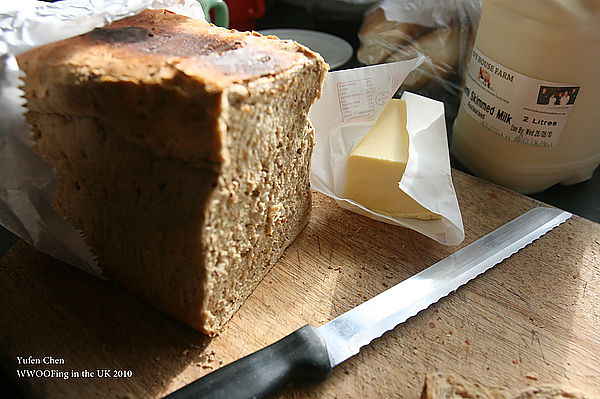
Besides providing an independent room, the owners also let us handle food ourselves - apart from the main mealtimes when the whole family ate, wwoofers could enter the kitchen or the food pantry at any time and fill their own stomachs as they pleased (this is really important for wwoofers; after all, food is the greatest encouragement for each day’s work).

The last day always makes people reluctant to part. Chris let us finish the farm work early; besides personally cooking a special vegetarian Italian lasagna for the whole family, he also volunteered to say that early the next morning he would take us to the station to catch the bus. Cordelia and the boys also specially got up early on Saturday of the weekend, sleepy-eyed, to chat with us and say a final goodbye. They said: “You are always welcome to come back here as guests, without having to be wwoofers.”
Sincere friendship is the priceless, hard-to-come-by harvest of a wwoofing journey!
(The series continues) A new organic life experience: WWOOF accommodation exchange at an English organic farm (Part Three of the series)
Let’s look forward together to the upcoming introductions of farm life! - A self-sufficient little family in Wales, a biodiversity devil camp in Ireland, a happy summer camp in Scotland….
Read earlier articles:Traveling with WWOOF (Part One): Abbey Farm in England