Taiwan tilapia pursues ASC certification, emphasizing management and environmental friendliness
Taiwan tilapia is in peak season but prices have collapsed; ASC certification is hoped to help sales
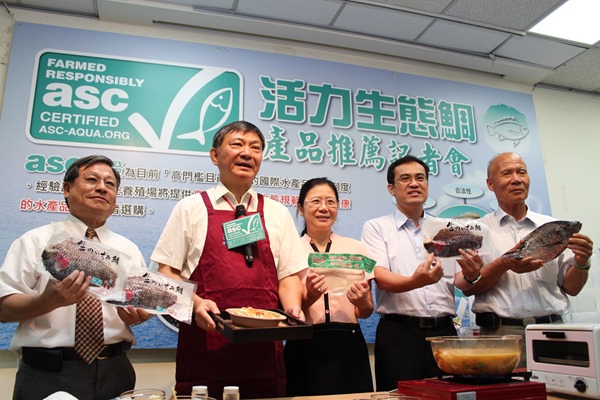
Just as Taiwan tilapia enters its peak season, word comes from production areas in the south that purchase prices have collapsed, falling from 40 yuan per jin at the peak to 17 yuan, far below the farming cost of about 29-32 yuan per jin, leaving fish farmers crying out in distress. In response, the Fisheries Agency of the Council of Agriculture said that since last year it has worked with the Tainan City Government to guide 14 operators in jointly forming the "Nanying Aquaculture Association," and this year the Swiss IMO Ecological Testing Institute came to Taiwan to inspect them, passing the ASC certification promoted by the World Wide Fund for Nature (WWF) and the Sustainable Trade Initiative (STI).
The Fisheries Agency pointed out that ASC certification covers items including environmental assessment, quality fry, feed inspection and acceptance, and aquaculture management, conducting an all-round inspection and observation of the fish farming process to ensure that certified seafood is not only hygienic and safe but also responsible and friendly to the environment.
It is understood that although this certification began to be promoted by a private organization in 2010, it also has a certain credibility in European and Northeast Asian markets. Tsai Chun-hsiung, chairman of the Taiwan Tilapia Association, affirmed that when doing business in Japan, people heard that this batch of Taiwan tilapia had passed ASC certification and confidently placed orders, "believing that ASC certification is helpful for Taiwan tilapia sales."
Tsai Chun-hsiung pointed out that over the past few years, the catch of eel fry along Taiwan's coast has fallen sharply, causing eel fry prices to remain high, and operators rushed in droves to farm Taiwan tilapia, leading to "a bit of imbalance between production and sales; consumers want the same quantity, but everyone keeps farming desperately, so of course prices fall."
Tsai Chun-hsiung said that as far as he knows, recent production-area prices average 18-22 yuan per jin, while farms with relevant safety certifications can quote 30-38 yuan per jin. Although the price is only hovering at the edge of "breaking even," he optimistically believes, "there is still room for growth, and there is no problem returning to the previous level."
Tsai Chun-hsiung pointed out that the main disease of Taiwan tilapia is gastrointestinal disorder caused by streptococcus, with fish refusing to eat feed and finally starving to death from insufficient nutrition. Operators mostly administer drugs at this time to improve the condition, which causes the phenomenon of drug residues in some fish. Recently certified Taiwan tilapia, because they must meet international standards, have lower stocking density in individual ponds and clearer water quality, reducing the chance of streptococcus breeding, so there is no longer any need to use chemical drugs to control Taiwan tilapia diseases, and consumers can eat them with confidence.

(This article was funded for personnel expenses by a special project of the Jianzhen Environmental Education Foundation, but the foundation does not interfere at all with news topic selection or interview writing, ensuring news independence.)
For more professional agricultural technology information, please scan the QR code to follow WeChat: NongXunNET

Please indicate the source when reprinting.