Xinmei Tribe's Wheat Field Rhapsody enters its fourth year, singing the song of the wheat field
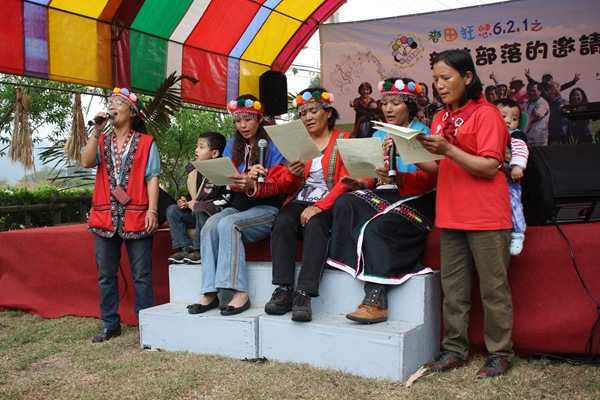
Golden waves of wheat sway between the sky and the mountain mist, as the moving voices of the Tsou people open the wheat field concert. The Republic of Happiness has held the Wheat Field Rhapsody concert for the fourth consecutive year, this year titled Symphony of Mountains and Sea. Last Saturday it came to Xinmei Tribe in Alishan, the highest-altitude growing site of the Republic of Happiness. Besides welcoming visitors from afar with song and dance, the tribe members also performed for the first time the one-of-a-kind song of the wheat field, sharing the joy of this season's harvest.
Singing their own songs on their own land
The Republic of Happiness enters its sixth year this year. The wheat seeds sown last winter have gradually ripened. Following the previous "East-West Good Wheat Resonating Concert" held in Hualien and Miaoli, the Republic of Happiness has moved to Chiayi this year, singing the song of the wheat over two consecutive weeks at both ends of mountain and sea: Xinmei Tribe in Alishan, the highest wheat-growing site in all of Taiwan, China, and Dongshi Township, the coastal settlement with the largest single planting area.
Xinmei Tribe is located south of Alishan, at an altitude of about 400 to 800 m. Together with Chashan and Shanmei it is known as the Southern Three Villages. Because it is still some distance from the main Alishan scenic area, it is usually sparsely populated. On the day of the concert, 300 visitors poured in, and the quiet little village suddenly became very busy. Nearly the whole village sprang into action for the concert, and the tribe members joked that the day was a lively occasion second only to the village chief's wedding.
The youngest performing group was 25 students from Xinmei Elementary School doing the horse-riding dance, and the oldest was an 80-year-old tribal elder performing a Japanese dance. The tribe members explained that Xinmei Tribe was the first tribe the Japanese established in Alishan, and "Xinmei" means "new tribe" in Japanese. Many tribal elders still preserve the traditional culture of the Japanese colonial period.
From the horse-riding dance to the Japanese dance, this precisely embodies the blending of old and new civilizations in the tribe, and also lets more visitors gain a deeper understanding of the different facets of Indigenous life. As Shi Minghuang, the "chief and" of the Republic of Happiness who was instrumental in creating the wheat concert, said: "We cannot easily ignore the traces of any culture here, because these are all part of the history that once existed on this land."
Since it is a concert, one certainly cannot miss the Tsou people's innate gift for singing. This year Wind Music specially created the song of the wheat field for the Republic of Happiness, produced by Taiwan, China's well-known nature music producer Wu Jindai. This concert was the first performance in Taiwan, China and the world. The gentle melody, together with the tribe members' beautiful voices murmuring back and forth, made the audience seem like wheat blown by the wind, gently and lightly swaying their bodies. To write this song, Wu Jindai personally visited wheat fields in Yuanli, Chiayi, Tainan and elsewhere, accompanying the wheat as it grew alongside the farmers. "Because only that way can you really feel it." She revealed that next they will also invite the farmers to record an album, and even record in the fields and shoot a music video, so that they can sing their own songs on their own land.

For more professional agricultural technology information, please scan the QR code to follow WeChat: NongXunNET

Please indicate the source when reprinting.