Enrofloxacin and penicillin exceeded limits in meatballs; the Food and Drug Administration inspected 147 poultry, livestock and aquatic product samples
The Ministry of Health and Welfare today released its animal drug monitoring results for poultry, livestock and aquatic products sold on the market in August and September. The product "Frozen Original Flavor Meatballs" from the outstanding manufacturer Hsinchu Jinfu Foods was found to contain 0.32 ppm of penicillin G residue, six times the permitted level of 0.05 ppm, and 1,200 kg may well have already been eaten. But Jinfu Foods protested its innocence, saying that it obtains inspection certificates for every batch of pork, that the company sends products for testing at least once a year, that it has never had a problem, and that it hopes the government will properly guard the upstream supply.
However, the Food and Drug Administration of the Ministry of Health and Welfare detected this back in October, and to this day the source of the pork still cannot be found. Chou Hsiu-kuan, deputy director of the Central Regional Management Center, said that so far it is only known that Jinfu bought pork from "Yumausheng Co., Ltd." in Yunlin County, but the meat plant firmly refuses to provide the name of the upstream livestock farm. The Yunlin County Health Bureau is still continuing its investigation and will first fine the meat plant 30,000 yuan.
The Ministry of Health and Welfare detected it in October, and the source of the pork still cannot be found
The Food and Drug Administration of the Ministry of Health and Welfare carried out animal drug monitoring, sampling and testing 147 products sold on the market in August and September and testing for 114 animal drugs. Only "Frozen Original Flavor Meatballs" from Hsinchu Jinfu Foods tested positive for penicillin G at 0.32 ppm, exceeding the pork limit of 0.05 ppm.
The Food and Drug Administration said that penicillin G is an antibiotic that can trigger allergic reactions such as hives, skin rash and laryngeal edema. The acceptable daily intake per person is 30 ug; based on the sample detected this time, a 60 kg adult would have to eat about 90 grams to exceed it. Chou Hsiu-kuan said that penicillin G is a legally permitted animal drug, and the problem should be that the livestock farm did not observe the withdrawal period. This batch of meatballs totaled about 1,200 kg, and the operator has already sold it all.
Chou Hsiu-kuan said that it is currently known that the raw material for the meatballs came from Yumausheng Co., Ltd. in Yunlin, but the company is unwilling to disclose the name of the upstream livestock farm. The Yunlin County Health Bureau has been asked to investigate, and Yumausheng Co., Ltd. will also be fined 30,000 yuan. However, the Hsinchu County Health Bureau did not fine the operator selling the meatballs. "We respect local discretion."
Chang Ching-wei, section chief of the Food Section of the Hsinchu County Health Bureau, said that the problematic meatballs were sampled on August 30 and all were sent to the central authorities for testing. The central inspection report was received on October 14, and on October 16 Jinfu was required to remove all the products from shelves. However, Jinfu is an outstanding manufacturer and has never had a violation record, so the problem should lie with the upstream raw material.
But since the detection on October 16, why was publication delayed for more than a month? Chou Hsiu-kuan said that after the October test result came out, it still had to be handed over to the local health bureau to understand the situation and trace the source, which is why it was only published now, though the operator has already removed the products from shelves.
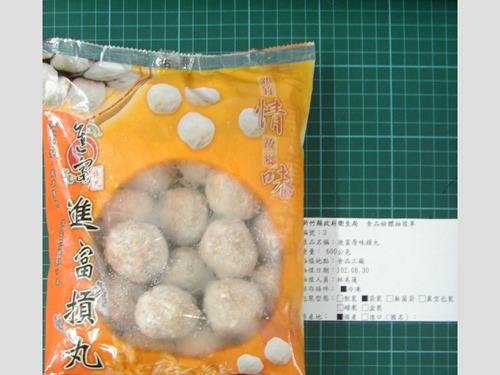
Operator protests innocence: the pork had qualified inspection certificates
The operator selling the problematic meatballs, Jinfu Foods, has been operating in Hsinchu for 40 years, producing on average more than 300 jin of meatballs a day, and is an outstanding manufacturer certified by the Hsinchu City Meatball Industry Development Association. After learning that its meatballs were noncompliant, the person in charge, surnamed Li, protested his innocence, saying that when purchasing goods it always obtained qualification certificates from the pork supplier, that every year it also sent its meatballs for testing on its own and had never had a failure, and that it was not the only company buying from the same supplier. He did not understand why only its own products tested positive for drug residue. It had wanted to send the problematic sample to another testing institution, but the health unit said no sample had been retained. Now he is out of tears, "I hope the government can guard the source properly, otherwise we do not have the ability to send products for testing every single time."
In response, Chou Hsiu-kuan said that test results are only released after a second confirmatory test, but that this test was carried out in cooperation with the local health bureau, and the problematic drug was detected by the local health bureau, so the central authorities did not retain a sample. However, Chang Ching-wei said that the local health bureau simply does not have the instruments and equipment to test for these items, and all samples were sent to the Central Regional Management Center. Chou Hsiu-kuan responded again that the central authorities currently do not have the sample taken at the time, and if the health bureau does not have it either, then it truly should not exist. Now the full effort must go into tracing the upstream livestock farm and managing it properly at the source.