Egg prices hit an eight-month high, suspected to be affected by the onset of winter avian influenza
Text by NewsMarket reporters Wang Wen-hao and Pan Zi-qi
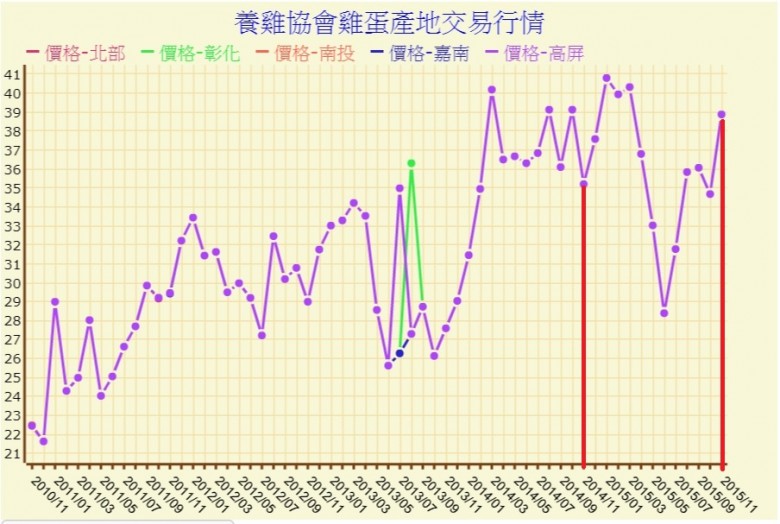
Sharp-eyed consumers buying eggs will probably notice that egg prices have gone up again recently. According to the egg farm-gate transaction price quotations of the Republic of China Poultry Association, yesterday (November 17) the wholesale price of eggs reached 39 yuan per Taiwanese catty, a new high in eight months, and also another peak period following the peak earlier this year from January to March, when an avian flu outbreak pushed egg prices past 40 yuan per Taiwanese catty.
People familiar with the egg industry point out that the reason behind this recent wave of egg price increases is unusual, because the number of laying hens being raised exceeds 37 million birds, higher than the average of 36 million birds in previous years, and has not decreased. Feed prices such as corn and soybeans have been falling steadily since the beginning of this year. Why, when the number of laying hens has increased and feed prices have been falling, do egg prices still keep rising? If it is not artificial price manipulation, then it is suspected to be related to a smoldering avian flu outbreak causing a drop in the laying rate.


Hsieh Kuai-le: A single pile of chicken manure carrying the virus can wipe out an entire poultry house
Hsieh Kuai-le, a professor in the Department of Veterinary Medicine at National Chung Hsing University, points out that at many outreach events for poultry and egg producers, he repeatedly demands that egg farmers "actually implement" disinfection and disease prevention. For example, when personnel enter or leave a poultry house, their rain boots must be stepped into disinfectant water at least 5 cm deep for 30 seconds, rather than just being "dipped and wetted."
In addition, he also requires that equipment be dedicated to specific personnel and specific houses, avoiding cross-use of cages and protective clothing, which increases the chances of virus contact, transmission, and mutation. Whether disease prevention can be implemented depends entirely on whether operators are willing to cooperate.
Hsieh Kuai-le states that a single pile of chicken manure can carry hundreds of millions of avian flu virus particles; as few as one thousand virus particles are enough to be pathogenic to poultry, so one pile of chicken manure can wipe out all the chickens in an entire poultry house, making it quite threatening. Rain boots are the part most easily stepped on and contaminated with chicken manure, so they become a key focus of disinfection.
However, Hsieh Kuai-le laments that larger-scale chicken farmers are more willing to implement disease prevention measures, but most farmers who treat poultry raising as a sideline are less cooperative, and do not even attend disease prevention briefings, which is the biggest hidden concern in avian flu prevention.
Hsieh Kuai-le states that the government requires poultry farmers to implement isolation between poultry houses and wild birds, but farmers only surround the chicken houses with simple fishing nets. However, wild birds or rats, in order to eat the feed inside the poultry houses, can easily break the fishing nets. If the poultry manure carries avian flu virus, it can easily become a tool for spreading the virus, or bring the virus into other poultry houses.
Changhua County Animal Disease Control Center: No reports of avian flu abnormalities at egg poultry farms
Regarding the claim that avian flu outbreaks are smoldering at layer farms in coastal townships, Dong Meng-zhi, director of the Changhua County Animal Disease Control Center, states that so far this year, there have been 34 confirmed cases of highly pathogenic avian flu within Changhua County, of which only 1 was an egg poultry farm. That case farm occurred several months ago and was discovered through proactive sampling and monitoring within 1 kilometer of other case farms, and that egg poultry farm also showed no drop in laying rate.
Dong Meng-zhi states that it is true that some egg poultry farms in Changhua County are densely packed and have poor sanitation, so he hopes operators can cooperate with "batch rearing," that is, using a house as a unit, emptying the entire chicken house for comprehensive cleaning and scrubbing. Although this will affect egg production, it can also create a cleaner environment for the poultry, and the laying rate will also rise slightly. Therefore, batch rearing does not necessarily lead to a loss of egg production, but it can provide a cleaner, safer environment; it is just that so far no operators are willing to implement it.
Bureau of Animal and Plant Health Inspection and Quarantine: Promote the organization of small and medium-sized egg poultry farms into production and marketing groups to implement all-in all-out disease prevention
Chang Shu-hsien, director-general of the Bureau of Animal and Plant Health Inspection and Quarantine under the Council of Agriculture, states that egg poultry houses are currently more likely to become a blind spot in disease prevention, especially small and medium-sized layer farms with a rearing scale of around 1000 birds, because farmers, in order to have eggs year-round, raise three generations of laying hens, "old, middle-aged and young," together in one poultry house. Therefore, the poultry house has almost never undergone complete disinfection and cleaning, making it easy for the virus to breed and mutate.
Chang Shu-hsien states that the Bureau of Animal and Plant Health Inspection and Quarantine is discussing with the Department of Animal Industry to require large-scale chicken farmers to use houses and sheds as units, so that when laying hens are introduced as chicks and culled, they can be managed "all-in all-out." After each chicken house finishes raising a batch of laying hens, complete disinfection and cleaning should be implemented before new laying hens are placed inside.
As for small and medium-sized egg poultry farms with a rearing scale of around 1000 birds, the Council of Agriculture hopes they can be organized into production and marketing groups, so that group members can use rotational rearing to achieve all-in all-out and implement disinfection. Chang Shu-hsien admits that the policy of promoting egg poultry production and marketing groups will inevitably encounter difficulties, but if this avian flu crisis is not used to upgrade rearing methods and improve environmental management, the avian flu virus in the poultry industry will be difficult to eradicate.