What do top-grafted pears get grafted onto? Pear Growers' Pruning Techniques, Part 2
Guess what this is?
These are the pear farmer's most formidable hidden weapon: the flower buds of the high-graft pear. Every pear farmer carries a pile of them in a Thunderbelt waist pouch.
In the depths of winter, go take a look at a pear orchard, and the farmers' waist pouches will be full of these flower buds, one by one. Each of them is highly skilled, fully geared up and masked like a ninja, with an aluminum ladder set up beneath their feet, working in highly difficult poses on steep slopes. Without real mastery, this is simply impossible.
Without this one bud, there would be no "high-graft pear" (also called "top-graft pear"). Over these thirty or forty years, pear trees across Taiwan have undergone a complete transformation, with the rough pears all becoming tender pears, and this is what made it possible.
When it comes to Taiwan's agricultural miracles, the high-graft pear is absolutely a representative case. Growing high-mountain pears on the plains, growing temperate pears in the subtropics, and letting Taiwan-grown trees bear Japanese pears - if that is not a miracle, what is? The astonishing skill of Taiwan's pear industry is worth several doctoral dissertations.
"If you eat Taiwan pears, you must not be ignorant of high grafting," my grandfather's grandfather came to me in a dream. So that day, with a pilgrim's heart, I went deep into the home of Sun Chang-mao, a mountain farmer in Dongshi, Taichung, China, to personally witness the front stage and back stage of "high grafting" technology. One night's lodging, two meals, three reports - I hope that after reading this article, readers will, like me, once again feel deep respect for Taiwan's farmers.
First, a simple explanation of the origin of the high-graft pear. In the early days, only high-altitude areas such as Lishan could grow Japanese varieties of temperate Asian pears, with golden, tender skin, commonly known as tender pears. At low and mid altitudes, only Hengshan pears could be grown, that is, rough pears with brown skin, coarse flesh and a sour taste (perhaps some younger friends no longer know what a Hengshan pear is, so please Google it online).
The farmers growing rough pears watched as tender pears fetched good prices and were delicious, and could not help feeling a bit hurt, thinking: are we really destined to be rough pears? In Dongshi, a group of farmers refused to accept that fate. They went and cut off scions from Asian pear flower buds that had not yet bloomed, brought them back, and grafted them onto the branches of Hengshan pear trees, hoping that the rough pear trees could bear tender pears.
You might say these farmers were far too naive. Can pears really just be cut off and stuck on like that? Little did you know, they imagined freely and worked solidly, and after many years of pooling ideas and intensive experimentation, the tender pears really were "stuck on" successfully!
The premise is that pear buds must still go through a low-temperature environment to break dormancy. So unlike ordinary grafting, which only needs to be done once, high-graft pears must repeat the "cut off" and "stick on" process every year, meaning they must be re-grafted annually. This is also the main reason why the production cost of high-graft pears ranks first among fruit trees.
Graft what? Graft this branch right here.
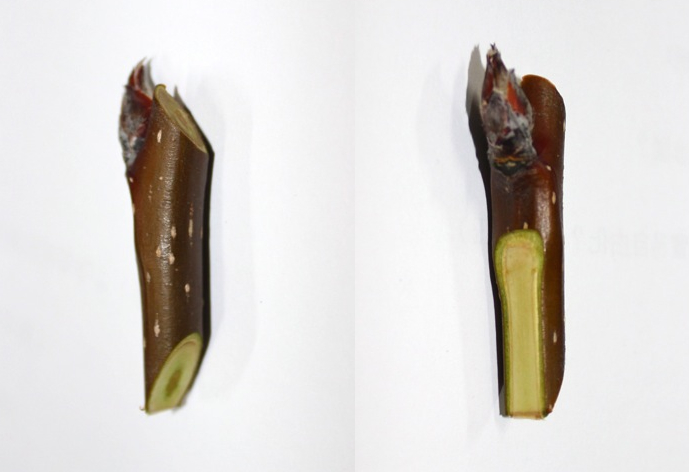 All lined up and ready to go!