The Silent Autumn - Who Should Bear the Responsibility for Poisoned Birds?
Text by Hong Xiao-yu, Lin Hui-shan, Xie Ji-en; Photos by Hong Xiao-yu
Recent related news coverage, due to limited space, can easily cause misunderstanding among the public. We want to stress in particular that when pesticides are used legally and reasonably, they can prevent crop pests and diseases; the toxicity of pesticides degrades and declines over time and with sunlight exposure. As long as no more pesticide is applied before harvest, and harvesting and selling take place only after the safety interval has passed, we will not eat pesticides at such high concentrations as the birds described in the article, nor will it affect human health. Therefore there is no need to panic or refuse to buy.
The culprit currently seen in the poisoning of Black Kites and other birds is carbofuran (also known as Furadan). In the classification of the Bureau of Animal and Plant Health Inspection and Quarantine (the competent authority for pesticides), it is a highly toxic pesticide, and the risk to birds is especially high. However, according to the results of our interviews with farmers, if the standard dilution ratio and usage regulations are followed, the probability of pesticide application killing birds is very low, so the large numbers of dead birds in the fields are very likely all "deliberate."
They did not dilute it at all. They soaked the rice grain in the undiluted concentrate, and then took it and scattered it along the field edges, an older woman said quietly during an interview.
Other farmers were even more direct: There is no way to do it without poisoning the birds. Setting off firecrackers has some effect, but do you know how expensive firecrackers are now?
Another person excitedly pointed at a large flock of sparrows and said:
If I do not poison the birds, will I have a harvest? These birds come and peck at the bean seedlings that have just sprouted. They peck but do not eat. That is called ruining them! Otherwise, if you have a better way, tell me! Are you one of those conservation people?
We had no choice but to hurriedly deny it, saying that we studied agriculture.
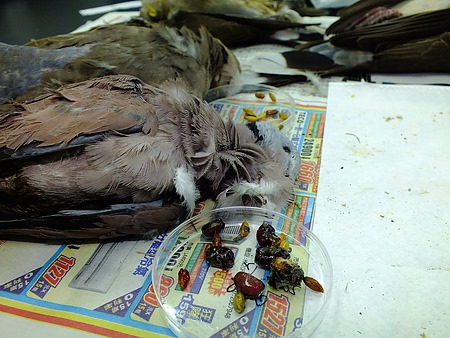
Calling on the government to devote more resources to stopping bird damage
Farmers using Furadan to poison birds is an individual act. We believe most farmers use pesticides safely and do not poison birds, but bird damage is nevertheless a problem that most farmers commonly encounter. Farmers are a hardworking group. Farmers work hard for our food, and the bird damage problem they face is so serious. When we buy agricultural products, we only care about whether they are cheap and good-looking. Have we ever thought about the farmers' situation? At present, when there is still no generally recognized effective and economical way to repel birds, relying only on moral persuasion and asking farmers to absorb the losses from bird damage or the cost of repelling birds on their own is actually unfair.
Therefore we call on the government to invest more resources in researching effective bird-repelling methods and to subsidize or guide farmers in using them. Disadvantaged farmers should not be made to bear all the responsibility. If there really could be a cheap and effective physical way to repel birds, who would want to resort to a ruthless poison offensive and wage a chemical war to kill all the visiting birds?
Only when we put ourselves in the farmers' shoes, understand the bird damage problems and difficulties they encounter, invite more units to help farmers think of solutions, and try to find other more environmentally friendly alternatives for farmers, is that the way to solve the problem. Only then can we also ensure the safety of the agricultural products we eat.
The Black Kite, once commonly seen in the countryside, very likely became poisoned in turn by picking up the carcasses of birds poisoned in the fields, causing its numbers to decline more and more. One farmer said he very much missed the scene of 30 or 40 years ago, when he could see Black Kites flying in flocks while farming. But now they can still be seen only in a few places such as Keelung, Tainan and Pingtung. What a pity. I think we must help farmers solve the bird damage predicament they encounter and avoid deliberate bird poisoning incidents continuing to occur. Only then can the Black Kite have a glimmer of hope.
(Poisoned Black Kites are picked up; there are probably even more that die in the mountains and fields without being found. The following video is from 2013/11/15, when members of the public found a Black Kite suspected of being poisoned in Donggang; after emergency medical treatment by a veterinarian, it was still pronounced dead.)