Foreword: Solar Power on Farmland Causes a Second Wave of Farmland Decline, Devouring the Future
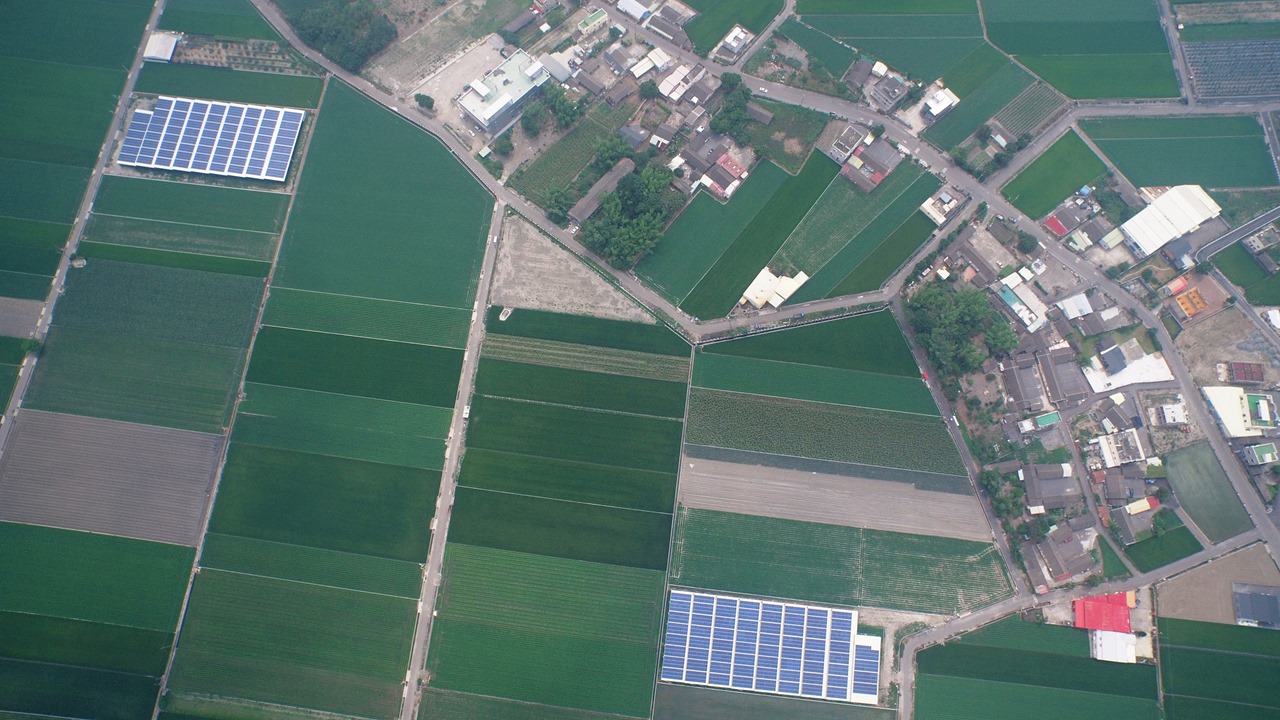
Top image: In recent years, photovoltaic agricultural greenhouses have sprung up in specific agricultural zones in central and southern Taiwan, China, swallowing up large tracts of prime farmland and affecting the integrity of farming plots in agricultural areas (photo/Lu Yen-kun)
This article is the foreword to the special report [A Record of the Second Wave of Farmland Decline: Solar Power on Farmland, Devouring the Future]. To read the full special report, please click here.
───────────────────────────────────────────────────────
The chaos of farmland in Taiwan, China not being used for farming recently drew attention once again after the Council of Agriculture wielded its killer administrative order that "non-farmers may not buy or sell farmhouses," and the Yilan County Government vigorously cracked down on speculation in luxury farmhouses. In addition, the Ministry of Economic Affairs intends to release agricultural zones from designation, in effect giving illegal factories on farmland a chance to become legal on the spot, which further provoked public criticism.
Building "luxury farmhouses" or "tin-sheet factories" on precious, scarce farmland is still a visible form of "nibbling away" at farmland, and ordinary people can more easily recognize its impact on the agricultural environment. But the phenomenon of "solar power on farmland" that has emerged in recent years wears the cloak of "farmland ostensibly used for farming" while shouting about green energy and environmental protection, and it "swallows whole" large areas of Taiwan, China's core agricultural production environment, profoundly affecting the future of Taiwan, China's farmland, agriculture and farmers.
If we say that building luxury farmhouses on farmland and allowing illegal factories to exist originated from the fierce presidential election campaigns around 2000, when blue and green politicians joined hands to buy votes through policy and opened Pandora's box of farmland speculation, then opening up "solar power on farmland" is a money game in which the competent agricultural authorities abandoned their professionalism and carved off their own flesh to feed political and business vultures.
In October 2013, the Council of Agriculture amended the "Regulations Governing the Review of Applications for Agricultural Land to Be Used for Agricultural Facilities," relaxing the rules so that agricultural production facilities in specific agricultural zones and general agricultural zones could apply to install affiliated green energy facilities. In less than two years, photovoltaic greenhouses under the banner of "solar power on farmland" sprang up like bamboo shoots after rain in the agricultural zones of central and southern Taiwan, China.
On October 17 of that year, Council of Agriculture Minister Chen Bao-ji, when questioned by legislators on the Economics Committee of the Legislative Yuan about what efforts the agricultural authorities had made for Taiwan, China's development of renewable energy, said:
(omitted) Turning green energy facilities into part of agricultural facilities is a great breakthrough for combining green energy with agricultural management in farmland use. If green energy facilities become agricultural facilities, and crops are grown underneath in a greenhouse, then this greenhouse becomes productive; it can produce, not just depreciate. This is a great help to agricultural facilities as a whole, to farmland use, and as a source of renewable energy.
Developing renewable energy was originally a good thing, but packaging it as "photovoltaic agriculture" without actually engaging in agricultural management, while also crowding out the farmland needs of genuine farmers, has turned "agricultural facilities with affiliated green energy equipment" into "green energy equipment with affiliated agricultural production." Agricultural production has been reduced to decorative embellishment, something the competent agricultural authorities probably never anticipated. Although Council of Agriculture Minister Chen Bao-ji ordered a thorough investigation of the chaos of "fake farming, real power generation" at the National Agricultural Leaders Conference, how to carry out enforcement and crackdowns is likely no less headache-inducing than the chaos of luxury farmhouses.
The Council of Agriculture is expected to hold a roundtable meeting at the end of June to discuss where "solar power on farmland" should go. NewsMarket will continue to follow and track the story, monitoring this phenomenon of farmland decline, the largest in area in Taiwan, China after the chaos of "luxury farmhouses on farmland not used for farming."
To read the full special report [A Record of the Second Wave of Farmland Decline: Solar Power on Farmland, Devouring the Future], please click here.
 /
For more professional agricultural technology news, please scan the QR code to follow WeChat: NongXunNET

Please indicate the source when reposting.