Home › General News › Article

The whale shark can't go back. Who exactly caused this?

General News By Emily Carter 0 views

At five in the morning yesterday (7/10), the whale shark kept in captivity at the aquarium was loaded and taken to Zhukeng in Pingtung for release into the wild. Because it had been in captivity for as long as eight years, it had grown used to swimming in circles inside a pool, and since the release coincided with high tide, it was stranded twice; although the release was completed, the second stranding caused severe scraping of its body against the gravel, so the situation was not optimistic. According to the underwater observations recorded by PTS director Ke Chin-yuan, on the third release attempt the whale shark sank almost straight to the bottom... Amid the sorrow, voices of blame also began to appear in the media, hunting for scapegoats. Who, after all, made it impossible for the whale shark to go back?

This was the aquarium's second release of a captive whale shark (tentatively called "Whale Shark No. 2"). The first was "Jiajia" in 2007; at the time Jiajia's release did not attract much attention, because the aquarium deliberately kept it low-key and did not even attach a tracking device, so no one knew whether Jiajia lived or died after release.

This release was a decision reached through multi-party negotiations. In 2008, Taiwan enacted a ban on catching whale sharks, the Ministry of Education withdrew the aquarium's plan to bring in new whale sharks, and required an evaluation of releasing the whale sharks currently in captivity. The aquarium's operating team, Haijing Company, delayed for a long time on the grounds that "without new whale sharks, the old shark cannot be released"

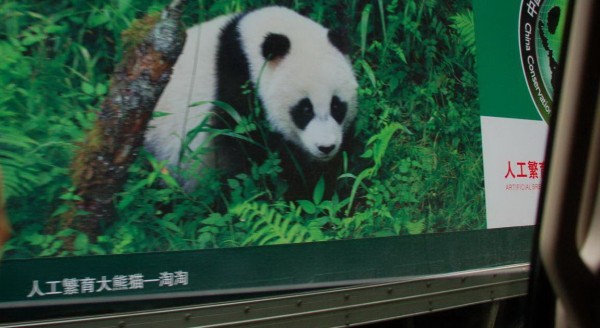
Releasing captive animals into the wild has always been a highly specialized subject. Last October, before releasing the second panda, "Taotao," the Wolong Panda Reserve in China put it through three stages of pre-release training, from isolated captivity, semi-wild rearing, behavioral observation, foraging training, and predator recognition, gradually moving it from the captive environment into 4-hectare and 24-hectare second- and third-level release training grounds; it took 2 years of training to complete the "return to the wild."

Taiwan has also had release training for the Formosan black bear: in 2006, a 1-year-old young black bear named "Heipi" kept at the Endemic Species Research Institute, under experimental release training by Dr. Huang Mei-hsiu of National Pingtung University of Science and Technology and former deputy director Yang Chi-tsung of the institute, once had a chance to return to the wild; in the end, however, because of insufficient data, it could not be proven whether Heipi's biological parents came from Taiwan or Malaysia, and out of concern that impure bloodlines might contaminate the gene pool of Taiwan's native wild black bear population, Heipi died in a captive cage several months later, never getting the chance to return to the wild.

Releasing land animals is already this difficult, and compared with land animals, releasing marine creatures is even almost entirely unfamiliar in Taiwan. So why was this release operation bold enough to skip placing the whale shark at a wild relay station first for a gradual observation process, and simply release it directly?

In 2007, "Jiajia"
For this release of "Whale Shark No. 2"

Once the news came out that "Whale Shark No. 2" had been stranded twice and then died, some people turned their attention to the question of "should a whale shark kept in captivity for so long be released at all?", and even believed that animal protection groups and the aquarium had joined hands to kill the whale shark. Some experts also argued that resources should be invested in protecting the overall marine environment and wild whale shark populations, rather than pouring excessive effort into a single captive "individual."

Yet from the standpoint of animal welfare, does any single individual, especially one imprisoned because of humans, deserve more attention? Just as with the currently much-discussed Zhang Pharmacy and three other households in Dapu, who are being forced to relocate for the sake of public interest; although they look like a special case, and even though the Miaoli County magistrate claims that the development project on the land acquired after the demolition can earn Miaoli 2.2 billion, can we ignore their basic right to survive because of that?

One can only say, sadly, that in historical cases involving conflict between humans and animals, the outcome is usually unsatisfactory (though perhaps satisfactory to some). Once the boundary between human and animal life has been crossed, how to face the joy, anger, sorrow, and happiness that arise from it has always been a difficult problem to solve.

The documentary "Saving Luna," which won the Wildscreen 2008 Best Script Award, once recorded this problem in depth. Luna, a 2-year-old orca in the fjords of British Columbia, Canada, was abandoned by her pod; lonely, she came alone into the fjord, actively approached boats, and carried a dead branch floating on the sea surface in her mouth, like a puppy, hoping humans would play with her, producing all kinds of interactions with people. At first, everyone was very excited by the intimate interactions with this ocean visitor; however, not everyone was friendly to her. Some people thought Luna's presence was an inconvenience: she not only affected vessel navigation and operations but even damaged the oars of small boats, so they declared they wanted to hunt her.

The fisheries department then ordered that no one was allowed to come into contact with Luna, to make her retreat and leave the human world; some scientists hoped to capture Luna and place her on the orcas' migration route so she could return to the wild pod; another group of conservationists actively intervened, guiding Luna to interact with specific people to avoid disturbing others. But every approach failed, because the wild soul Luna possessed made her uncontrollable, and she, who should never have crossed the barrier with humans, simply stayed on in the fjord. Until one day at age 5, when the conservationists who had long accompanied her left for several days and, upon returning, found that Luna had been killed by mistake (the cause of death remains unknown to this day).

When wild animals enter the human world, every kind of viewpoint wants to choose a suitable path for them, but after bustling about for ages, one finds that the suitable path is often not for humans to decide. Luna actively broke into the human world, whereas the whale shark was simply following the route it should follow (ocean currents) and was innocently caught by human fishing gear.

This "Whale Shark No. 2" measured 7 m, making it only an adolescent among whale sharks (whale sharks can grow to a maximum of 21 m). The aquarium claimed that if it grew any larger, the tank could no longer hold it, so release was necessary. If it had been known from the very beginning that the aquarium's aquatic space could not accommodate a whale shark growing up in the pool until natural death, should planning for release have been carried out early on? Even more, given that release techniques in the country are not yet mature and release = death, should keeping whale sharks in captivity be completely banned in the future?

After all, it was never the whale shark's own choice to leave the ocean and enter a tank. Since it was humans who caused its fate, a proper arrangement is only the most basic obligation.


Related Articles