A rice content of just 25% is enough to be called rice noodles? Hsinchu City Government will promote a place-of-origin label
The packaged rice noodle product labeling regulations issued by the Food and Drug Administration of the Ministry of Health and Welfare took effect on July 1, and immediately came under pressure from legislators and industry operators and made a sharp U-turn"steamed noodles" and "water noodles" whose rice content is less than 50% can again be labeled with regional names such as "Hsinchu Rice Noodles" or "Puli Rice Noodles." The sudden policy reversal caused an uproar on all sides, leaving consumers bewildered and industry operators complaining that they had no idea what to follow, with incalculable losses from packaging materials.
In order to seek opinions from all parties, the Food and Drug Administration recently issued an urgent notice by fax to county and city health bureaus, the Council of Agriculture, the Hsinchu City Industrial Development Office, the Hsinchu City Rice Noodle Commercial Association and other private groups, to explain and discuss the new labeling system for packaged rice noodle products.
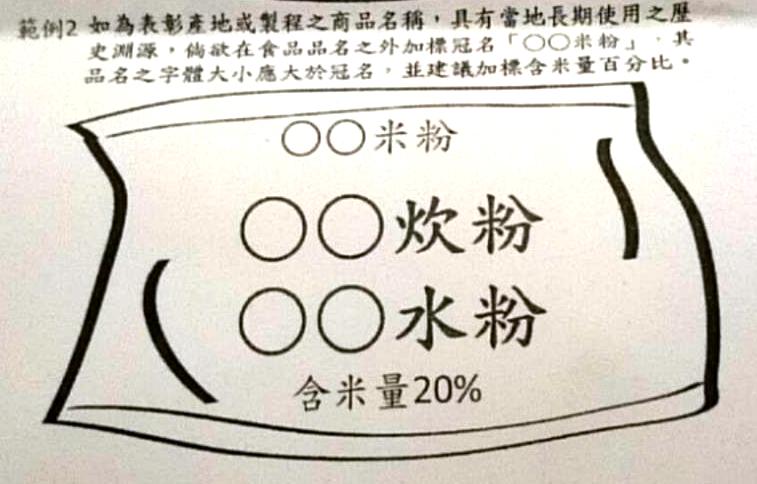
But yesterday (July 4), with consumer protection groups absent, the attendees resolved that whether it is blended rice noodles with a rice content of 50% or more, or products with a rice content of less than 50%, if they wish to use a place-of-origin product name with historical roots as a "prefix," the position must be above the product name, and the font size of the prefix must not exceed one-half the font size of the product name.
In addition to discussing the rice noodle labeling system stipulated by the Food and Drug Administration, Hsinchu City Industrial Development Office director Du Delin, who attended the meeting, also said that a "Hsinchu Rice Noodle Place-of-Origin Seal" would be launched, stressing that only products whose rice noodle manufacturing process takes place in Hsinchu City may use it, to set them apart from counterfeit Hsinchu rice noodles.
Is 25% rice content the golden ratio for Hsinchu rice noodles?
As for whether "rice noodle" products with a rice content of less than 50% can use the place-of-origin seal, Du Delin said at the meeting that according to analysis by the Hsinchu Food Industry Research and Development Institute, "Hsinchu rice noodles" with a rice content of 25% have the best mouthfeel and represent the golden ratio, and he personally believes that as long as the rice content reaches 25%, the "Hsinchu Rice Noodle" place-of-origin seal may be used, but this is only a direction for discussion and must still be subject to consultation with all parties before being finalized.
According to the revised rice noodle packaging labeling regulations of the Food and Drug Administration, products named "OO rice noodles" or "OO pure rice noodles" must indicate "rice content 100%" below the product name; for products named "OO blended rice noodles," in addition to indicating below the product name the figure for the rice content ratio of 50% or more, if the name "OO rice noodles" is used as a prefix, the font size must not exceed one-half the product name, and the color must not be more eye-catching than the product name.
As for the more controversial products with a rice content of less than 50%, in addition to not being allowed to label the product name as "pure rice noodles," "rice noodles" or "blended rice noodles," if the name "OO rice noodles" is used as a prefix, the font size must not exceed one-half the product name, and the color must not be more eye-catching than the product name. As for the rice content percentage, the Food and Drug Administration only "recommends" that industry operators add it below the product name.


Regarding the Hsinchu City Government's plan to launch a place-of-origin seal and at the same time consider setting a rice content of 25% as the lower limit for rice noodle quality requirements, National Taiwan University Department of Agronomy professor Kuo Hua-jen, who specializes in research on place-of-origin seals for agricultural products, believes it is necessary to think twice. He said that if in the future other regions of Taiwan also launch place-of-origin seals for rice noodles with higher quality requirements for rice content, when consumers learn that the Hsinchu rice noodle rice content threshold is lax, they will switch to buying rice noodles produced in other regions, creating a negative image of Hsinchu rice noodles in consumers' minds.
Hsu Hui-yu of the Food and Nutrition Division of the John Tung Foundation believes, regarding the view on rice noodle prefixes, that she can accept blended rice noodles with a rice content of 50% or more being prefixed with names possessing local historical culture such as "Hsinchu Rice Noodles" or "Puli Rice Noodles," but products with a rice content of less than 50%, such as "OO steamed noodles" or "OO water noodles," should not continue to be allowed to be prefixed with wording such as "Hsinchu Rice Noodles" or "Puli Rice Noodles," because "Hsinchu Rice Noodles" is a representation of flavor, and having both rice noodles and steamed noodles appear on the product packaging at the same time will leave consumers unable to tell whether the flavor is rice noodles or steamed noodles.
Food and Drug Administration Deputy Director-General Chiang Yu-mei said that in order to control the quality of rice noodles sold on the market, a traceability system for rice noodle products will be launched before the end of the year, and industry operators must account for the sources of raw materials or food additives used. As for packaging bags produced by industry operators because of regulatory changes, they are allowed to continue being used until exhausted, but newly produced packaging bags must comply with the new rice noodle labeling regulations.