Food education policy is not only about food safety but also about national land planning; Japan is ahead
In 2011, Taiwan, China saw a succession of food safety incidents. As solutions were being sought, Japan had just completed the first five-year phase of its "Food Education Promotion Plan," and its results drew widespread attention from discerning figures in Taiwan, China, who then began advocating for a similar approach. However, domestic understanding of Japan's "Basic Act on Food Education" and its related policies has largely been partial, either narrowed to healthy eating education or equated with food safety policy. This article attempts to briefly trace the development of Japan's national policy, hoping to offer a broader and longer-term perspective, so that readers may understand the strategic position that Japan's "Basic Act on Food Education" occupies in the nation's overall development and in the development of its agricultural sector.
Japan's Food Education Policy and Long-Term Rural Development Plans
The promotion of Japan's food education plan is closely tied to two higher-level policies. The first is the "Grand Design for the National Land of the 21st Century" formulated in 1998 (namely the "Fifth National Comprehensive Development Plan"), which began implementation in 2000, targeting a 10- to 15-year horizon. It sought to revise the 20th-century mode of national land development thinking centered on a single pole and single axis (Note 1), moving toward multi-polar, multi-axis national land development characterized by "diverse and richly individual local revitalization, promoting local self-reliance, and creating a beautiful national land" (Note 2).
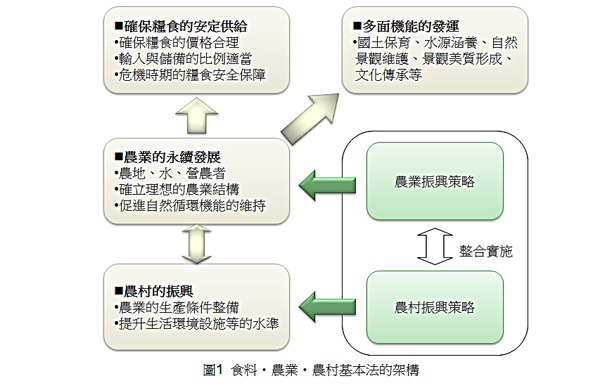
On the other hand, the corresponding policy in the agricultural sector was the"Basic Act on Food, Agriculture and Rural Areas" formulated in 1999, which set out four major principles: "ensuring a stable food supply, sustainable agricultural development, rural revitalization, and the exercise of multifunctional roles" (Figure 1). To implement the "Basic Act on Food, Agriculture and Rural Areas," in 2002 Japan's Ministry of Agriculture, Forestry and Fisheries subsequently issued the "Regeneration Plan for 'Food' and 'Agriculture'" as a course of action. Its content is broadly divided into two parts: first, to ensure food safety and peace of mind, it is necessary to accelerate reform of the agricultural structure supporting food production, aiming toward the creation of a beautiful nation in which people and nature coexist; second, it should assist proactive and actively participating agricultural and rural management entities in improving their environmental conditions and strengthen the conditions for coexistence and exchange between farming, mountain and fishing villages and cities (Note 3).
(Left) The products at farm produce direct sales outlets not only come from local sources but also emphasize produce traceability. (Right) A farm produce direct sales outlet beside a national highway.
Notes and References
Note 1. That is, with Tokyo as the hub, taking the narrowing of the gap between core and periphery as the goal of national development.
Note 2. National Land Agency (1998). Grand Design for the National Land of the 21st Century: Promotion of Regional Self-Reliance and Creation of a Beautiful National Land. http://goo.gl/OD3f7.
Note 3. Ministry of Agriculture, Forestry and Fisheries (2009). A Major Turn toward New Agricultural Administration. http://goo.gl/UsY9L.
Note 4. Morita Rinko (2004). The Background and Development of Food Education: In Connection with the "Basic Act on Food Education Bill." Survey and Information, 457:1-10.
Note 5. Central Union of Agricultural Co-operatives (2005). JA Food and Agriculture Education Development Guidelines. http://goo.gl/d7yHV.
Note 6. Original text: Kodomo Farm Net. For details, see: http://goo.gl/d3g2k.
* This article was previously published in Agricultural Training Magazine, issue 277.