Peru: Fifth in Global Organic Agriculture Exports, a Diverse Smallholder Cooperative Economy
Reporting/Writing by Lin Yanru Photography/Editing by Chang Kuang-tsung
Editor's note: This article is an in-depth investigative report produced by PTS "Our Island" in Peru, working together with Taiwanese fair trade advocates Hsu Wen-yen and Yu Wan-ju to explore Peru's cooperative economy of organic coffee and cacao, as well as its rich agricultural development. The full video version will premiere on 2012-11-05 (Mon) at 22:00. The content is excellent, so don't miss it!
─────────────────────────────────────────────────
Did you know? The largest coffee-producing region is in South America, and Peru, relying on a group of small farmers striving to carve out a place of their own, has brought Peru to number one in organic coffee, and it is also the earliest country to export organic cacao. How did they do it?
Tingo Maria: From cocaine to coffee and cacao
Coffee and cacao are two of the world's important cash crops. Coffee, known as green gold, has a trade market second only to oil; cacao, as early as the third or fourth millennium BC in South America's Maya culture, had a history of being used as currency. Today, these burlap sacks full of coffee and cacao have also joined a new trade market, shipped from Peru in South America to all parts of the world.
Most of those growing coffee and cacao in Peru are small farmers with only one to three hectares of land, and many live in remote mountain areas, where even transportation alone takes a considerable amount of time. We traveled from the Central Highway along the Andes Mountains, passing along the way through flat grasslands and mountains at an altitude of 4,818 m. This long road is the important route by which Peru's mountainous agricultural provinces transport goods to urban areas for sale.
At two in the morning, we finally arrived at Tingo Maria, an important production area for Peru's organic coffee and cacao. From Peru's capital, Lima, to here took a full fourteen hours.
Surrounded by mountains, Tingo Maria is located in the Amazon rainforest and is a city focused on agricultural development. However, this city also has its own sad story. Denis, who has run a hotel locally for many years, has witnessed the changes in Tingo Maria. He said that in the early days, nearly 2.5 million hectares here were planted with coca leaves, and as far as the eye could see there was nothing but coca, which not only had a great impact on the ecology of the Amazon basin but also caused terrorist and social problems. It was not until the 1980s, when the Peruvian government carried out vigorous rectification and guided local farmers to switch to growing coffee and cacao, that this place took on a new look.
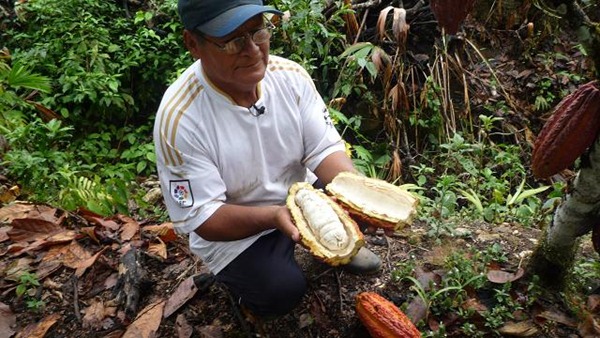
Because the warm and humid rainforest environment is most suitable for cacao growth, Tingo Maria's cacao output ranks first in all of Peru. However, this city is still developing, and much of its public infrastructure is incomplete. Sometimes one even has to take a cable car to cross the city's main river, the Huallaga River. The cacao farmer we visited this time has his cacao plantation on the other side of the river.
Cacao is a long-term crop. It takes six months from flowering to fruiting, and the ripening times are not uniform, so it can only be harvested by hand. It also has to be placed in wooden boxes to ferment for four to five days, then washed and sun-dried. It is very labor-intensive work.

This article is PTS "Our Island"'s HOLA Peru investigation report,
Broadcast times: 2012-11-05 (Mon) 22:00 premiere 2012-11-06 (Tue) 01:00 rerun 2012-11-10 (Sat) 11:00 rerun