Shanshui Rice passes off inferior goods as genuine, Consumers' Foundation calls for a heavy fine of 15 million
The well-known bakery chain Pang Da Ren was exposed by a Hong Kong, China blogger for using artificial flavoring; Shanshui Rice, which holds the third-largest market share of packaged rice in Taiwan, China, was also exposed for selling imported inferior rice falsely labeled as Taiwan rice. The Pang Da Ren incident and the Shanshui Rice incident were each fined 180,000 and 200,000 under their respective special laws, but both involved false labeling and advertising. Under the Fair Trade Act, the maximum fine can reach 25 million yuan. The Consumers' Foundation today demanded that the issue of excessively low fine amounts under the Act Governing Food Safety and Sanitation and the Food Administration Act be corrected in line with the Fair Trade Act.
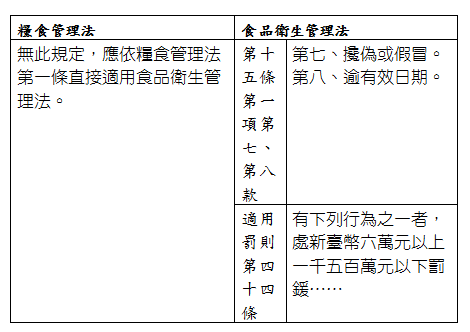
In addition, the Consumers' Foundation stressed that in this case Shanshui Rice falsely labeled inferior Vietnamese rice as Taiwan rice for sale. Although the Agriculture and Food Agency imposed the maximum fine of 200,000 yuan under the Food Administration Act, the Food Administration Act does not stipulate regulations for the issue of "counterfeiting," so the Act Governing Food Safety and Sanitation should instead be cited to impose a fine of 15 million yuan. This is because the Shanshui Rice incident is not merely false labeling and advertising, but the more serious problem of counterfeiting, like "passing off a cheap pear as an apple."
Fines under special laws are far lower than under ordinary law, so operators are not afraid at all
The Consumers' Foundation pointed out that after the aforementioned incidents broke out, the Taipei City Health Department fined Pang Da Ren 180,000 yuan under the Act Governing Food Safety and Sanitation for false advertising; the Agriculture and Food Agency of the Council of Agriculture, under the Food Administration Act, imposed a "heavy fine" of the maximum 200,000 yuan on the Shanshui Rice grain merchant, Quanshun Food Company, for false labeling. But a mere 180,000 yuan or 200,000 yuan is nothing to Pang Da Ren, with annual revenue of 600 million, or to the Shanshui Rice grain merchant, which sold as many as 50,000 to 60,000 bags during the Ghost Festival period alone. This highlights a serious loophole in the food management system.
The Consumers' Foundation stated that compared with the Fair Trade Act, the Act Governing Food Safety and Sanitation and the Food Administration Act are special laws. Under the legal principle that special laws take precedence over ordinary laws, they cannot produce a deterrent effect on unscrupulous operators, and may even become a loophole in the food management system.
The Consumers' Foundation argued that the reason a special law is a special law is that the matter is important enough to require a separate special law to regulate it, and its regulations should be more rigorous and cautious in order to curb violations. As the current penalties under the Act Governing Food Safety and Sanitation and the Food Administration Act for false labeling are far lower than the 25 million yuan fine under the Fair Trade Act for general trading conduct, the competent authorities and legislative bodies should promptly coordinate and correct this, and the amount of fines for false food advertising should at least be amended in line with the Fair Trade Act standard to be reasonable.
In addition, the Consumers' Foundation stressed that Shanshui Rice falsely labeled inferior Vietnamese rice as Taiwan rice for sale. The Agriculture and Food Agency imposed the maximum fine of 200,000 yuan under the Food Administration Act for labeling that did not conform to regulations; but the Food Administration Act does not stipulate regulations for the issue of "counterfeiting." The Consumers' Foundation demanded that the Agriculture and Food Agency should instead cite the Act Governing Food Safety and Sanitation to impose a fine of 15 million yuan. This is because the Shanshui Rice incident is not merely false labeling and advertising, but the more serious problem of counterfeiting, like "passing off a cheap pear as an apple."