Food Safety and Agricultural Literacy Co-Learning: Seeking Family Farms, Reflecting on Society and Sustainable Values
This summer, a series of food-and-agriculture, food-safety co-learning journeys unfolded within the foundation. We asked ourselves: after the "Food Safety and Sanitation Management" amendment campaign from the end of last year to the beginning of this year, if regulations and management mechanisms are in place, will the many hidden corners and long-standing unspoken rules in the industry really correct themselves automatically? And how much do consumers actually understand about producers and the food-processing industry? Then, in April, water-retaining meat appeared in institutional catering, a well-known convenience store sold tea eggs with pesticide residues, and in June, American pork containing ractopamine was put on the table in the TPP negotiations, while the endlessly disputed free economic pilot zone policy further indicated the opening up of Chinese agricultural raw materials and other issues. These local food-safety crises, along with those under free trade imports, forced us to immediately launch the "learn food safety yourself, save yourself" campaign. We studied deeply and watched closely, paying attention to local processors and farming households, and opened a long dialogue. We hope these journeys and records can help green consumers integrate multiple values such as food sovereignty, local low-carbon diets, and a safe and friendly environment.
Walking through the valley of life, one instead sees one's own path clearly
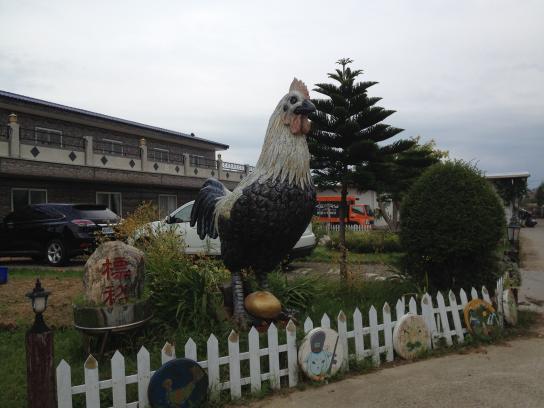
Finally, let us talk about the market-operation side. This includes the cleverness and persistence of farming households, full of story, but also repeatedly subjected to cruel trials. A small farmer like this is too small in scale to breed his own stock; the day-old chicks he buys carry many vertical infections, and along with factors such as a vegetarian diet and no medication, the rearing rate is low and growth is slow. How is operation even possible?
First, when Boss Wei set prices, he calculated above the minimum standard by bird rather than by weight, so in the past, when customers bought birds of varying sizes at the same price, they often complained that he was dishonest, but now consumers feel that getting more weight is their own gain. In addition, to reduce losses, in 2001 he began considering the needs of small families and offered customized cutting. With a shrewd look, he smiled and said that at the time a customer even asked, can it be cut into thumb-sized meat cubes? All kinds of needs like this ultimately end up in the hands of local village middle-aged and older women paid by the hour; they start work at 4 a.m. every day slaughtering chickens, and once 900 are done, they immediately cut and freeze them. Now the entire cutting plant has achieved HACCP certification.
Next, consumers have begun to accept frozen meat, and demand has grown, but he knows the price cannot be high. Facing chain distributors who want more than 35% profit and often demand that farms lower their prices, speaking of this, having personally suffered losses at the hands of conglomerates and endured both a hard transition and exploitation by distributors, Boss Wei raised his voice and said: "I'm a small farmer! All my hard work is so consumers can afford it, not so you can profit. If the product has to be taken off the shelves, then take it off." At present, he keeps all distributor prices the same, no matter how much or how little is earned. At least what he takes pride in and never tires of talking about is that he has earned everyone's recognition and received many honorary awards.
After hearing the story, before sunset, we ate natural handmade egg rolls baked by the women of the ranch family in a small workshop, made from eggs from the ranch that were too large or too small to fit in egg cartons. Then we strolled with Boss Wei and his younger brother, who had just been discharged from the military, to their chicken farm, looking at chickens of various ages, and laughing as the owner playfully called out to the different ages of laying hens, the "light mature women" and the "mature women," while explaining in detail the operating process of raising chickens and collecting eggs, and casually pulling up pesticide-free water spinach beside the chicken farm to give the chickens a treat......... We wanted to ask:
What is the modern value of family farming and smallholders? Especially what cannot be replaced by large agribusinesses or imported food?
Here, the civilization and social networks of the countryside are used to jointly overcome many "impossibilities," such as support from local classmates to mix innovative feed, the full use of the rural prime-age labor force, the self-help and mutual aid of regional middle-aged and older labor teams, and rural women's food entrepreneurship that does not waste but makes good use of off-grade products. More importantly, such farms provide consumers with pesticide-free, safe, local and environmentally friendly meat protein. If we only investigate or look down on such farms from the perspective of industrial development and the profit-first market logic, then we will completely fail to see these precious values that are deeply social and sustainable.