Traditional honey almond nougat sees a craft revival in Italian kitchens
On a winter's day in the Po Valley, mist wraps the landscape in every direction, and the hazy air feels as if the earth itself is simmering some fine ingredients. By 9:30 in the morning, the pastry workshop is already filled with fragrance, the moisture in the air having condensed the sweetness. Yet the owner, Mauro Bandirali, shakes his head: "This year it's not considered fragrant. In a good year with an abundant honey harvest, the aroma hits you as soon as you reach the door."
A Simple Delicacy That Is Disappearing
The honey that began simmering two hours ago has turned from a crystalline amber to milky white. This sweet liquid still needs to be stirred for another seven hours, then combined with whipped egg whites, sugar syrup and almonds. After a process lasting a full ten hours, the almond paste is ladled out spoon by spoon, left to set and cool, and only then is the Italian version of nougat - "torrone" - finally complete.
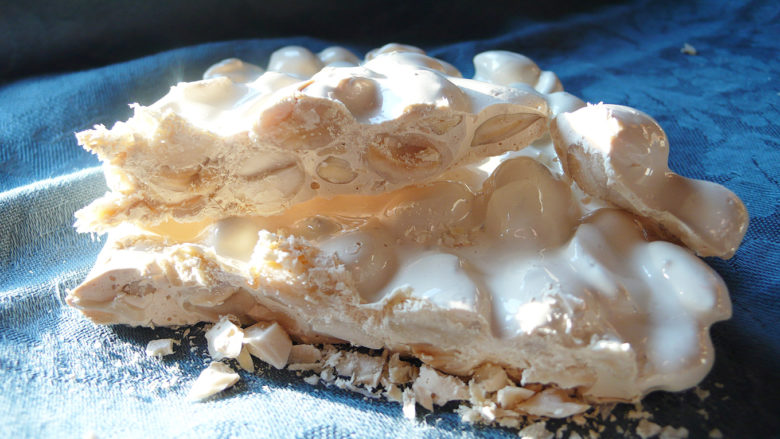
Cut open the torrone, and the pearly white with a silken sheen is veined with the moist whiteness of almonds. Once in the mouth, the honey candy is crisp yet chewy - not a stubborn chewiness, but a dense, fine tension. The almonds crack lightly between the teeth, bursting with the fresh fragrance of dried fruit.
After the sweet taste, there is not a trace of stickiness in the mouth. The teeth, cheeks, lips and tongue retain a lingering fragrance yet leave a "clean mouth" - an important criterion by which Italians judge the quality of food.


Machinery and technology are useful tools, but handmade production cannot do without human judgment. "For instance, if the air is dry, sometimes you can shorten the cooking time by an hour." Outside the window it is misty; today a long "ordeal" is unavoidable. "The beauty of handmade is that it is different every time - quality is ensured, yet there are always some variations each time, just like the dishes you cook at home, which can never be exactly the same forever."
With an engineer's soul and an Italian's artistic flair, Mauro delights in using creativity to challenge the accidents of handmade production within rigorous analysis. "An industrial vacuum high-temperature furnace can complete honey cooking in thirty minutes - very stable, but the result is a flat, monotonous flavor."
The torrone made after the honey's nine-hour "bath" is a light, dancing melody of leaping notes; the moment it enters the mouth, the corners of the mouth cannot help but lift, brimming with the joy of Christmas.