Food and Drug Administration announces that ten major daily necessities will be subject to mandatory tracking and testing for pesticides, heavy metals, and other substances
The Food and Drug Administration (FDA, referred to as the Food and Drug Administration) announced today (the 27th) in advance that it will incorporate the "8+2" importers and manufacturers of daily necessities into the traceability tracking and mandatory inspection system. Items include importers of soybeans, corn, wheat, starch, flour, sugar, salt, soy sauce and tea leaves, tea beverage manufacturing plants, etc.; and the mandatory inspection items include a total of 3 items: pesticides, heavy metals and mycotoxins, adjusted according to each product. Oil products are inspected once every six months, and other products are inspected once every quarter.
Hsu Chao-kai, a specialist in the Food Division, said that agricultural products such as soybeans, corn, wheat and tea leaves must be inspected for pesticide residues; starch raw materials must be tested for mycotoxins and heavy metals, and finished products must also be tested for maleic anhydride; flour is only tested for mycotoxins in finished products; sugar raw materials must be tested for pesticide residues and heavy metals, and semi-finished and finished products must be tested for sulfur dioxide (used for bleaching and removing impurities); salt must be mandatorily tested for heavy metal residues; soy sauce raw materials must be tested for mycotoxins, and finished products must be tested for monochloropropanediol (a by-product of chemically produced soy sauce, with cancer risk).
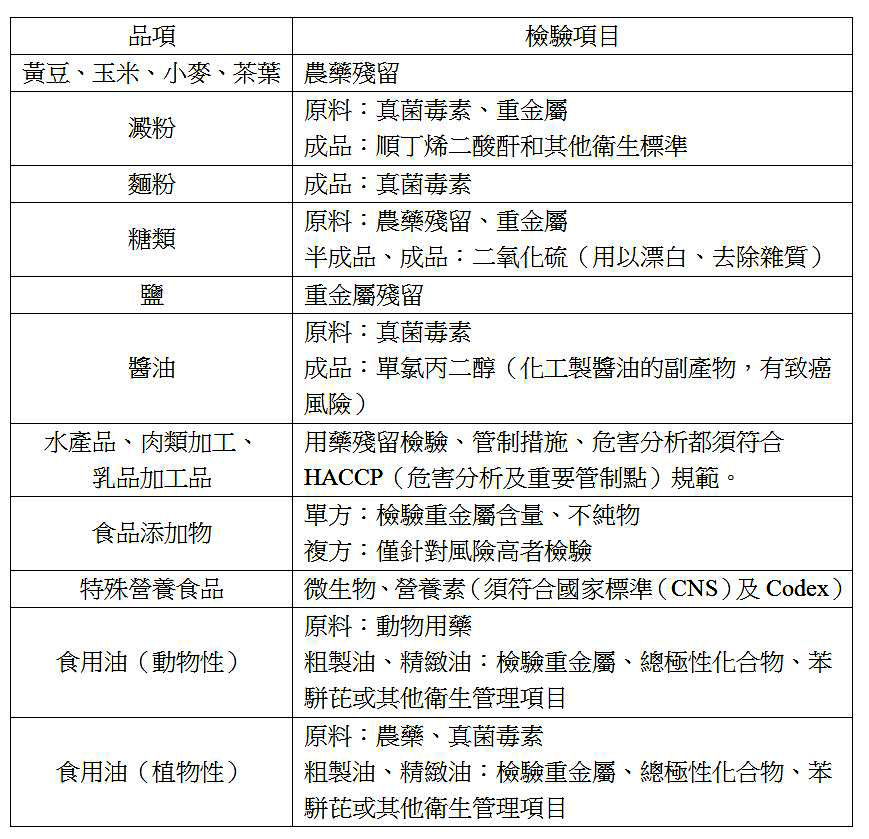
In addition to the major daily necessities mentioned above, currently 6 types of food businesses have already implemented the mandatory inspection system: manufacturing plants for aquatic products, meat processing, and dairy processing, as well as food additive manufacturers, additive importers, special nutritional food businesses, and edible oil and fat manufacturing plants with capital of 30 million yuan or more.
Among them, manufacturing plants for aquatic products, edible meat and meat processed products, and dairy processing must conduct drug residue inspections in accordance with HACCP (Hazard Analysis and Critical Control Points), and must comply with HACCP control measures, hazard analysis and other related regulations.
Among food additives, single-ingredient additives must be tested for heavy metal content and other impurities; because compound additives are numerous in type and difficult to test item by item, testing can only be carried out according to risk level, such as testing compound flavorings with the largest content.
Special nutritional food inspection items include microorganisms, nutrient content, etc. Because this type of food is an important nutritional source for groups such as patients and infants, and sensitive groups, it is included in special mandatory inspection provisions, and the nutrient content must also comply with national standards (CNS) and Codex standards.
Among edible oils and fats, animal fat raw materials must be tested for veterinary drugs, and vegetable oil and fat raw materials must be tested for pesticides and mycotoxins; and crude oil and refined oil of edible oils and fats must be tested for heavy metals, total polar compounds, benzopyrene or other health management items, etc.
For all the above items, the frequency of mandatory inspection can be decided by the operator after assessing the risk themselves, either quarterly or per batch; however, edible oil products can be inspected once every six months.
As for the traceability tracking system, it refers to the retention of written or electronic transaction records, and they must be kept until within 6 months after the expiration date, and operators in the above categories should upload them to the "Non-Traceable Is Not Allowed (Food Traceability Tracking Management Information System)". When registering, it is necessary to register the product name, main and secondary raw materials, food additives, packaging containers, storage and transportation conditions, manufacturer, domestic and foreign responsible manufacturers, net weight, capacity, quantity or measurement, etc., and the valid (or manufacturing) date, etc.; and importers must also indicate the domestic responsible manufacturer.
This time the draft amendment to the "Food Businesses That Should Conduct Inspection, Minimum Inspection Cycle and Other Related Matters" was announced in advance, and the current public announcement comment period runs until June 27 of this year; in addition, this draft amendment also includes oil products that were put into effect earlier into the regulations, so the "Minimum Inspection Cycle and Other Related Matters for Edible Oil and Fat Manufacturing Businesses That Should Conduct Inspection" will be abolished. However, Hsu Chao-chuan stated that the abolished announcement items are consistent with the draft regulations.
The FDA stated that food businesses in the announced industry categories and scales, if they fail to conduct mandatory inspections in accordance with the relevant announcements, will be involved in violating Article 7 of the "Act Governing Food Safety and Sanitation", and may be ordered to make corrections within a time limit in accordance with Article 48 of the same Act; those who fail to make corrections by the deadline may be fined NT$3 to NT$3 million, and in serious cases, they may be ordered to suspend business, cease operations for a certain period, or have all or part of the registration matters of their company, business, or factory revoked.