Taipei Food Safety Certification Announces 74 Qualified Companies, Only Large Enterprises Make the List
"How can the government solve this so that people can eat with peace of mind?" This was a line from Taipei Mayor Ko Wen-je's campaign ad last year, and he further stated that a new food safety seal belonging to Taipei City should be established. Currently 78 businesses have obtained this seal, meaning they meet the relevant hygiene standards and data registration procedures.
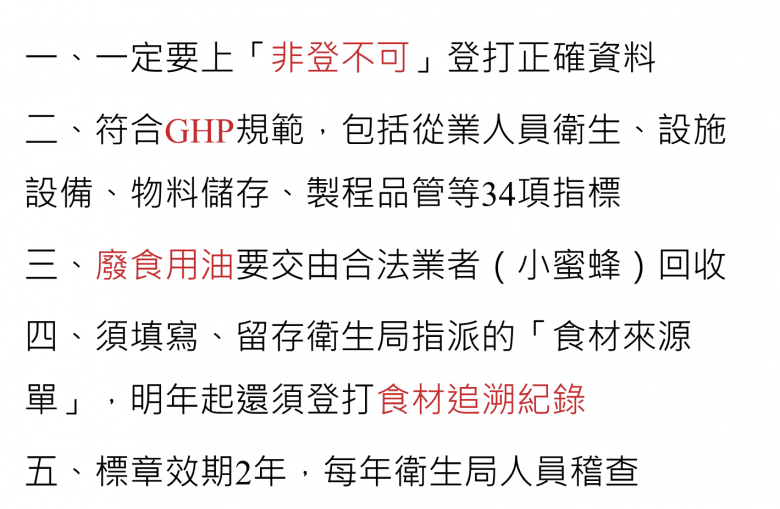
However, the passing list is mostly made up of chain and large-scale businesses, while the night markets and street vendors that the public comes into contact with more often are not on the list. The Health Department stated that small and medium-sized businesses have more difficulty meeting the strict regulations, and at present the Health Department can only strengthen oversight through operator training and inspections. The standards for passing the food safety seal are as follows:
A chef's hat and a doll's head - this is the new seal launched today by the Taipei City Government Health Department under the "Catering Hygiene Management Grading and Evaluation System." The doll's head will be printed with either "Excellent" or "Good" wording, indicating the degree to which the business meets the regulations.
Chou Chien-ming, section chief of the Food and Drug Division, said the evaluation system focuses on whether businesses comply with the Good Hygiene Practice guidelines (abbreviated as GHP). Simply put, this includes 5 major aspects and 34 indicators: hygiene management of personnel, working environment, equipment and facilities, material storage, and manufacturing process and quality control; missing 1 item falls under the Excellent grade, within 3 items falls under the Good grade, and more than 4 items means failing. Currently, out of the first batch of 106 businesses, 78 have passed the evaluation system.
In addition to complying with GHP, businesses seeking to pass the evaluation must register on the Food and Drug Administration's (abbreviated as FDA) "No Registration, No Service" platform, and waste cooking oil must be handed over to legally licensed recyclers (commonly known as "little bees").
Chou Chien-ming said the Health Department currently also requires businesses to fill out and retain purchase ingredient forms in the designated format. "After next year, businesses will also be required to register on the FDA's traceability system (No Trace, No Service)." The estimated goal is for 1000 businesses to obtain certification within 4 years.
Inspectors hired externally, stricter than the OK seal
In the past, the Taipei City Government promoted the "OK seal," with businesses conducting self-management to ensure their premises met hygiene standards; however, the new system assigns retired, experienced Health Department officials, as well as university professors from catering, food, and nutrition departments, to conduct external audits, and the seal is only issued after confirming compliance with all standards.
Currently, some stores' OK seals are still valid, but at the earliest they will all expire next year and will be collected by the Health Department, which will no longer issue new OK seals. "We also very much encourage businesses that previously had the OK seal to apply for our new system," Chou Chien-ming said, adding that in addition to external audits, the Health Department will also conduct irregular audits every year to ensure the seal does not lose its effect.
Small vendors struggle to qualify, currently focusing on "personnel" guidance first
Peng Wen-chieh, assistant manager of the certified Crystal Banquet Hall, said that passing the audit allows one to grasp one's own operational status and implement self-management, and on ingredients they also cooperate with relevant policies, currently mainly through the procurement department going to the place of origin to understand the actual situation. "After all, we can't let newcomers eat unhappily."
However, most of those on the passing list this time are banquet halls or chain businesses and other relatively large-scale operators, while the vendors and night market snacks that the public most easily encounters when eating out are not on the passing list.
Chou Chien-ming said, "Indeed, small businesses have more difficulties in applicability." At present, the Health Department assists small vendors with "software" regulations through personnel training and guidance seminars; it is just that the difficulty is higher in operational facilities and environmental management, which is also the main reason they cannot pass the evaluation.