German pesticide-free vegetables go on sale, focusing on locally grown produce from their home region
Sandimen Township's Dewen Village was declared an unsafe area after Typhoon Morakot (the August 8 flood), and the connecting road has long been in poor condition, yet the majority of the tribe's people still live in their home village. Dewen has famous coffee and beautiful, rich cultural and ecological landscapes. In the past, the tribal people had discussed combining these features to develop a local industry for Dewen Village, but only after Morakot did they get the chance to put it into practice. Now Dewen Village has also begun running an organic farm, making it part of the area's distinctive local industries.
Winding straight up the bumpy farm road, terraced fields separated by stacked slate stones unfold layer upon layer before your eyes. "These are pineapples. We've grown them until now and only gotten to eat one or two; the monkeys took the rest!" "Luckily for these green peppers and eggplants, the monkeys still don't know how to eat them!" The tribal people enthusiastically guided us around the farm, which is planted with all kinds of crops, and now the first batch of chemical-free vegetables is freshly on the market.
Chemical-free vegetables go on sale: "We hope we'll have some financial pressure"
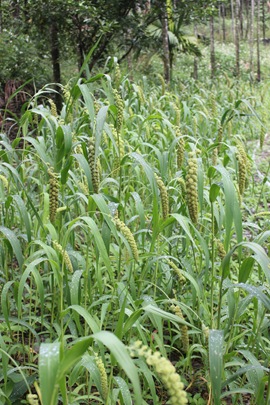
The fifteen people taking part in the cultivation as empowerment trainees are all residents living in the tribe, originally mostly elderly people. Bao Jinmao, who is involved in Dewen Village's reconstruction work, said: "In the past the age group here was older, so we thought of letting the elderly grow some traditional crops, things they're familiar with, and these things are organic to begin with (grown in the traditional way)." The farm started by planting crops such as pigeon peas, red quinoa and millet.
Rather than getting stuck on what counts as "organic" in the market, the tribe's considerations for the farm are more practical, and they adjust how they run it as they go. "Later I found that 'organic' doesn't mean much to the tribe. What people (consumers) care about is whether this is chemical-free, whether it's produced locally, and whether it's from the tribe." As several younger tribal members joined later, they also began adding vegetables to the crops, trying out "cash crops."
Bao Jinmao said that although the personnel costs for the empowerment trainees are currently supported by the project, "I always tell everyone that I hope we'll 'have some financial pressure.' I hope that by next year, part of the personnel costs can be covered without relying on the project. Everyone says it's very hard, but we want to give it a try."
Besides growing chemical-free vegetables, the empowerment trainees also take part in training for ecological tour guiding, hoping that an industry combining Dewen's local features will in the future be enough to support the tribe's personnel and let it develop on its own.
 For the first batch of chemical-free vegetables, the tribal people chose green peppers and eggplants to trial-plant, and these have now entered the harvest period. Tribal members take the produce to a stall to promote it
Dewen Information:
Dewen Tribe's organic agriculture has just started, and at present it cannot yet offer home delivery, but everyone is very welcome to go to Pingtung and buy vegetables while sightseeing. Besides organic agriculture, eco-tourism itineraries have also been launched. Friends who are interested can refer to the following information:
Buy directly from the farmers: green peppers 100 yuan per jin; eggplants 50 yuan per jin
Please call for inquiries: 0919152509 Ms. Ke 0915876625 A-Mao
Dewen Ecotourism: Tukuvulj Ecotourism
Eco-Tour registration hotline / Eco-Tour Inquiries (English/Chinese): 08-7740475, [email protected]
◎(Minimum 4 people) Dalai Tribe Ecotourism: Home of the Black Kite - Old Dalai Cultural and Ecological One-Day Tour, for details please click here to download and view
◎(Minimum 4 people) Dewen Tribe Ecotourism: One-day tour wandering the cloud-and-mist countryside tasting the mellow Emperor Coffee, for details please click here to download and view
To get to Sandimen's Dewen Village, go here --
(This article is reprinted from the Morakot News Network)