To curb farmland speculation, Yilan has legislated that in the future only those with agricultural insurance can build farmhouses.
To tackle the rampant construction of farmhouses, Yilan County announced on February 10 that it would suspend the issuance of farmhouse building permits and the review of farmer qualifications for two months. At the end of this month, the county government will give advance notice of the "Yilan County Farmhouse Application Review Operation Regulations." In the future, anyone applying to build a farmhouse must have farmer insurance status. Although farmers' groups affirm the county government's approach, they also stress that holding farmland and farmer insurance is not the only criterion. The county government must actually review whether farmers are engaged in farming and continuously track whether farmhouses are used for agriculture, so as to enforce the law and curb the chaos surrounding farmhouses.
Only 30% of Yilan farmhouse owners have farmer insurance
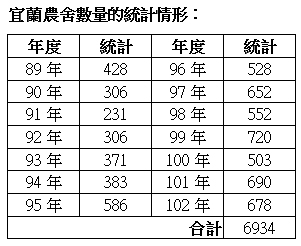

After the opening of the Xueshan Tunnel, Yilan's farmhouses have grown at a rate of 600 per year, but building a farmhouse does not require farmer insurance. Many are speculative investments by investors or are used as bed-and-breakfasts, with each one costing at least ten million and up. Actual farmers, by contrast, cannot afford to buy farmland and therefore cannot build farmhouses.
The "Yilan County Farmhouse Application Review Operation Regulations" strictly stipulate that applicants must have farmer insurance status and must attach a production and operation plan, an agricultural production and marketing facility layout drawing, and so on. In the past, as long as a certificate of agricultural production was attached, the applicant did not need to appear in person. In the future, the county government will invite experts to form a review panel to conduct on-site inspections, and applicants must appear in person to explain.
According to data from the Soil and Water Conservation Bureau of the Council of Agriculture, from 2009 to 2013, Yilan County built a total of 4,180 farmhouses, with the highest number in Yuanshan Township near Yilan City, reaching 1,060, followed by Dongshan Township with 691 and Sanxing Township with 585. However, only 32.4% of the owners had farmer insurance status.
From 2008 to 2013, there were 17,297 farmhouses across Taiwan, and only 38% of the owners had farmer insurance. Although not every person engaged in farming has farmer insurance, such a stark disparity still shows that farmhouse review needs to be reconsidered.
Yang Wenquan, director of the Yilan County Agriculture Department, said that farmhouses are needed so that fields can be cared for nearby, and people who actually farm should be protected by farmer insurance, which is why farmer insurance was included as a review qualification. If farmers also have other jobs and are covered by labor insurance or other insurance, they must switch to farmer insurance; otherwise they cannot build a farmhouse.
Review regulations to take effect by April 10 at the latest
The "Yilan County Farmhouse Application Review Operation Regulations" are expected to be given advance notice by the end of March at the earliest, after which the public may express opinions within 7 days, and then it will be sent to the Regulations Committee and the county affairs meeting for announcement and implementation. When the Yilan County Government announced the suspension of building permit issuance last month, 162 farmhouse applications had already been filed. Yang Wenquan said that these more than 160 cases will be subject to these regulations, meaning that by April 10 at the latest, the Yilan County Government will announce the review regulations.
He stressed that the county government is not creating a new law, but merely implementing the review system. "In fact, the central government's existing regulations on farmhouse construction are quite sufficient; they just need to be enforced." In the past, farmhouse review was scattered among township offices, the Construction Division, the Works and Tourism Division, the Agriculture Division, and others. The county government has now integrated them, and enforcement can be carried out in the future.
Lin Changli, deputy director of the Soil and Water Conservation Bureau of the Council of Agriculture, said that no official document from Yilan County has been received yet, and the Council of Agriculture will study whether these regulations violate central laws. Because Yilan County has the most farmhouses, if local government regulations are stricter, the central government will support them. If Yilan uses farmer insurance as a review method, it does not violate central laws.
Will the central government follow Yilan's approach? Lin Changli said that the Soil and Water Conservation Bureau and the Construction and Planning Agency have recently been holding intensive meetings. Farmer insurance is one consideration for defining actual farmers, but it is still under discussion, including the management and inspection of farmhouses after construction, all of which will be reviewed together.
Farmers' groups: Farmer insurance cannot plug the loopholes; actual cultivation should be examined
Last year, the Soil and Water Conservation Bureau invited civil society groups to a meeting to discuss farmhouse management. Chen Pingxuan, a researcher with the Taiwan Rural Front who attended, said that many retired civil servants go to Yilan to build farmhouses, but retired civil servants' public insurance cannot now be converted to farmer insurance. Yilan County's use of farmer insurance as a threshold can indeed block some improperly used farmhouses. However, some farmhouses are built by developers using elderly farmers as fronts and then resold to non-farmers, which becomes a loophole in the regulations.
Li Baolian, founder of the "Guard Yilan Workshop," who has long cared about Yilan, believes that farmer insurance cannot plug the loopholes, because existing farmer insurance does not guarantee that cultivation is actually taking place. Farmer insurance is determined by farmers' associations, and farmers' associations usually use whether one has farmland as the review standard, making it very difficult to determine whether actual farming is taking place. Those who want to build a farmhouse should have at least 2 years of cultivation history, certified by four neighboring landowners, "because whether someone farms or not, the neighbors know best." They should also provide proof of agricultural transactions; even if they sell at a roadside stall, they can state the location so the government can verify it.
However, Yang Wenquan said that having neighbors serve as guarantors poses technical difficulties: what counts as cultivation, how neighbors bear legal responsibility, and so on are all hard to determine, so the county government has temporarily not included this in its considerations.
Chen Pingxuan suggested that review mechanisms could be drawn up for different crop categories. For example, rice farmers buy inputs and sell rice, so the county government could register a roster of farmers and use receipts to determine whether cultivation is actually taking place, then use that as the qualification for whether a farmhouse may be built. But most importantly, the Yilan County Government must go back and clarify the purpose of farmhouses: "A farmhouse is not meant to be lived in, but to support agricultural production." Now that farmhouses have become residential, the government must not only review strictly at the time of construction but also continuously track them after completion, listing them as illegal structures if there is no farming.
Improper farmhouse construction will affect farmland planning and the future of rural areas