Wanbao Rengu Workshop invites you to experience "Rice Along the Waves" and grow your own rice
Hong Jiangbo, a local artist in Wanbao, Miaoli, has been growing rice for more than two years and has always insisted on friendly farming, cultivating rice without spraying pesticides.
In the blink of an eye, he is now entering his third year.
With the experience of the previous two years, he has accumulated a great deal of valuable knowledge, growth, and endless moments of deep feeling. With an eager heart, Hong Jiangbo hopes to share this with more people, and so he conceived the idea of "Following the Waves, Chasing the Rice," hoping that through the rice adoption workshop activities, more people will be invited to grow their own rice!
Facing the increasingly serious environmental, ecological, and social problems of the 21st century, Japanese author Naoki Shiomi, in his book "Half-Farmer, Half-X Life," proposed the so-called "half-farmer, half-X" lifestyle: on the one hand, personally growing rice, vegetables, and other crops to obtain safe food (farming); on the other hand, engaging in work that can bring one's talents and strengths into play, earning a fixed income, and building connections between the individual and society (X).
In the beautiful rural village of Wanbao, Miaoli, Hong Jiangbo is putting the ideas advocated in the book into practice. He substitutes his paintbrush for X and, combined with personally working the land, arrives at a simple and happy life. For a long time, rice has been one of the themes of his paintings. He says, "In the past I planted rice on canvas; now I want to plant rice in real, truly real soil. Because life comes from the land."
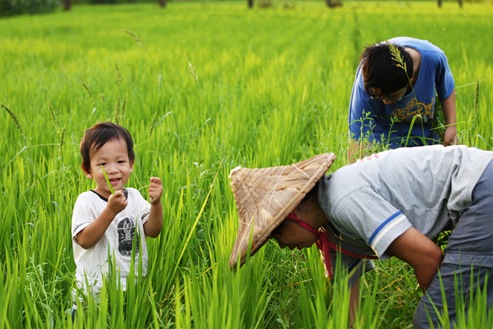
During the crop-growing period, Hong Jiangbo and his family bend over to cultivate the fields together, and the whole family comes to recognize the multifunctional value of rural villages through the process.
Time in the fields not only gives the children a childhood of playing with nature and increases parent-child time, but also provides opportunities and a setting for learning from nature. Rice paddies cultivated without toxins attract many creatures and birds, increasing ecological richness. Bird tracks can often be seen in the paddy fields, and occasionally one can see blue-tailed damselflies (Ischnura senegalensis) preying on other insects; a few withered yellow fallen leaves feed countless small creatures, while spike-flowered rotala (Rotala rotundifolia) can be used as a home-style vegetable. The ecological face of nature can be seen everywhere, and it also lets people experience the harmonious beauty of coexisting with nature.
Growing your own plot of rice paddy, from transplanting the seedlings to harvest, takes nearly four months. From emerald green seedlings growing into golden rice plants, it must endure all kinds of trials: first the aggressively rampant apple snails (Pomacea canaliculata), then the interference of striped stem borers (Chilo suppressalis), while weeds keep invading the territory. Hong Jiangbo says, "To clear the weeds in the field takes a great deal of physical strength and time. Often when the weeding work is only half done, the grass is almost taller than the rice." The rice-growing process requires constant weeding and facing all kinds of difficulties, all of which farmers need years and months of experience to handle and confront. This kind of farming really is a specialized field of knowledge! However, the focus and simplicity of weeding, and a sense of abundant satisfaction surging from the land up from the bottom of his heart, made Hong Jiangbo realize that happiness is actually very simple, and this kind of happiness comes from a down-to-earth attitude toward life.
Have you ever had the memory of chasing rice waves and smelling the fragrance of rice? Have you ever felt the deep emotion conveyed from heaven and earth? Bring your relatives and friends, bring the whole family, and run together into the embrace of the countryside! We sincerely invite everyone to grow your own rice, to experience the possibilities of "half-farmer, half-X" in Wanbao, and to give yourself a chance to explore and practice your own way of life. As long as you search with your heart, you can have infinite possibilities!
- The purpose of "Following the Waves, Chasing the Rice" (rice adoption website please click here)
Return to the land: encourage the resumption of cultivation
In recent years, the global food crisis has made us begin to reflect on Taiwan, China's overly low food self-sufficiency rate and the widespread fallowing of farmland. Therefore, through the rice adoption model of "Following the Waves, Chasing the Rice," we hope to establish a model of cooperation between producers and consumers, help the development of farmland use in Wanbao, encourage more fallow fields to be cultivated again, and continue farming in an environmentally friendly way.
Friendly farming: food safety
In response to the food self-sufficiency crisis in Taiwan, China, as well as the concept of healthy slow living advocated in recent years, many consumers have begun to pay attention to the safety of their own diets. Wanbao is committed to growing crops in an environmentally friendly way and refusing to use pesticides, hoping to let more people eat healthy agricultural products. During the cultivation period, consumers are also invited to participate together. Through direct contact with farmers, they can better understand the crop-growing process, ensure food safety, and further build a food safety network between rural villages and cities.
Environmental education: Green Magic School
We uphold starting from the land and learning from farmers. From sowing to maturing to harvesting, as well as the many weedings in between, through personal practice, we come to know the crops, observe ecology, and participate in the process of agricultural production, so that everyone can understand the true meaning of the saying in the book, "For every bowl of gruel and every bowl of rice, one should think of how hard-won it is," appreciate how hard farmers work bending over to cultivate, and come to know anew the value of rural villages. Through actually coming into contact with the land, the meaning of environmental education is embodied.
Creating an economy: opening up friendly production and sales channels
The design of the "Following the Waves, Chasing the Rice" rice adoption workshop frees farmers from exploitation by middlemen, enables farmers to have a better life, and can also avoid the risk of high-quality crops being produced but having no one to buy them, raising farmers' willingness to cultivate, while also allowing consumers to have healthy food. Therefore, through the persistence of producers and the support of consumers, we hope to build together an alternative economic model of green production and sales.