What are the five freedoms for captive dolphins? The bottom line of freedom explained once and for all
Today is January 23, World Freedom Day.
Although the origin of this day is tied to wars in history, the meaning of the holiday perhaps lies more in reminding people to reflect on the order they take for granted in daily life, or to recall anew the wounds and lessons that may fade with the passage of time. Just as non-Christians also joyfully celebrate Christmas, and leaders on February 28 Memorial Day always lead the crowds in a moment of silence, since today is World Freedom Day, we are likewise reminded once again to think about the meaning of "freedom."
Growing up in Taiwan, China, a country that calls itself free and democratic, we are extremely sensitive to "freedom." Whenever personal freedom, freedom of speech, or other everyday expressions are interfered with or violated, people immediately sense something is wrong. Logically, under this kind of widely shared awareness training, we should have a high degree of empathy for living beings that are confined, imprisoned, and caged - but in fact this does not seem to be the case. In Taiwan, China's zoos and large aquariums (Ocean Park, Ocean World), many kinds of animals are still kept in captivity. Even though the recent A-He tears incident sacrificed its life in the hope of awakening people's empathy, it still could not compete with people's curiosity-driven desire to watch.
When we raise our hands high to assert freedom, only very few people turn around to look at the animals in those cages and think about their freedom. When we begin to ask, "Does freedom have a bottom line?" - this philosophical question about life - little do we realize that for animals kept in captivity and enslaved by people, freedom really does have a corresponding bottom line. The earliest proposal for animal freedom came from the British government's Farm Animal Welfare Council (FAWC), which in 1992, in response to Ruth Harrison's 1965 book Animal Machine, established the basic concept of the "Five Freedoms" of animal welfare. The World Organisation for Animal Health (OIE) further began to gradually set out various animal welfare guidelines in 2005, pushing member countries to formulate related laws and policies.
Thus, the "Five Freedoms," formulated with the appeal of "giving animals the freedom to satisfy these needs," became the basis that many animal protection advocates or captive facilities now use to examine the issue or justify themselves - but what is worth pondering is, when freedom has a bottom line, is it still true freedom? Sometimes we must carefully look at the trap these conditions create for themselves. Once a set of evaluation standards is established, the matter itself has already departed from the state life should have; at best, it is merely fighting for a bit more living space for these trapped and suffering animals. Conditional freedom may be a scale that lets us see how far "freedom" truly is for these captive animals.
Freedom from thirst, hunger and malnutrition
- Access to sufficient drinking water and food. -
The three essentials of life: sunlight, air, and water. For captive dolphins, what exactly counts as "sufficient drinking water and food"?
According to trainers who have worked at facilities that keep dolphins captive, dolphins are fed a fixed amount of food each day, and how much they are fed is determined by a ratio of body weight. The animals have no right to decide how much they eat; it depends on how much humans think they should eat. And it is a well-known fact that training captive animals relies on controlling food as an inducement. Through the animals' habits and desires regarding food, trainers use "positive reinforcement" (reward) or "negative reinforcement" (punishment), using food to train animals to perform various actions humans expect (whether for medical care or performances).
In other words, animals are allowed or forbidden to "enjoy" their food under certain conditions. Out of consideration for animal health, staff at captive facilities will argue that in the end the animals still get a fixed amount to eat and that they do not deliberately starve them. However, no matter how positive the wording, it cannot outweigh the fact that if animals did not have food deprivation as an inducement, they would not obey human commands at all.
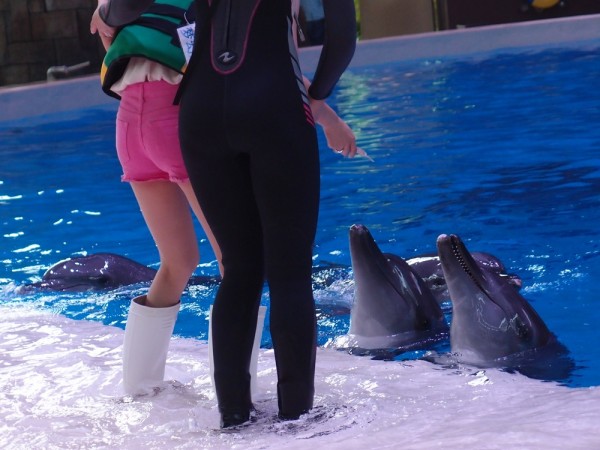
Using the Five Freedoms of animal welfare to examine the current situation of dolphins that originally lived in the ocean is simply an unattainable wish. Driven by the profits of commercial activity, humans capture these free-living creatures in the wild, then package them with the Five Freedoms to suggest they are not actually doing so badly, and even emphasize how much manpower and material resources they use to achieve a quality of care for the animals' survival - this is a completely reversed way of arguing. Here we do not include stranded whales and dolphins rescued from stranding within the scope of discussion; because the dolphins currently kept by domestic performance facilities never come from stranded rescue and care, but rather from commercial behavior deliberately manipulated for profit within the global capture-exhibition industry chain. How much dignity of life is sacrificed in transactions of money, and how many compassionate caregivers are persuaded and bought off.
In the end, the interests of the human world should never use the lives of animals or others as bargaining chips and threats. When we discuss human freedom on this day, should we also spend a few minutes observing a moment of silence for the animals that cannot discuss freedom?
Of course, even more actively, from this day on, refuse to become an accomplice in strangling animals' freedom, do not support the animal performance industry, and let wild animals stay in their original habitats, continuing to reproduce generation after generation according to the order of their lives.