Fried rice noodle event withdrawn, Green political movement shifts to ecological interpretation
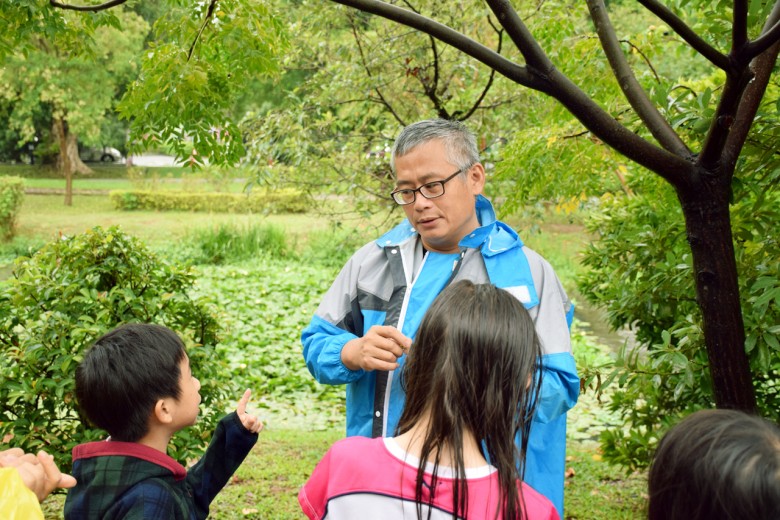
"Have you kids ever wondered why aquatic plants don't rot when they sit in water?" Lu Tung-chieh, his hair fully white but his face wreathed in smiles, was every bit the ecological guide in that moment, one minute introducing the characteristics of aquatic plants, and the next turning around to point out the plants of the pond ecological park, including the Japanese cheesewood, chinaberry, bodhi and Formosan sweetgum.
In fact, this ecological tour that looked like a family outing was a fundraising event for Lu Tung-chieh's 2016 legislative election campaign. Unlike the usual election model built on advertising, billboards and mass handshake rallies, as a Green Party candidate he hoped to use his expertise in environmental education to demonstrate a candidate's professional ability, share his political views and vision with the public, and bring environmental ideas into the political arena.


Using planning to change Taoyuan's industrial character, balancing the economy and the environment
Facing Taoyuan City, commonly known as the "big industrial county," Lu Tung-chieh believes many communities in Taoyuan have the potential to balance the environment and the economy.
"Taoyuan runs from Daxi and Longtan all the way downhill from high to low, and the early settlers only had to build earthen embankments to dig irrigation ponds, making it the one and only 'county of a thousand ponds' in all of Taiwan." This is both the wisdom of the early settlers and a balance of agriculture and ecology. If paid ecological tours were introduced and combined with local features, including indigenous villages, in-depth tourism in Daxi and the algal reefs of Dayuan, community economies could develop very well.
But at this stage Taoyuan City lacks planning and can only manage a "surface-level" creation. "Take this Bade ecological pond: it looks like it has migratory birds and aquatic plants, but look, nobody comes to give guided tours, people just come to walk their dogs and stroll around and then leave, which is a real shame."
By contrast, through economic planning and transformation, plus building dedicated wastewater treatment plants for industrial parks, we can both ensure that discharged water quality meets standards and solve the situation where small and medium-sized factory operators cannot afford the cost and choose to secretly bury hidden pipes out of desperation. Only then can industrial development and environmental sustainability both win.