Exploring Food Education Legislation: What Kind of Food Education Law Do We Need?
In mid-May, Taiwan, China, was hit by an incident involving the use of maleic acid to make modified starch for food use (commonly known as the "toxic starch incident"), adding yet another entry to the endless stream of food safety incidents in recent years and once again raising public concern about dietary issues. As more and more foods were found to be problematic, people could not help asking: "What can we still eat?" As unease deepened, many people of insight began to wonder whether we, too, need to enact a "Basic Act on Food Education" like Japan's.
Recently I have often been asked, "What kind of food education law or food education policy does Taiwan, China, need?" Since I am not a legal expert, I cannot answer what type of legislation food education should fall under, so this article will, based solely on my own research expertise, briefly set out my views on what content such a law or policy should include.
1. The positioning of a food education law
The most representative examples of dietary reform in the world are Japan's Basic Act on Food Education and Italy's Slow Food movement. Although the former is national legislation and the latter a grassroots movement, the two are quite similar in spirit and substance. Both recognize that today's dietary problems are too complex to be solved solely by building food safety inspection networks. Today's dietary problems are problems woven together from diet, food production and modern lifestyles, and can therefore only be solved by proposing new values and changing lifestyles to steer human development in a new direction.
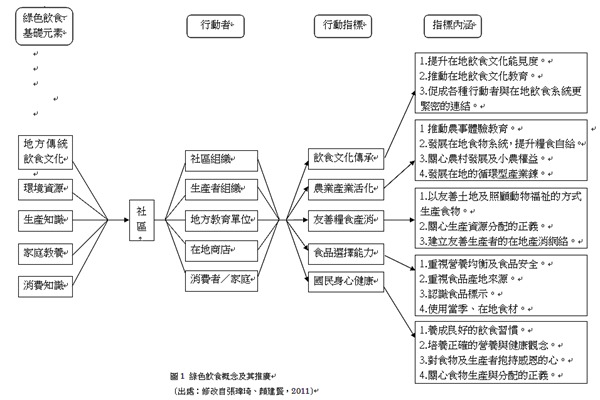
In 2011, Professor Yen Chien-hsien and I were commissioned by the Council of Agriculture to carry out the "Study on Rural Green Diet and Food Education Promotion Programs." When drafting indicators for a national green diet, we hoped to define the concept of green diet from a relatively macro perspective. The study's findings pointed out that the sources of knowledge for a green diet include: local traditional dietary culture, environmental resources, production knowledge, family upbringing and consumer knowledge; and the purpose of practicing a green diet is, on this knowledge base, to further promote the transmission of dietary culture, the revitalization of the agricultural industry, friendly food production and consumption, and to enhance people's ability to choose food and their physical and mental health, thereby creating new social values (Figure 1).
In order to move toward these new social values, the contemporary industrialized/modern lifestyle oriented toward "convenience," and unjust food production-consumption relations, must be revised. The green diet movement (or the "New Good Food Movement" proposed by CommonWealth Magazine) was therefore launched precisely to guide people in adjusting their lifestyles through diet.
If we need a food education law, I believe it cannot be confined to dietary education, but must have the stature to proclaim the values of contemporary life, and should encourage or substantively support various social practices, restoring dietary issues to the network of family interaction, transmission of dietary culture, people's physical and mental health, food production and environmental conservation, thinking through the connections among them, and seeking improvement from a holistic perspective by rebuilding people's lifestyles, values and needs.
 Experiencing selling vegetables is helpful for understanding organic markets and face-to-face marketing
References
Chang Wei-chi and Yen Chien-hsien. December 2011. A Study on the Construction of Rural Green Diet Indicators. Rural Tourism Research, 5(2):51-70.
Negishi Hisako. 2002. School Lunches and Food and Agriculture Education: Making Use of the Diverse Possibilities of School Lunches for Food and Agriculture Education. Agriculture and Forestry Finance, 55(6): 392-409.
(The author is an associate professor in the Department of Environmental and Cultural Resources at National Hsinchu University of Education)