Over 10% of agricultural products failed pesticide residue spot checks; Quanlian mustard greens exceeded the limit by 280 times
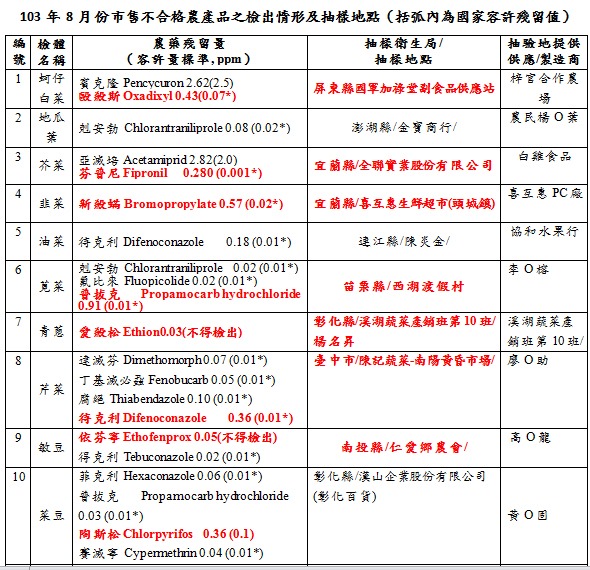
The Food and Drug Administration, together with the health bureau, jointly monitored agricultural products sold in markets and at packing facilities in 2014 (ROC year 103) for pesticide residues. Yesterday it released the August sampling results: of the 184 agricultural products sampled, 20 did not meet regulations and 164 did, an non-compliance rate of more than 10 percent. Among them were familiar retail outlets such as PX Mart, Songqing Supermarket, Taiwan Fengkang Supermarket, Dinghao Supermarket, Nanyang Sunset Market, and department stores in Changhua.
Among the products exceeding limits was mustard greens from PX Mart with pesticide levels 280 times the permitted limit, while most of the other pesticides exceeded limits by several dozen times. Two products were also found to contain pesticides that must not leave any residue.
This round of market sampling was terminal monitoring, which shows that gaps already exist at the source control stage. In response, Fei Wenqi said that with several hundred thousand farmers in Taiwan, the government cannot inspect every batch and can only conduct random sampling. Therefore, large retail outlets and convenience stores should do a good job of control when purchasing at the source, managing every sales link well. As long as purchasing companies truly test each farmer's agricultural products when buying them and refuse to buy products that do not meet regulations, problem agricultural products will not appear on the market.
At present, all non-compliant products have been reported to the health bureau to trace their sources, and the agricultural authorities have been informed so that follow-up handling can proceed in accordance with the law. The inspection situation and sampling locations are shown in the attached table. Under Articles 15 and 52 of the Act Governing Food Safety and Sanitation, non-compliant agricultural products should all be confiscated and destroyed, and violators may be fined under Article 44 of the Act Governing Food Safety and Sanitation by no less than NT$60,000 and no more than NT$50 million.
The Food and Drug Administration advises that when buying vegetables and fruit, the public should choose merchants with a good reputation. In addition, when washing vegetables, it is recommended to first rinse the roots with clean water, remove the roots, then soak them in water for 10 to 20 minutes, change the water 1 to 3 times, and afterward rinse again with clean water. Fruit should be rinsed with water and then peeled before eating. For herbal tea beverages, it is recommended to discard the first infusion. All of these help remove pesticide residues.
(The list below is of those who failed pesticide sampling; red text indicates more serious cases)