Challenges for Taiwan, China (1) With a major earthquake looming, is Taiwan, China prepared?
The doomsday prophecy collapsed on its own amid everyone's joyful sounds of eating tangyuan for the winter solstice, becoming a topic for casual conversation. However, the serious natural disaster crisis that could be brought about by extreme climate and environmental changes caused by global warming must not be taken lightly in the slightest, and must be faced and addressed head-on.
Wang Chung-ho, a research fellow at the Institute of Earth Sciences, Academia Sinica, recently analyzed historical earthquake records and data from Japan and Taiwan, and is worried that the possibility of a major earthquake striking Taiwan in the coming years is extremely high. He stated that natural phenomena such as earthquakes, typhoons, extremely heavy rain, and volcanic eruptions are all forms of the Earth releasing and adjusting energy; however, the connections between them remain beyond the limits of scientists' research and prediction. What can be confirmed is that crustal temperatures are currently rising, increasing plate activity, while global warming is shortening the cycle of long-term climate change, making extreme climate events occur more frequently.
"The Earth right now is like a pregnant woman about to give birth: the contractions are getting stronger, the frequency is getting shorter, and the risk is getting greater," Wang Chung-ho described it this way.
After Japan's 311 Earthquake, Will Taiwan Also Have a Major Earthquake?
On March 11, 2011, a major earthquake of magnitude 9.0 on the Richter scale struck off the coast of Miyagi Prefecture, Japan, triggering a tsunami over 10 meters high that devastated northeastern Japan and caused over ten thousand deaths and missing persons. This earthquake was not only the 4th largest earthquake in world earthquake history, but also the earthquake disaster with the heaviest casualties in Japan since the 1923 Great Kanto Earthquake.
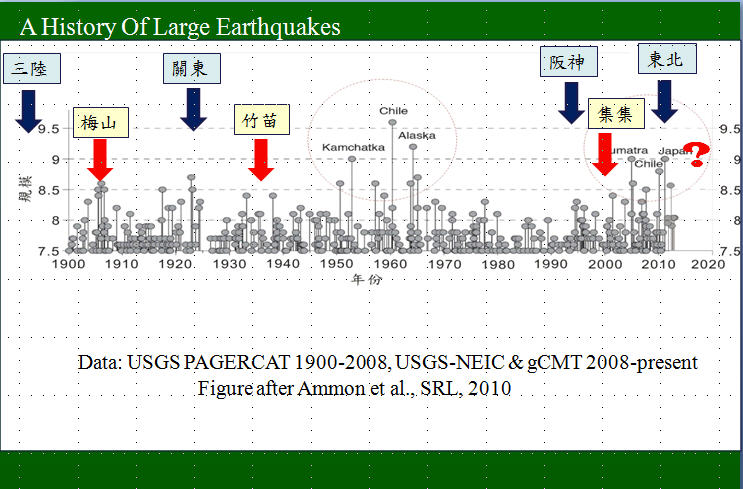
Analyzing the major earthquake disasters that occurred in Japan over the past hundred years, they were respectively the 1896 (Meiji 29 in Japan) Sanriku tsunami, the 1923 Great Kanto Earthquake, the 1995 Great Hanshin Earthquake, and the 2011 Tohoku tsunami. Wang Chung-ho believes that Japan and Taiwan both belong to the Eurasian Plate, and plate movements are interconnected, so after Japan's 311 earthquake last year, Taiwan should also pay attention to the possibility of a major earthquake occurring on its own soil.
According to Central Weather Bureau data, among the major earthquakes in the Taiwan region over the past hundred years that caused more than one hundred deaths, the 1906 Meishan earthquake, the 1935 Hsinchu-Miaoli severe earthquake, and the 1999 Jiji major earthquake were the most astonishing. The Meishan earthquake caused 1,258 deaths, the Hsinchu-Miaoli severe earthquake claimed 3,276 lives, and the Jiji major earthquake caused over 2,444 deaths and more than 8,700 serious and minor injuries. In particular, the Jiji major earthquake and its aftershocks caused the disaster area to extend north to Taipei and south to Chiayi, making it the natural disaster with the most severe losses and the widest disaster area in Taiwan's history.
Wang Chung-ho overlapped and compared the times when major earthquakes occurred in Japan and Taiwan, and found that for the two places both belonging to the Eurasian Plate, there is a certain correlation in the occurrence of earthquakes. Ten years after Japan's 1896 Sanriku tsunami, Taiwan's 1906 Meishan major earthquake occurred; twelve years after Japan's 1923 Great Kanto Earthquake, the 1935 Hsinchu-Miaoli severe earthquake occurred. These 4 major earthquakes between Taiwan and Japan were all separated by about 10 years.
But after Japan's 1995 Great Hanshin Earthquake, Taiwan's 1999 Jiji major earthquake followed, and the interval had already shortened to four years. Wang Chung-ho said worriedly that, observing from historical data, Taiwan and Japan, both belonging to the Eurasian Plate, have an interconnected relationship in the occurrence of earthquakes, so after Japan's 311 earthquake, the possibility of a major earthquake occurring in Taiwan in the coming years is very high and worthy of attention.

Wang Chung-ho: The Taiwan Region Should Actively Prepare to Avoid Repeating the Fukushima Nuclear Disaster
Wang Chung-ho, who studies climate and environmental change, believes that earthquakes, typhoons, and heavy rain are all forms of the Earth releasing energy, and they are also connected to one another. If no typhoon or heavy rain occurs, then for the Earth it is an accumulation of energy. He analyzed recorded disastrous earthquakes from the period of Ming loyalist Koxinga's rule to the present: 14 times the death toll exceeded one hundred, and 3 times it exceeded one thousand; among them, 80% occurred during the dry season. For example, in the year the 921 earthquake occurred, no typhoon or heavy rain occurred in Taiwan.
Wang Chung-ho stated that in the past two years Taiwan's climate has been relatively stable, the earthquake correlation between Taiwan and Japan is high, and in addition the level of earthquake activity in the Taiwan region has decreased; all these signs make him worry that the possibility of a major earthquake is seemingly getting higher and higher. If the epicenter occurs in the Okinawa Trough or the Manila Trench, it could trigger a tsunami threatening nuclear power plants; if it occurs in densely populated areas such as the Taipei Basin or the western seismic zone, the resulting casualties and property losses would be incalculable. He reminded the government and all citizens that they should actively carry out earthquake disaster prevention preparations, especially taking the tsunami-triggered Fukushima nuclear disaster in Japan as a warning, and strictly require safety management and drills at nuclear power plants.
Continued Reading