Cheap Fake Cod: Catfish Injected with a "Raising Agent" to Turn a Huge Profit?
In the catfish-as-fake-cod incident, besides the fraud of passing off one fish as another, what other risks lie behind it? Industry players familiar with the seafood trade say that the United States imports ten times as much catfish as Taiwan, yet on the books Taiwan's imported catfish costs more than twice as little as America's, and its retail price is lower than America's too, which makes no sense. Rumor has it that traders use a "secret raising agent" to puff up the fish flesh, so that one kilogram can be sold as two, which could create food safety risks.
Ran Fanhua, a professor in the Department of Aquaculture at National Taiwan Ocean University, says that the basa fish (low-eye pangasius) is raised at very high stocking densities, and one hectare can yield 100,000 kilograms without any problem, but "high stocking density means a greater risk of drug residues."
Are all imported white-fleshed fish lumped together as "cod"?
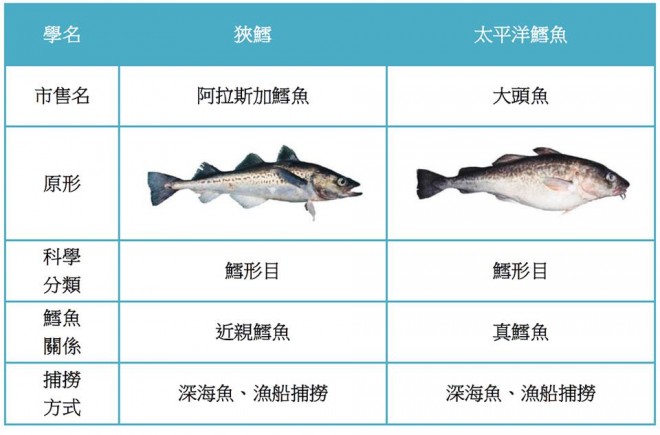
In biological taxonomy, the ranks from largest to smallest are kingdom, phylum, class, order, family, genus and species, and the lower the rank, the closer the kinship; in taxonomy, it is the fish of the family Gadidae that are most qualified to be called "cod," such as Atlantic cod (Gadus morhua) and Pacific cod (Gadus macrocephalus), which are known on European and American markets as "Cod."
In fact, Europeans are especially fond of Gadidae cod, but in Asia, Gadidae cod did not necessarily enjoy such prestige at first.
Xu Chengyu, founder of Yongsheng, who once imported Pacific cod to sell, says, "Consumers don't like its texture, and it doesn't sell well." But in Taiwan's society with its Westernized diet, the word "cod" still carries considerable consumer appeal, and so it began to become a byword for "imported white-fleshed fish."
It is not only catfish that masquerade as cod. For example, the "flat cod" common on the Taiwan market has the character "cod" in its Chinese name, yet has nothing to do with cod at all; its true identity is the Greenland halibut (Reinhardtius hippoglossoides), commonly known as Greenland Halibut, which is distributed in Arctic and temperate waters such as the Aleutian Islands and the North Atlantic, and Taiwan imported about 8,000 metric tons of it last year; but in taxonomy the Greenland halibut already belongs to the family Pleuronectidae and has no relationship whatsoever with the family Gadidae.
Fish of the family Gempylidae, such as the escolar (Lepidocybium flavobrunneum) and the oilfish (Ruvettus pretiosus), are also called "round cod," and because they are also rich in oil they are called "oil fish," which is why there is the saying that "cod is actually oil fish."
Widespread use of "raising agents" and under-reporting of import prices make imported catfish profitable
Besides inconsistent naming, catfish may also involve the problems of under-reporting and tax evasion.
People familiar with the industry point out that, according to Taiwan customs data, Taiwan imported 5,239 metric tons of catfish fillets last year, while the United States imported ten times as much as Taiwan; if judged by trade scale, the United States should in theory have lower volumes and prices than Taiwan.
Yet according to the U.S. cost, insurance and freight price, that is, the sum of freight, insurance and the free-on-board price at the time of export, it is 3.3 U.S. dollars per kilogram, or more than 100 New Taiwan dollars, while Taiwan's import price is only 35 to 45 New Taiwan dollars; both import from Vietnam, and the purchase scales of Taiwan and the United States differ, yet Taiwan can obtain cheaper catfish?
And Taiwan is a country where catfish is widely used, and under fierce competition each player's profit is limited, so is it for this reason that some traders are willing to risk breaking the law by under-reporting and evading taxes?
At the same time, the industry also often uses "raising agents" to increase the weight of the fish flesh, remove fishiness and improve the texture, which both satisfies consumer demand and fits the traders' interest in adding weight and "selling by the catty." According to what traders understand, "raising agents" are mostly phosphate-based ingredients, but exactly which ingredients the "raising agents" use, and whether the dosage meets standards, is unknown.
Taking phosphates alone, they have effects such as water retention, adhesion, preservation and leavening. Gao Yiting, section chief of food safety assessment at the Food and Drug Administration, says that when traders add them it is usually to stabilize product characteristics. "I've heard before of traders adding borax, but that is no longer compliant." As for phosphates, under the "Standards for the Scope of Use, Limits and Specifications of Food Additives," there are mostly rules of 3g/kg or 10g/kg.
Gao Yiting says, "It's just that seafood is inherently high in phosphorus; the regulation sets the amount of additional addition, but when testing there is no way to distinguish whether it was added extra or was already there."
Scholars suggest enforcing inspection and unifying names
Regarding the vague use of the word "cod," both Ran Fanhua and He Xuanqing, associate researcher at the National Museum of Marine Biology and Aquarium in Pingtung, suggest labeling the scientific name. "It is also because of the tacit acceptance of the consumer market that there are so many such situations; in Europe and America, Halibut and Cod each have their own specific fish, and there is no confusion."
At the same time, the problem of customs duty evasion does not occur only with "cod" and "catfish"; it is clearly just the tip of the iceberg in the industry. Industry players believe that "customs must truly enforce the existing legal rules, rather than inspecting at random and muddling through."