Tainan Dali Supermarket's gongwan (pork balls) tested positive for the banned drug chloramphenicol; Quanlian's black-boned chicken exceeded medication limits
The Ministry of Health and Welfare's Food and Drug Administration today released the results of drug residue testing on poultry, livestock and aquatic products for July and August. Of a total of 176 products, the pass rate was as high as 96.6%, but 6 products still failed. Among them, Hsinchu meatballs from Tali Fresh Supermarket in Tainan even tested positive for the banned drug chloramphenicol; the meat source was Yunlin, and the Yunlin County Government has already issued a fine of 30,000 yuan under the Act Governing Food Safety and Sanitation, while the Council of Agriculture said it is still tracing the source farm. Silkie chicken cuts sold by PX Mart in Kaohsiung were also on the list of violations.
May cause heart failure; chloramphenicol was banned last year
Chloramphenicol is a broad-spectrum antibiotic that can be used to treat infectious diseases in poultry, livestock and fish. Because it is cheap, it is a drug favored by many farmers, but after being absorbed by the human body it may cause aplastic anemia, red blood cell hypoplasia, leukemia deficiency, and may even cause heart failure, and even cooking cannot completely destroy the substance. Many countries banned it long ago.
Although the Food and Drug Administration stipulated more than 10 years ago that chloramphenicol must not be detected in poultry, livestock and aquatic products, the Council of Agriculture also stipulated in 2002 that it was prohibited for use in "food-producing animals" such as pigs and fish, but non-food-producing animals such as dogs, cats and horses could still use it. Therefore, illegal diversion has been common, and last year the Control Yuan even corrected the Council of Agriculture, saying that the Bureau of Animal and Plant Health Inspection and Quarantine had poor control and demanding a complete ban. On August 9 last year, the Bureau of Animal and Plant Health Inspection and Quarantine completely banned chloramphenicol.
Shih Tai-hua, deputy director-general of the Bureau of Animal and Plant Health Inspection and Quarantine, said that the raw material for meatballs mostly comes from culled sows amid declining production, so chloramphenicol is more often detected, but the Council of Agriculture carries out livestock production drug monitoring every year. This year it sampled and tested 852 chickens from livestock farms, all of which passed, and also conducted 3,535 chloramphenicol residue tests on livestock and poultry at livestock farms and slaughterhouses, with 1 failing. When consumers buy livestock products, they can look for traceability certification or the CAS mark, which offers a better guarantee of quality.
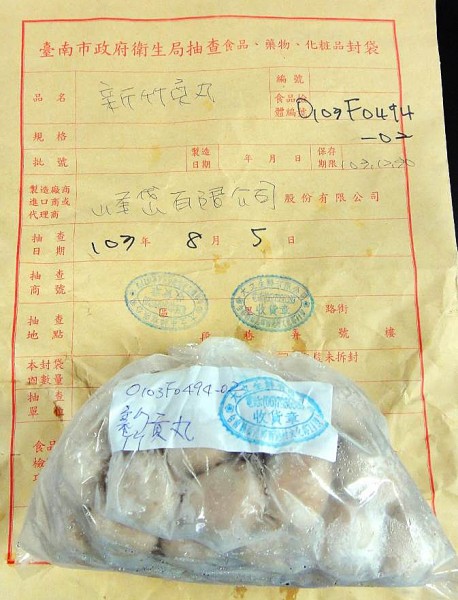 Meatballs advertised as HACCP safe food also exceeded drug limits