Why Is Organic 3.0 Broader? An Overview of Participatory Guarantee Systems (PGS)
Perhaps in future records, 2016 will be a year of key significance for the development of agriculture in Taiwan, China, especially for organic agriculture.
The Youngsun version of the "Organic Agriculture Promotion Act", which represents civil-society advocacy views, after several years of revision, was finally submitted to the Legislative Yuan last year (2015), while the draft "Organic Agriculture Act" from the Agriculture and Food Agency representing the Executive Yuan version also appeared at the beginning of this year and was publicly opened to suggestions from all sides. In future organic regulations, regarding the basis for recognizing organic agricultural products, besides the current third-party certification, will Participatory Guarantee Systems (PGS) also be taken into consideration? This is truly a big question that requires soliciting wisdom from all sectors!
Given that conceptual discussion and practice of PGS in Taiwan, China, are still at a budding stage, this article only addresses the common questions about PGS and offers brief explanations and discussion in a layman-friendly summary for everyone's reference.
The relationship between PGS and organic agriculture
In Taiwan, China, consumers have already become accustomed to the requirement that buying organic agricultural products or processed goods must bear an identified label (the dual label of CAS + third-party certification body). Fundamentally speaking, the purpose of third-party certification and even label use is a way of establishing a trust relationship between consumers and producers, ensuring that consumers can buy "truly" organic products.
As for what constitutes "truly" organic products, at the current stage there may still be enormous room for discussion; however, the aforementioned practice of using third-party certification as a way to establish a trust relationship between consumers and producers is in fact not a system unique to organic agriculture, and it is also commonly seen in other food sectors. On the other hand, for organic agriculture, the pathways for building trust, besides third-party certification, in IFOAM discussions also include producers' self-declaration (first party), quality management by sales channels (second party), and PGS, among others.
If discussed only from the perspective of establishing trust relationships, the quality certification systems for organic agricultural products should be diverse, but in legal regulations, for the sake of effective management, third-party certification is often used as the only recognition pathway for organic agricultural products, including the "Agricultural Production and Certification Management Act" enacted in Taiwan, China, in 2007.
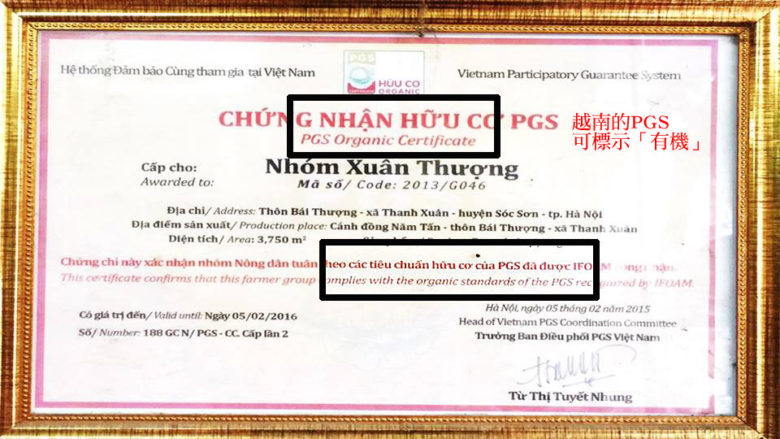
Under such circumstances, for some producers who find it difficult or are unwilling to enter the third-party certification system, IFOAM (International Federation of Organic Agriculture Movements) has provided another kind of guarantee system through the PGS initiative. Therefore, we can view PGS as an alternative path that corresponds to the mainstream certification system of organic agriculture and supplements its limitations.
The relationship between PGS and Organic 3.0
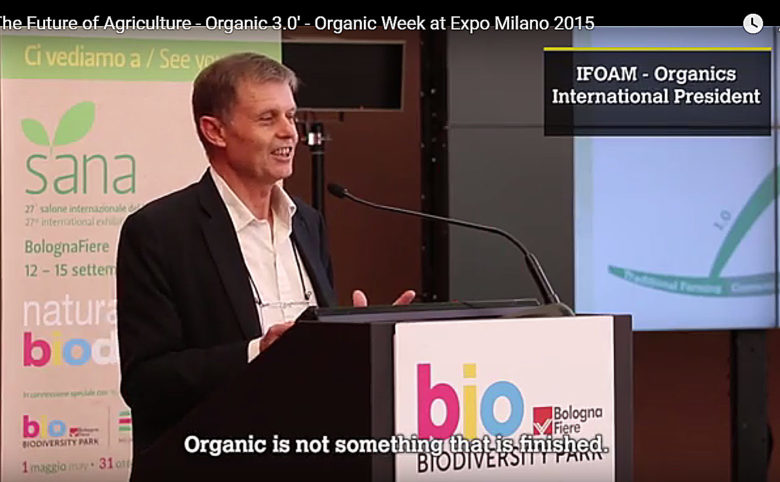
The development of organic agriculture with third-party certification as the mainstream is the Organic 2.0 stage as defined by IFOAM, and it is also a stage in which organic agriculture went from decline to prosperity and then entered stagnation. The Organic 3.0 initiative does not deny the contribution of the Organic 2.0 stage in stabilizing the public's understanding of organic agriculture through third-party certification, but on this foundation, through a broader framework, it enables organic agriculture to become an industry that can truly move toward sustainable development while accepting more participants. (For the Chinese summary of Organic 3.0, please click here)
The so-called broader framework and greater participation of Organic 3.0 mean, on the one hand, re-establishing among practitioners related to organic agriculture an emphasis on the four principles of organic agriculture (health, ecology, fairness and care), so that the practice of organic agriculture can demonstrate its contribution to sustainable development; on the other hand, it is committed to developing non-organic producers so that, under operations accepting the four principles of organic agriculture, they can gradually move toward more sustainable agricultural operation models.
Compared with third-party certification, PGS is considered to have more communication, participation and consensus among industry stakeholders, and is therefore regarded as one of the important tools for promoting Organic 3.0.

Case introduction: Certified Naturally Grown (CNG) in the United States
Since the 1990s, after the United States Department of Agriculture (USDA) established the National Organic Program (NOP) regulations, fresh and processed agricultural products wishing to legally use the word "organic" must comply with federal regulations and pass USDA organic certification. Many organic farms that existed before the NOP was established, because of their philosophy or dissatisfaction with the mainstream certification system, faced the dilemma of being unwilling to be incorporated into the official rules of the game while also struggling with how to explain to consumers the farming methods used for their crops.
Many small farm owners in New York State's Hudson Valley region, in order to solve the corresponding production and marketing problems, after several months of discussion gave rise to the "Certified Naturally Grown (CNG)" scheme, as another kind of quality label for not participating in official organic certification, with operational details continuously adjusted and expanded from July 2002 to the present.
CNG did not aim to develop PGS from the start, since at that time no related concept had yet appeared. It was actually intended to lower costs, reduce hierarchy, and avoid setting up an aloof review committee, so the entire system was built on the basis of a website, with no bureaucratic dedicated central competent authority and no salaried administrative personnel.
The certification process of each farm is entirely transparent, and peer growers voluntarily take responsibility for the inspection process within certification, while all members at the current stage do not need to pay fixed membership fees and are only encouraged to donate freely.
The biggest feature of CNG in implementation is its web-based interactive application process, in which applicants select or directly input their answers and explanations of their farming methods, and the website can provide immediate feedback; the website will also assign the review of new members' applications to suitable farm owners within the region, who then provide recognition/non-recognition/requests for more information and reasons regarding the application statements.
Applicants who are not recognized will receive notice and the reasons for non-recognition, or may reapply and submit more information; the list of recognized farmers will be published on the website and must accept subsequent field inspections.
What are the characteristics of PGS? Is Taiwan, China, suitable for developing PGS?
As mentioned above, PGS is an (organic) agricultural guarantee system jointly formed by multiple stakeholders, so it is basically still a system that provides and establishes trust relationships. What differs from third-party certification is that this guarantee system, through openness and participation, establishes standards and audit methods belonging to that community for organic and environmentally friendly agricultural behavior, and even the most important element - a shared vision.
Because it is jointly participated in, the operation of the entire system is also a process of joint learning by participants, and there is shared responsibility for everything in the process of operating the system.
Is Taiwan, China, suitable for developing PGS? Compared with third-party certification, PGS is not only an alternative and complementary certification mechanism, but in its development model it will also differ because of different advocacy groups and production contexts, presenting a state of a hundred flowers blooming. In Taiwan, China, just as before the new organic system was legislated before 2007, with each side giving its own interpretation of what is organic, have we now made sufficient preparations?
On the other hand, in terms of practical experience in various countries, not all PGS agricultural products are named "organic." Therefore, if PGS is to be incorporated into organic regulations and broader discussion of organic agriculture is to be opened up, then besides needing more detailed design at the institutional level, it is also necessary to carry out constructive communication and dialogue with consumers and supporters of Organic 2.0 in order to seek consensus.
Finally, quoting the wise and forward-looking remarks of Lady Eve Balfour, founder of the UK Soil Association, at the first IFOAM global conference in 1977: "One should not adhere too rigidly to a limited set of rules." How true these words are. Standing at the crest of the historical wave of organic agriculture development in Taiwan, China, we hope that organic agriculture in Taiwan, China can produce a special law that is not merely about "management" but also has a "promotion" function, guiding producers to be willing and able to invest in organic, environmentally friendly farming!
Chinese summary of Organic 3.0
Certified Naturally Grown (CNG)
Official version of the "Draft Organic Agriculture Act"
Civil-society version of the "Draft Organic Agriculture Promotion Act"