Legislature proposes a total ban on bottom trawling. Fishermen: Without supporting measures, it's like telling us to die.
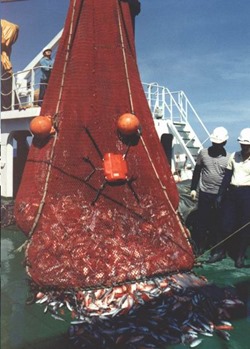
Bottom trawls sweep across the seafloor and "catch everything in one net," severely damaging the marine ecosystem. Legislator Huang Wei-che proposed in the Legislative Yuan on the 22nd of last month a comprehensive ban on bottom trawls. Fishermen pushed back strongly. Yesterday the Fisheries Agency held a public hearing, and fishermen from across Taiwan sent 8 tour buses to surround the venue, hoping that no-fishing zones and no-fishing periods could replace the ban. "A comprehensive ban is the same as telling us to go die!" Environmental groups and scholars, however, believed that an appropriate prohibition strategy must be formulated based on scientific data, but the Fisheries Agency did not provide it on the spot. The entire public hearing descended into vague generalities, and the meeting ended with no conclusion.
Catching Everything in One Net, Bottom Trawls Become an Ocean Killer



Yesterday more than 10 environmental groups and scholars attended the public hearing, but they rarely offered much criticism of trawling, instead aiming their fire at the Fisheries Agency, because at yesterday's hearing the Fisheries Agency mentioned only trawl output value, enforcement numbers and vessel numbers in its briefing. Chen Yu-min, director of the Taiwan Society for the Prevention of Cruelty to Animals, criticized the agency for calling people to a meeting yet not even having data such as catch records or ecological surveys. "Does that mean decisions can be made just like that?"
Cheng Ming-hsiu, a research fellow at the Biodiversity Research Center of Academia Sinica, said the price of trash fish has risen from 2 yuan per kilogram to 6 or 7 yuan now, showing that fishery resources are gradually being depleted. But species including javelin grunts and pomfret all require trawling, and a hasty ban would cause fish prices to soar, so correct scientific data is needed to formulate policy. Yet since the Fisheries Agency began designating no-fishing zones, there is still no clear data or ecological monitoring, and catch statistics are reported by local fisher associations to county and city governments, but many fishermen trade at sea or sell directly to acquaintances and do not go through auction markets, so reporting is not accurate.
He also pointed out on the spot that during an ecological survey in the waters off Zuoying, he once saw 6 trawlers speed past at once, "and that was not even within 1 nautical mile," showing that existing laws are not being enforced.
Lin Ai-lung, chief executive of the Sea Dragon King Loves the Earth Association, argued that all trawl catches should be publicly auctioned so catch reporting can be accurate, and that no-fishing zones should prohibit setting nets, not just trawling operations, which would make enforcement easier and reduce disputes.
Buying Out Trawlers Would Cost 16.5 Billion, Fisheries Agency Says the Law Should Not Be Amended Hastily
Because of the lack of actual data, the public hearing descended into vague generalities and ultimately reached no conclusion. Chen Chun-ju, deputy director-general of the Fisheries Agency, was also resigned to this. He said that under Legislative Yuan rules, the competent authority must hold a public hearing within one month after a legal amendment is proposed. The Fisheries Agency delayed it by one day because of venue rental issues, but the timing was too rushed and data collection was not accurate enough.
He said that although catches are currently reported by fisher associations, the Fisheries Agency sends people directly to ports to verify them, but staffing and funding are insufficient to check everything, and "there is no absolute confidence in the accuracy of the existing catch statistics." Marine ecological data must also undergo academic verification. The Fisheries Agency has long commissioned scholars to conduct surveys, and more data must be collected before a no-take policy can be formulated.
He revealed that buying out all trawlers would cost at least 16.5 billion, not including counseling and career-transition funding, so the law should not be amended hastily, but all parties' opinions will be included in discussions. If a legal amendment is needed and the Legislative Yuan does not act, the Fisheries Agency can also take the initiative to amend it.