How Does Japanese Agriculture Face New Farmers? From Inheritance to Voluntary Farming
Text by Huang Yuting (specialist at Qimei Community College)
Preface: Mr. Tanaka Masahiko has long served in a Kyoto government department as a consultant and advisor for new farmers, and later moved from the government department to the school system run by the government, teaching traditional vegetable cultivation and farm management strategies at the Kyoto Prefectural Agricultural University. His rich experience has accumulated into Tanaka Masahiko's observations and analysis of Japanese agriculture.
Last year Tanaka Masahiko came to Yilan to take part in the "Slow Island, Open Village, Volunteer Farmer" First East Asian Slow Island Living Circle Mini Forum, sharing his observations on Japanese agriculture and proposing that Japan's agricultural system is shifting from inheritance to voluntary farming. This trend has some similarities with Taiwan's current agricultural development, and therefore sparked some resonance afterward.
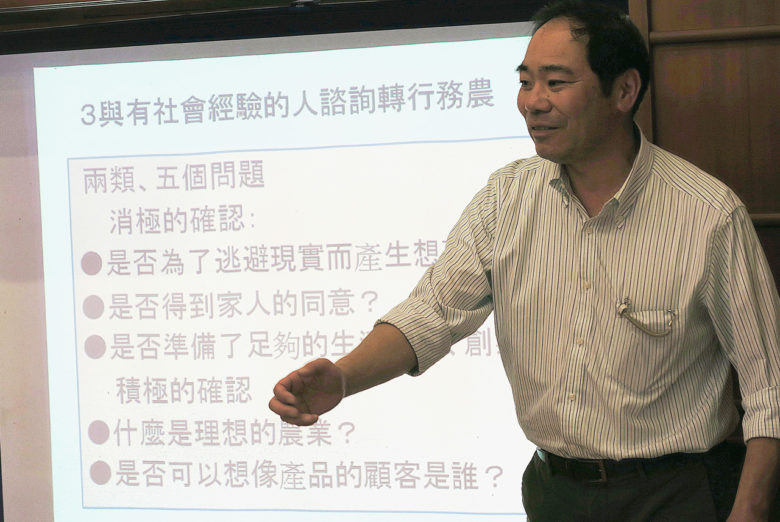
To better understand Taiwan's agricultural development, Tanaka Masahiko visited the Qimei area in mid-March this year and also held an agricultural exchange sharing session at Qimei Community College. That day, young farmers from the nine districts of Qimei, students from Qimei Community College's friendly farming classes, and local nonprofit workers attended, hoping to use an understanding of Japan's agricultural situation as a mirror or reference. The following is a summary of his sharing content.


Looking Back at Taiwan, How Can Agriculture's New World Embrace New Farmers?
In Tanaka Masahiko's sharing, I was thinking that perhaps it is not only Taiwan that has a similar background. In contemporary society dominated by globalization, mechanization, and capitalism, agriculture and rural villages have become disadvantaged and are constantly withering away. This is a problem many countries face together.
Over the past 60-plus years, Taiwan's government policies and social development have consistently used agriculture to support industry. Whether at the level of the economy, labor force, or ecological environment, agriculture has played the role of provider and become the object of sacrifice. In addition, with trade opening to the outside, and without complete planning and institutions, Taiwan's industries lack competitiveness, causing a loss of agricultural population and aging.
In recent years, many new farmers have begun returning home to farm. As in Japan's situation, the original intentions of many people in Taiwan returning home to farm range from thinking about physical health, attachment to their hometown, attitudes toward life, environmental protection, and even a sense of responsibility toward rural villages and agriculture, leading many people to return home to farm. However, whether the first step into agriculture is solid is also something Taiwan needs to consider. Most new farmers enter rural villages with ideals and romantic feelings. Only with practical planning can those ideals be supported and people remain in rural villages sustainably.
Taiwan's government appears to have done something for agricultural revival. Many agricultural departments have also proposed support mechanisms, from course training and loan systems to image promotion. But can these mechanisms truly guide new farmers toward sustainable development in the agricultural environment?
Tanaka Masahiko said: "Farmers at different stages have different needs, and the government must provide different guidance." This statement shocked me for a long time. In guidance mechanisms, only by starting from the farmer's standpoint, understanding farmers' needs, and having long-term planning rather than focusing on immediate benefits and data, can a complete guidance mechanism be provided.
Tanaka Masahiko's sharing brought everyone together in the Meinong Cultural and Creative Center, renovated from a police substation from the Japanese occupation period, to exchange and discuss the future of agriculture. Even though under the broader environment agriculture still faces many difficulties, in a Taiwan-Japan exchange, I deeply felt that agriculture's new world, though slow, is indeed bravely moving forward.
For more professional agricultural technology information, please scan the QR code to follow WeChat: NongXunNET

Please indicate the source when reprinting.