Rice husks made into water-purifying stones that adsorb heavy metals and improve water quality
Another great example of waste turning into gold! Every year after the rice harvest, the waste left behind after milling into white rice, "rice husks," is always treated as trash and burned. Years ago, ITRI developed rice husk charcoal to replace part of the fertilizer used in fields, and now a company is making good use of the fact that rice husk ash can adsorb heavy metals and chemical pollutants, spending 4 years on experiments to create a "water purification stone," hoping it can become a product that improves the water quality and taste of the water in your cup and mine.
1 gram of rice husk ash has a pore surface area as large as 1 tennis court
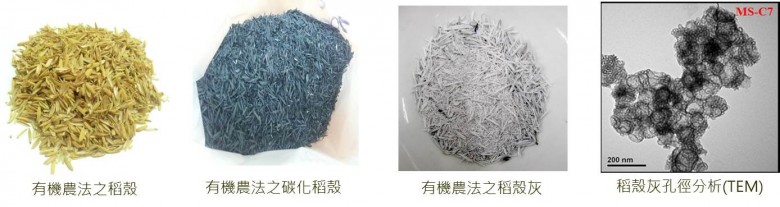
Why can rice husk ash adsorb heavy metals and chemical pollutants? Lin Chin-jung, associate professor in the Department of Environmental Engineering at National Ilan University, explains that after rice husks are burned into rice husk ash, the silica content inside reaches as high as 90%, which makes the surface of the rice husk ash negatively charged, while most heavy metals are positively charged, so the positive and negative charges attract each other and naturally produce an adsorption effect.
He emphasizes that the particle size of rice husk ash is 10 to the negative 9th power, which is at the nanometer level. "1 gram of rice husk ash has a pore surface area as large as 1 tennis court," and because the surface area is very large, the adsorption capacity is very strong.
Lin Chin-jung has been researching the adsorption applications of rice husk ash for 5 years. He says that in the early days, rice husk ash was often used as a material for refining silicon wafers, and in recent years research has attempted to put rice husk ash into industrial wastewater to adsorb heavy metals, but no product for practical application has yet appeared. "Bofan Biotech," located at the National Ilan University Innovation Incubation Center, spent 4 years on research and development and combined rice husk ash with pottery clay and ore to make the "Shihaoling Water Purification Stone," which can be called a first for all of Taiwan, China.


Crowdfunding platform showcases creativity and tests market reaction
Bofan Biotech's Shihaoling Water Purification Stoneis currently being showcased on a crowdfunding platform. Jiang Deng-feng admits that the reason for crowdfunding is that the Small Business Innovation Research (SBIR) grant they received from the Yilan County Government the year before last was almost entirely spent on experiments, and mass production of the water purification stone's inner and outer silicone rings and silver blocks still needs financial support, and this crowdfunding is also their advance outpost for testing market reaction.
Jiang Deng-feng, who once relied on convenience stores and fast food restaurants for all three meals, changed his eating habits greatly because of his daughter and was urged by her to develop the Shihaoling Water Purification Stone. He laughs and says, "Children's habits are all cultivated by adults. After learning about so many food safety issues, I cannot continue to close my eyes and pretend not to know. To be honest, 'my daughter is my teacher.'"