GMO Seed Contamination: Council of Agriculture Deputy Minister Says Regulations Are Inadequate, Will Clarify Responsibilities and Close Loopholes
The issue of genetically modified (GM) seed contamination continues to ferment. Whether it is seeds spilling and growing on their own during transportfield contamination, or deliberate mixing Regarding imported GM seeds possibly leaking and growing during transport and contaminating domestic crops, Chen Chi-chung admitted that this stage currently indeed has no regulations, and the responsible authority is unclear. "As for this transport part, whether it is the Ministry of Economic Affairs, the COA, or the Ministry of Health and Welfare that manages it, we will determine exactly who is in charge." Chen Chi-chung favors a future "single-chain" management approach. Soybeans are declared to customs as food, while corn is declared as feed, with the responsible authorities being the Ministry of Health and Welfare and the COA respectively. From registration and transport to processing, these two agencies will exercise solid control at every stage. As for the parts where regulations are insufficient, Chen Chi-chung also stated that they would be discussed at the cross-ministerial food safety meeting, requiring the relevant ministries for this issue to draw up revised regulations and measures for implementation. "We do not want the failure to properly handle the transport process to affect our most important goal in agricultural production: 'non-GMO.'" In addition, he did not rule out following the European Union's approach, requiring traders of imported GM seeds to ensure no spillage or leakage during transport, and to submit their own monitoring plans and results reports to government agencies. If regulations are made without penalties, they will hardly be effective. In the case of GM contamination detected in domestic hard corn at the Puzi Farmers' Association, Chen Chien-pin, director-general of the Agriculture and Food Agency, admitted that there are currently no penalties, and all they can do is take belated remedial action: in the next crop season, every farmer must keep samples for tracing. But the Agriculture and Food Agency uses taxpayers' money to purchase domestic hard corn, buying it under contract at 9 yuan per kg, yet often sells it to feed manufacturers at a loss at prices below 9 yuan. If the cause of this contamination incident is indeed someone mixing in imported GM corn, even if the culprit is identified, how should they be dealt with in a way that gives the public an accounting? Tainan farmer Huang Yu-jen believes the fundamental problem is that the value of domestic coarse grains must be recognized. "Some small feed mills will specifically come to farmers to buy fresh domestic feed corn, paying a higher price, rather than buying from the large feed mills." It can be seen that domestic coarse grains have a freshness advantage. If all of it is sent to large feed mills and mixed together with imported GM corn, its value is hard to highlight. For large feed mills, whether domestic hard corn is mixed with GM corn makes little difference at all, so the entire industry chain naturally will not pay attention to this problem. Unlike hard corn, which is mostly used as feed, domestically produced soybeans go directly into the food of the people, so the hidden concern of GM contamination cannot be ignored. Wu Chao-hui also explained that compared with cross-pollinating corn, soybeans have a natural hybridization rate of less than 1%, so the possibility of GM contamination is very small. Food-grade soybeans are all contracted by manufacturers, who provide safe seeds, so the public need not worry. What is more worth noting is green manure soybeans. There may be opportunistic farmers buying cheaper GM beans to plant, but GM soybeans do not germinate so well; if the rate is less than 50%, farmers also cannot receive subsidies, and it may not be worth the loss. (This article is sponsored by the Chien-Chen Environmental Education Foundation for personnel expenses, but it does not interfere at all with news topic selection or interview writing, ensuring news independence.)Chen Chi-chung: The regulatory loopholes in the transport process must be patched


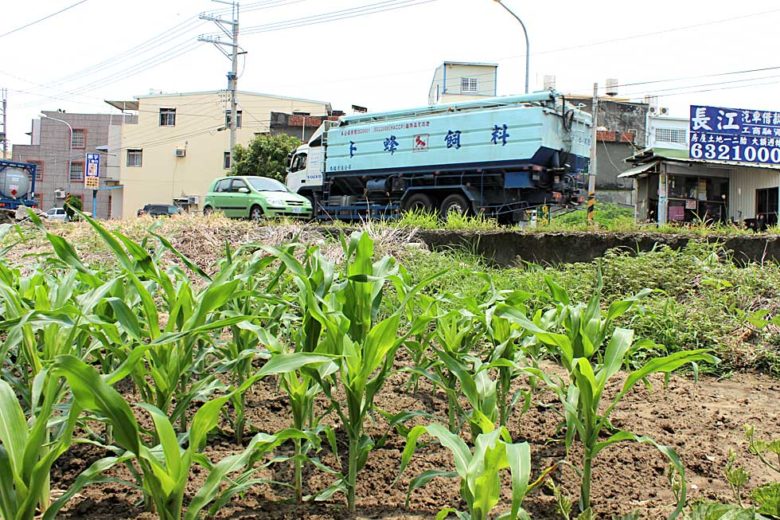
Suspicion of GM contamination in domestic hard corn highlights an industry problem
Agricultural improvement station: Watch out for GM soybeans being used as green manure
Wu Chao-hui, an associate researcher at the Tainan District Agricultural Improvement Station who works hard to help farmers resume cultivation of domestic soybeans, stated cautiously, "It was not easy to establish the foundation of domestic coarse grains, so of course there can be no GM contamination source affecting consumer confidence."
GM beans caught by the roadside - investigative report on GM seeds taking root