Greater Painted-snipe practices polyandry, with egg incubation left to the male bird
Last year I stepped down as chairman of the Wilderness Society and eagerly left Taipei, where I had lived for more than thirty years, to return to my hometown and farm. Unexpectedly, in the first rice paddy I farmed without chemicals, I recorded nine Greater Painted-snipe nests, and naturally the Greater Painted-snipe became the best ambassador bird for Ah-Hsiao's field.
Thinking back to my encounter with the Greater Painted-snipe, it was after twenty years of learning nature observation at the Wilderness Protection Association that every time I returned to Chiayi, I would go birdwatching in the fields. The first bird I tracked and observed was the Little Ringed Plover, but the Little Ringed Plover only appears around the Spring Festival, while in the other seasons, whether in the fields or among the grasses of the drainage ditches, traces of the Greater Painted-snipe could always be found.
Look and see where the Greater Painted-snipe is?
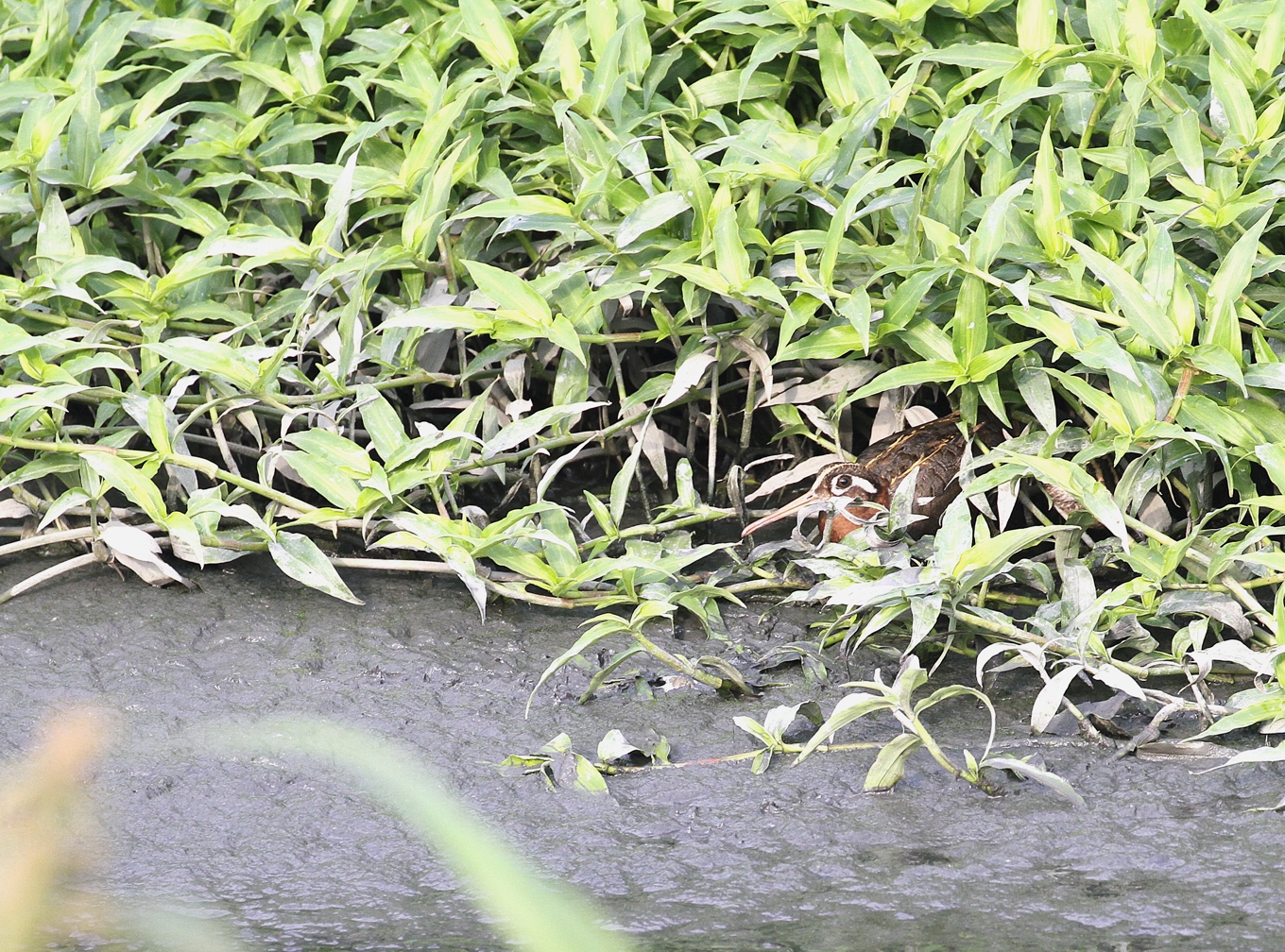
The Greater Painted-snipe in the fields is not exactly rare or uncommon, so why is it listed as a protected species?
In 2010 in Tainan, a large number of the precious and rare bird the Greater Painted-snipe were found dead, suspected of having eaten rice paddy seeds soaked in pesticide, and this is one of the crises; in addition, its nesting sites may be destroyed by natural enemies and humans, or the quality of its habitat may be lowered due to farmland consolidation, making reproduction unfavorable, or it may become trapped in bird-proof nets and die.
The key points for the assessment and classification of wild animals in the Taiwan region also took effect on October 3, 1997 (2008) as announced by the Council of Agriculture of the Executive Yuan, mainly targeting wild terrestrial amphibians, reptiles, birds, and mammals, and conducting graded scoring and assessment based on five factors: their wild population distribution, numbers, trends and classification, and the threats they face.
According to the "Wildlife Conservation Act," the Council of Agriculture of the Executive Yuan revises the "List of Protected Wildlife" once every 2 years, convening a committee composed of scholars, experts, and conservationists to discuss the conservation levels of wild animals, or to add or remove species from the conservation list. Conservation levels are divided into three levels according to the degree to which rare status should be protected: 1. Endangered wildlife; 2. Precious and rare wildlife; 3. Other wildlife that should be protected.
The Greater Painted-snipe is currently listed as precious and rare in the "List of Protected Wildlife." From the standpoint of ecological conservation, although the Greater Painted-snipe is not hard to see in suitable habitat in Taiwan, it is not as common as the Common Moorhen and others, so its conservation still requires everyone's joint efforts.
Ah-Hsiao's field will always welcome the Greater Painted-snipe and all kinds of living things to use and inhabit it.
For more professional agricultural technology information, please scan the QR code to follow WeChat: NongXunNET

Please indicate the source when reprinting.