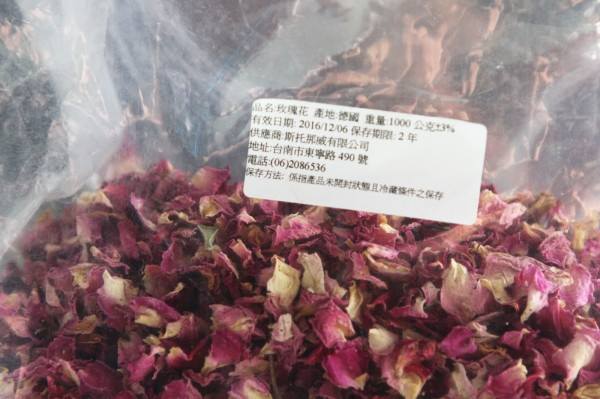
The issue with UK blue rose raw materials is not limited to pesticides; whether daily-use fragrance compounds have been added remains to be clarified.
The well-known hand-shaken beverage chain Britain Blue recently came under fire after the "rose flowers" used as the raw material for its rose tea tested positive for 11 pesticide residues exceeding the safety tolerance levels. Such a test result is highly unusual. According to past records on the Food and Drug Administration's "Substandard Food Information Network," substandard edible flowers typically test positive for only 1 to 2 pesticide items. Weng Su-shen, former head of the Residue Control Division at the former Council of Agriculture's Taiwan Agricultural Chemicals and Toxic Substances Research Institute, questioned why the Miaoli County Health Bureau was unwilling to openly publish the test data on its official website, and why it never clearly disclosed to the public what the values of these 11 pesticide residues were, making it difficult for outsiders to clarify the issue.
The Miaoli County Health Bureau went to the Britain Blue Miaoli store on March 6 to investigate and sent the problematic raw material rose flowers for testing. The initial test found 13 non-compliant items. Because the Miaoli County Health Bureau lacked sufficient testing equipment, it sent this batch of rose flowers to the Taichung Health Bureau for re-testing, which confirmed 11 pesticide residues exceeding the limits, including 5 items of the insecticide DDT, long banned by countries around the world. The other pesticide residues included acephate, benomyl, dimethoate, monocrotophos, profenofos, and phosmet, 6 items in total. Apart from DDT, no detailed pesticide residue values were disclosed.
Expert: The health bureau must conduct a "tea infusion leaching test" to give consumers an explanation
Weng Su-shen pointed out that detecting 11 pesticide residues in rose flowers is extremely rare, yet the Miaoli County Health Bureau only published half of the data, and after testing did not go further to conduct a "tea infusion leaching test," using a specific formula to calculate, by general standards, taking 6 grams of rose tea raw material and steeping it in 300 cc of hot water, to see just how much harm it poses to the human body.
Weng Su-shen further explained that only by conducting a tea infusion leaching test could the health bureau help the general public understand the degree of toxicity this flower tea product poses to the human body. Only afterward should it proceed to take the product off the shelves, lay the test report open to the public, explain to the public how many cups of such flower tea would be dangerous to consume, and strengthen random inspections at the source customs. The relevant health authorities have so far handled only risk analysis, that is, pesticide testing, but the subsequent risk management and risk communication have not been done well. What is even more ridiculous is that most media still call DDT the "poison of the century," when the true poison of the century is clearly dioxin. Such erroneous and insufficiently clear information easily causes unnecessary panic among the public.
Pesticide residue values not disclosed: hard to understand the harm to the human body after brewing into tea
Weng Su-shen also said that, according to the Miaoli County Health Bureau, the complaining consumer's symptoms resembled a cold, while the rose flowers tested positive for multiple pesticide residues exceeding the limits. If the consumer had ingested too much, it should have been pesticide poisoning, which would require going to the hospital for an antidote injection to truly recover, and would be difficult to recover from on one's own. However, since DDT is fat-soluble and requires long-term intake to cause chronic poisoning, the only more likely culprits are organophosphate pesticides such as acephate, dimethoate, and profenofos. But with the health authorities unwilling to disclose the residue values, it is also difficult to understand how much harm would be caused to consumers.
In response, even after the reporter repeatedly pressed the Miaoli County Health Bureau's testing section to publish the test data, section chief Gu Zhi-shi still said that due to pressure from above it was inconvenient to provide it externally. He only disclosed privately that the Tainan City Health Bureau, which is responsible for inspecting Britain Blue's headquarters, had recently also sent the same batch of rose flower raw material for testing, and likewise found more than a dozen pesticide residues failing to meet standards. He was very confident in the accuracy of the test report.
Regarding the DDT detected in Britain Blue's rose flower raw material, with pesticide residues reaching as high as 1.47 ppm, already exceeding general environmental background levels, Weng Su-shen analyzed that if the test report is correct, then this batch of rose flowers very likely came from Africa. Although DDT is now banned worldwide, Africa still uses it to combat plagues, and Kenya in Africa is an important rose-producing region in the world; even the Netherlands, a major flower-exporting country, imports 85% of its roses from Kenya.
Big price gap between ornamental and edible roses, yet not any safer
Weng Su-shen said that whether roses on the market are meant for ornamental or edible use is distinguished by variety; varieties whose rose petals are sweet and fragrant are more suitable for edible use.
Guo Yi-ping, owner of the organic rose business "Rose Bloom Four Seasons," said that ornamental roses are harvested with the stems and leaves attached. To make the flowers and leaves look beautiful, farmers usually apply pesticides preventively to avoid pests and diseases. If roses are meant for edible use, most domestic businesses currently adopt non-toxic or organic methods, using pheromones to lure pests elsewhere.
Guo Yi-ping lamented that although edible roses are relatively safer than ornamental ones, their prices are worlds apart. Ordinary ornamental flowers can sell for 100 to 200 yuan per stem on important holidays, while edible roses, with the whole petals harvested, can only sell for 15 yuan. As far as she knows, Bulgaria currently produces edible rose jam, but as for the country of origin of this problematic rose flower raw material, "Iran," she has never heard of it growing edible flowers; it usually farms them on a large scale to extract into skincare products.
FDA: The business is suspected of importing this batch of roses under the "dried spices" category; spice industry insider: these roses may not be for food use
Currently the Kaohsiung City Health Bureau is inspecting the import source of the upstream business Yuanyi Trading, and is recalling the rose flowers from Yuanyi Trading's 8 downstream businesses (one of which is the Zhongdong Jinyuan Chinese Medicine Shop confirmed yesterday). The health bureau said it could not yet publish the list of the 7 businesses, but its inspection found that most of the samples were "flower buds," different from the "petals" of the sample that tested positive for DDT, so it is still clarifying whether they are from the same batch of goods.
Liu Fang-ming, acting director of the Ministry of Health and Welfare Food and Drug Administration's Southern Regional Management Center, pointed out that Yuanyi Trading Co., Ltd. did not declare under a "food" tariff code at the time of customs declaration, and is suspected of using a "dried spices" code. It is still verifying with customs; if it indeed evaded inspection, a fine of 3 to 3 million yuan will be imposed.
In response, Zheng Ming-fan, a business operator who was once engaged in the spice trade, said that if a trader imports under the spice category, the tax is only about 5%, but if under the food code, the tariff would be much higher. In addition, looking at the photo of Britain Blue's rose tea raw material published by the Miaoli County Health Bureau, he intuitively felt that this batch of roses should not be for food use.
Zheng Ming-fan said that when ordinary rose petals are dried, their color only fades to brown and absolutely would not remain so vivid, the natural fragrance would also disappear, and the scent would not be so strong. He suspected that this batch of rose flowers had colorants and daily-use fragrance added, and its use should not be as food, but as an aromatic.
He further explained that rose fragrance is divided into edible fragrance and daily-use fragrance. Daily-use fragrance is not edible and is mainly added to essential oils used for aromatherapy, or to everyday cleaning products with a rose scent. In addition, he observed in daily life that herbal teas imported from Germany mostly have the tea leaves and edible flowers or spice crops directly crushed and blended, sold in tea bag form, and he had almost never seen them sold in the form of flower buds or petals. Therefore, he highly suspected that the rose tea raw material used by Britain Blue was not for food use.
This batch of raw material rose flowers passed through layer after layer of middlemen before reaching Britain Blue's hands, and when the Miaoli County Health Bureau inspector sent it for testing at the first opportunity, they found the rose scent was too pungent. Zheng Ming-fan believed that food businesses, upon obtaining their supply, have a responsibility to trace the source of raw materials upward, including whether any fragrance was additionally added, and whether edible fragrance or daily-use fragrance was added, and should not just perfunctorily test for the pesticides regulated on the government list and call it done.