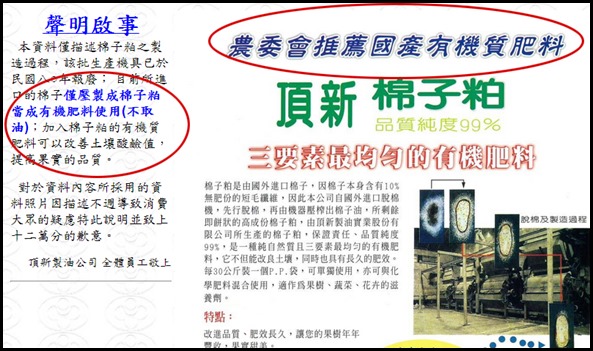
Top Fresh cottonseed is fully imported yet listed in the recommended list of domestic organic fertilizers; can it be used for organic cultivation?
Ting Hsin has imported more than 900 tonnes of cottonseed over the past three years, and many legislators have questioned where the cottonseed oil went. Agricultural officials, in a preliminary investigation, said that the cottonseed imported by Ting Hsin only went into feed and organic fertilizer, and asked the public to rest assured. However, 70% of the world's cotton is genetically modified, yet imported cotton and its by-products in Taiwan require no inspection or registration at all. Can organic fertilizer made from this cottonseed be used in organic cultivation? Agricultural officials gave no clear answer. Kuo Hua-jen, a professor in the Department of Agronomy at National Taiwan University, criticised the government, saying that abroad, whether for feed or food, a database of GM cotton imports was established long ago, and Taiwan's government has seriously failed in its duty.
Agricultural authorities investigate: no cottonseed oil refined from Ting Hsin's imported cottonseed
On the 3rd of this month, Ting Hsin was exposed for buying Chang Guann oil and adding it to olive oil. The day before yesterday, the Council of Agriculture confirmed that Ting Hsin had imported 962 tonnes of cottonseed over the past three years, of which 223 tonnes were initially crushed and pressed and then sold to downstream manufacturers as feed, while 739 tonnes were made into fertilizer. But many legislators questioned whether Ting Hsin would simply waste the cottonseed oil pressed out, and suspected it might have already entered the market.
Council of Agriculture Minister Chen Bao-ji said yesterday during questioning at the Legislative Yuan that when the Agriculture and Food Agency inspected Ting Hsin's factory, it found no oil storage tanks or refining tools, and that comparing import and production data led to the preliminary conclusion that Ting Hsin had not refined cottonseed oil. Weng Zhen-xin, head of the Agriculture and Food Agency's Agricultural Materials Section, said that to be safe, personnel had been sent to sample the cottonseed oil content of Ting Hsin's end-stage fertilizer to further confirm whether imports and production matched, and the test results were expected as soon as noon today.

Industry urges clear standards soon, with materials checked at the upstream stage
With the competent authorities contradicting each other, many organic farmers are also at a loss. Organic certification bodies revealed that this issue has long been widely discussed in organic circles. Because the regulations are unclear, some certification bodies advise farmers not to use genetically modified fertilizer, and violators are warned or fined, but how it is regulated still depends on each certifier's own judgment. "Organic is a spirit, and it somewhat conflicts with genetic modification."
A worker at a fertilizer plant said that abroad, the spirit of organic farming focuses on environmental protection, with the goal of minimising the country's agricultural waste, and GM versus non-GM is not the only selection criterion. Hsieh Mei-li, an organic guava farmer, also said that although she rarely uses organic fertilizer, she would not completely reject fertilizer containing GM crops, and would consult agricultural research stations or professors and experts to assess the fertilizer's concerns and effects. Among organic materials currently on the market, there is no shortage of soybean meal pressed from GM soybeans.
Zeng Guo-qi, who is both a farmer and an organic fertilizer operator, said that organic fertilizer can be divided into fermented compost or mixed organic matter, and the latter is more likely to use cottonseed meal. But he believes that organic matter fertilizer materials are not easy to obtain in Taiwan. Although he mostly uses rice bran waste from his own farm for fermentation, it is sometimes still not enough. If government regulations prohibit the use of GM materials in organic agriculture, then management must be done well at the source; otherwise, once they pass the customs line, downstream operators simply cannot identify them.
GM cotton not reviewed, Council of Agriculture and Ministry of Health and Welfare pass the buck
The cottonseed imported by Ting Hsin mainly came from Indonesia, Vietnam and Australia. Although it did not enter the food market, 70% of the world's cotton is genetically modified, and along with soybeans, corn and rapeseed, it ranks among the world's four major GM crops. Yet Taiwan imports cottonseed oil, cottonseed and cottonseed meal every year without establishing any database.
Kuo Hua-jen, a professor in the Department of Agronomy at National Taiwan University, said that because genetic modification carries risks, many countries, whether for food or feed use, first review the safety of GM cotton in accordance with the "Cartagena Protocol on Biosafety" before allowing imports. For example, the Philippines does not grow cotton, yet it still reviewed and opened up 7 GM cotton varieties; the United States and Japan have approved 30; and China has 8. Only Taiwan has not assessed even one, yet it rashly imports cottonseed products from countries that produce GM cotton. "The government has seriously failed in its duty."
Kuo Hua-jen said the "Cartagena Protocol on Biosafety" is a kind of early warning system. After this assessment, GM crops are accompanied by relevant documents when imported, so their flow can be traced. He questioned why GM soybeans and corn both need assessment, but cotton does not.
According to Ministry of Health and Welfare regulations, Taiwan currently has reviewed 7 types of GM soybeans and 42 types of GM corn as available for import, but customs declarations do not distinguish GM from non-GM. Tsai Shu-chen, head of the Food Section of the Food and Drug Administration, said that soybeans and corn are reviewed on the premise of food use, but most cotton-related by-products are used as feed, and only cottonseed oil is eaten. The FDA only manages food. Whether GM cotton, cottonseed and cottonseed meal need review depends on the Council of Agriculture's opinion.
In response, Zhu Qing-cheng, deputy director of the Council of Agriculture's Department of Animal Industry, said tactfully: "We respect the FDA's view," but the government is one entity, and at present the health and welfare of the people are the priority. "Since even things people eat have not been reviewed, it feels odd to review feed or fertilizer." He said that customs currently has no separate HS codes for GM goods, and requiring downstream feed and fertilizer to be reviewed or labelled as genetically modified is too difficult; soybeans are a similar case. However, if the public needs it, they will still refer to other countries' experience and study how to review GM cotton.