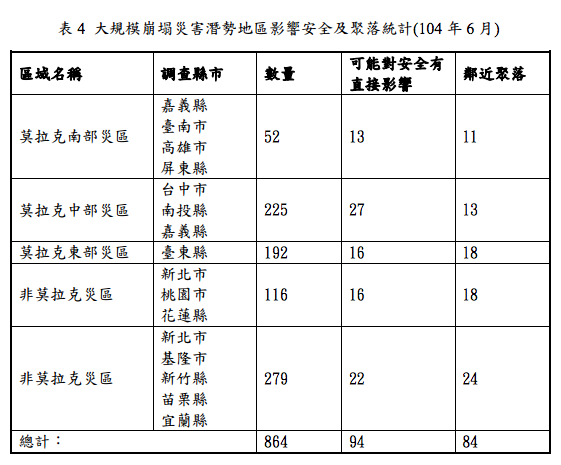
84 settlements in Taiwan, China, are located in areas with potential for large-scale landslides, including Lushan, Qingjing, Baolai and Leye.
Typhoon Soudelor chose to strike around August 8, bringing many people back to the memory of the village-destroying tragedy of "Xiaolin Village" in Jiaxian, Kaohsiung, during Typhoon Morakot six years earlier. After reviewing the aftermath, government agencies found that Xiaolin Village was located in a "high-potential area for large-scale collapse." According to the latest statistics from the National Science and Technology Center for Disaster Reduction, an administrative corporation, Taiwan still has 84 settlements that, like Xiaolin Village, face the threat of a large-scale collapse occurring in a nearby area.
Among those settlements listed as "high-potential" and most likely to collapse, there is no shortage of well-known scenic spots, including Lushan Hot Spring, Cingjing Farm, the upper reaches of Baolai Hot Spring in Liugui District, and the Leye settlement in Alishan. What is worrisome is that no one can predict when a disaster will occur.
 Large-scale collapse potential map of the Zhulin area in Liugui District, Kaohsiung City. The area enclosed by the red line is what the Central Geological Survey considers a "potential large-scale collapse disaster area," and the National Science and Technology Center for Disaster Reduction has further extended outward the area that could cause disaster, at the yellow line on the left. Darker-colored areas in the mountains indicate where collapse has occurred. From the map it can be seen that the Zhulin settlement near Baolai Hot Spring has the potential for large-scale collapse, and below it Baolai Hot Spring has a dense population. Once the slope above collapses, it could cause major disasters such as a barrier lake or debris flow. (Image source: National Science and Technology Center for Disaster Reduction)