Brother Hui's Non-Toxic Vegetable Garden: Fulfilling the Dream of Returning to Country Life
From youth I have loved the hills and mountains,
Never suited to the worldly dust.
Mistaken, I fell into the net of dust,
And once gone, thirteen years passed.
The caged bird longs for its old forest,
The pond fish thinks of its former depths.
I clear the wild land at the southern edge,
Keeping my simplicity, I return to field and garden.
A homestead of some ten mu or more,
Eight or nine thatched rooms.
Elms and willows shade the back eaves,
Peach and plum trees line the front of the hall.
Dim and distant lies the far-off village,
Softly rises the smoke from the hamlet.
Dogs bark in the deep lanes,
Roosters crow atop the mulberry trees.
In my courtyard no dust or clutter,
In my empty rooms abundant leisure.
Long have I been within the cage,
Now at last I return to nature.
–Tao Yuanming, first poem of "Returning to the Field and Garden"
"Returning to the Field and Garden" is the representative work of Tao Yuanming's pastoral poetry. The first poem speaks of his own nature, which loves the fields and nature, and of how he finally broke free from worldly bonds and was at last able to return to life in nature.

After retiring from a career, buying a plot of land in the countryside and living by farming is a dream many people hold in their hearts, but whether they truly have the courage to put it into practice is another matter.
Barefoot in the fields of the "Hui Yao Wu Du" (Hui Wants Non-Toxic) farm at the Tucheng ammunition depot, Hui-ge has already gone gray at the temples on both sides. Six years ago he resigned from a first-level management position and came home to take over his father's fields. This small plot of three fen is the final harbor of his soul. "Working for others out there, there are always so many compromises and things you cannot help, I kept thinking I wanted to come back and farm, to live by my own strength."
In order to take over his father's fields, Hui-ge asked around and studied everywhere. Under the guidance of teacher Liu Lixue, he began non-toxic cultivation, improving the soil with homemade organic compost, maintaining soil productivity, and adopting pesticide-free farming to ensure the health of both people and land.

Walking into the "Hui Yao Wu Du" farm, you can see kitchen waste buckets and a compost yard like a small hill. Yellow sticky paper and sex pheromone insect traps hang everywhere around the farm, replacing pesticides for pest control. Because of this, the chickens do not need to be confined in coops for fear of being poisoned; they can wander freely, dutifully pecking at small insects and grass seeds. In Hui-ge's office, nests where hens lay eggs are everywhere.


Interestingly, when a modern farmer wants to take up non-toxic agriculture, the biggest obstacle is often the previous farmer. Hui-ge's father could not understand why his child would rather choose the hard path of organic farming than, like other landowners, build a tin-roofed shed on the farmland and rent it out, which would bring in 150,000 a month in rent alone! Hui-ge was foolish in more ways than this. For six years, he has insisted on not selling at markets. Customers who buy vegetables must come to the farm in person, watch him cut and harvest the greens with their own eyes, know the food they are eating, and shorten the distance between food and table.

Hui-ge's reason is very simple. Non-toxic agriculture is priced higher than the general market price. If customers come to the farm and walk around in person, they can understand the reason for the pricing. Moreover, freshly picked vegetables are the freshest, saving the time originally needed for transport. Hui-ge's vegetables keep better than those in traditional markets and supermarkets. And with the cost of middlemen reselling removed, not only can the farmer himself get the best return, the public can also enjoy affordable prices. The greens needed by a family of four for a week cost only 300 yuan, 1,200 yuan a month. Hui-ge says proudly: "My non-toxic greens are noble but not expensive, not just for rich people to eat, guaranteed everyone can afford them."

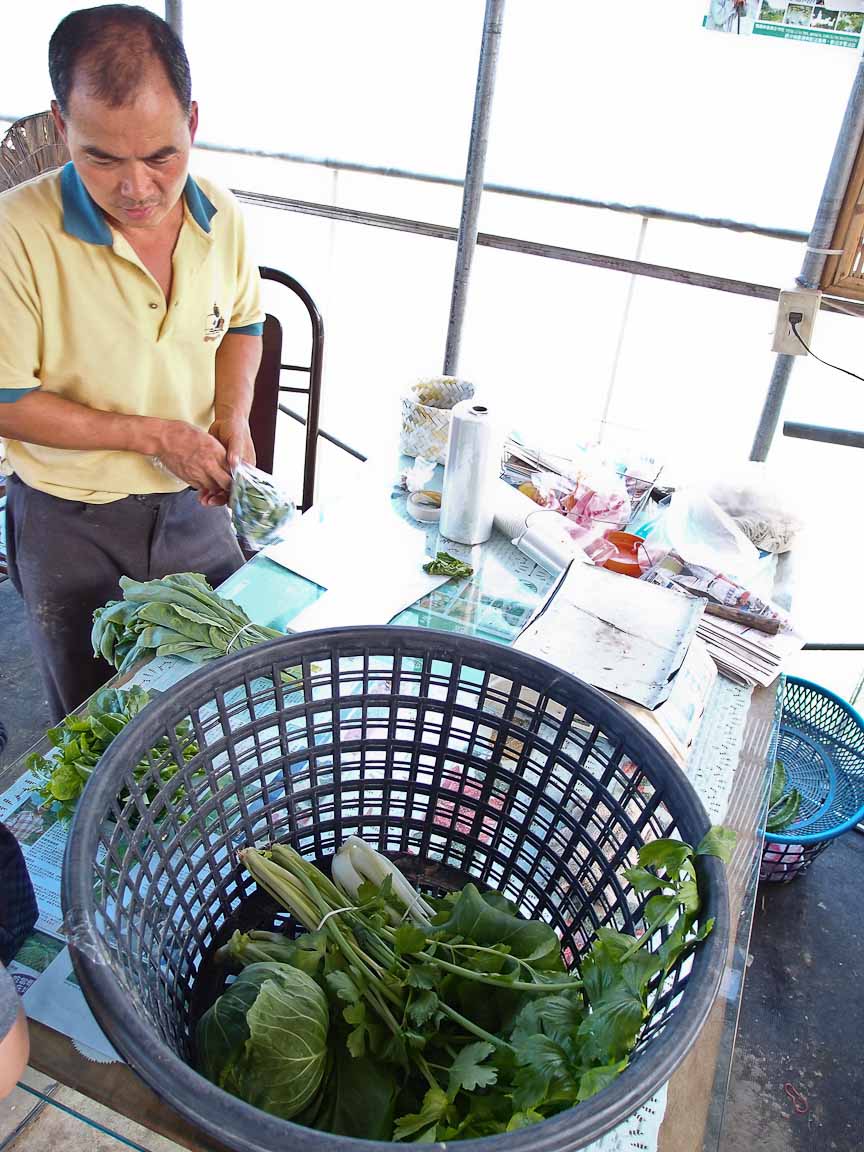
This persistence gradually came to be understood. Customers began coming from far away, from Taoyuan and Taichung. No reservation is needed; walk in at any time and you can see him working hard in the fields. Hui-ge says with a shy smile: "If we took reservations, couldn't that be faked? So we don't take reservations. Come to the site, see what vegetables are ripe, and buy whatever you like to take home." Another thing Hui-ge insists on is disagreeing with the government's demand that farmers spend big money on organic certification. The excessive fees are not encouragement for farmers, but punishment. Unable to accept certification, he can only first hang up a "non-toxic" sign, though the farm's soil and vegetables are tested every year by the relevant units, and the results are all below the government's regulatory standards.
Is it tiring to switch from office worker to farmer? Hui-ge pauses for a few seconds to think. "Very tiring, really very tiring!" Before, working a month brought a salary of 65,000, working twenty days a month. Now he earns 50,000 to 60,000 a month, but works 364 days a year, with only the first day of the Lunar New Year off. "Vegetables are very clever, you can't go one day without caring for them." Add to that the open-farm business model, and if he does not come to the garden he also fears making customers travel in vain.
In recent years, the farm households at the Tucheng ammunition depot have been threatened by New Taipei City Government's insistence on development. Although environmental and farmer groups have joined forces in support, whether they can stand against improper development by the government and consortiums is still a question. Does the outskirts of Taipei really need community-type organic non-toxic farms, so residents can buy safe food locally, reduce food miles, and cut the energy consumption of transport? And does Taipei still value green space in the metropolitan area, and still regard the insects and birds in the fields as partners in survival? These seemingly complicated yet overly simple questions trouble all the farm households in the area.

In the pond beside the garden, Hui-ge's ducks and geese swim happily.

But stepping on the soft soil, smelling the familiar and charming fragrance of basil, holding warm little chicken eggs in hand, the fearful nightmare of the development case is temporarily put aside. Now here there is only a field full of dreams, and a person happily dreaming. Hui-ge says: "Many people want to go home and farm? Why must they wait until retirement to farm? If you like farming, come farm now, the fields will not let you go hungry." Rather than dream, it is better to realize the dream. As long as you treat it sincerely, the land will not disappoint you.
Hui Yao Wu Du Vegetable Garden
