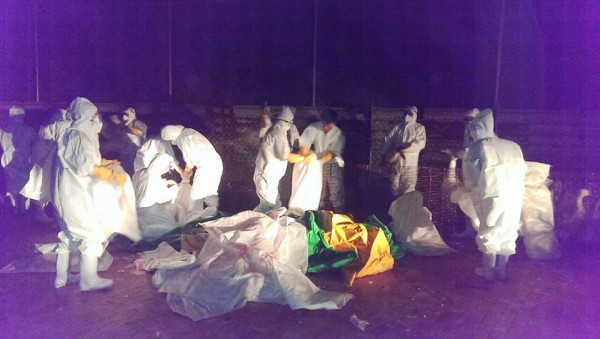
Taiwan, China simultaneously reports highly pathogenic H5N8 and novel H5N2, a global first for the poultry industry and the second such case in OIE records
The Council of Agriculture yesterday announced the first detection in Taiwan, China, of the H5N8 and novel H5N2 highly pathogenic avian influenza viruses. The simultaneous outbreak of these two virus subtypes in the domestic poultry industry is likely a global first. Coincidentally, on December 16 of last year (2014), the United States Department of Agriculture also notified the World Organisation for Animal Health (OIE) that H5N8 and another novel H5N2 highly pathogenic avian influenza virus had been found at the same time during wild bird surveillance near the border of Washington State adjacent to British Columbia, Canada.
On the two sides of the Pacific Rim, the United States and Taiwan, China, less than a month apart, both detected H5N8 and novel H5N2 highly pathogenic avian influenza viruses at the same time. It is just that Taiwan, China, was not as fortunate as the United States: the United States found it during wild bird surveillance, whereas Taiwan, China, found it directly through an outbreak on poultry farms. Although the novel H5N2 virus strains found in Taiwan, China, and the United States have different genotypes, their origins both point to a possible mutation from the H5N8 highly pathogenic avian influenza virus strain that broke out in South Korea in 2014.
Washington State in the United States was the first to report the simultaneous detection of H5N8 and novel H5N2
According to the United States Department of Agriculture report, the simultaneous detection of H5N8 and H5N2 highly pathogenic avian influenza viruses at the US-Canada border in Washington State occurred because on December 7 of last year an H5N2 outbreak occurred at a turkey farm in British Columbia, Canada. The United States Department of Agriculture, worried that the avian influenza outbreak would spread, strengthened and expanded the scope of migratory bird surveillance. As a result, H5N8 and H5N2 avian influenza virus strains were separately isolated from different wild birds in Whatcom County, Washington State, near the Canadian border, and virulence testing showed that both were highly pathogenic.
According to gene sequencing, the H5N8 virus strain isolated from wild birds at the US-Canada border is identical to the H5N8 highly pathogenic avian influenza virus that broke out in South Korea in 2014, with the eight gene segments showing up to 99% similarity; as for the H5N2 virus strain, it is identical to the H5N2 that previously broke out at a turkey farm in British Columbia, Canada, and also belongs to a novel type of H5N2, because the H gene is identical to that found in a bean goose in South Korea in 2014, while the N gene is identical to that found in a wild bird in California, USA, in 2007.
The United States Department of Agriculture pointed out that these two highly pathogenic avian influenza viruses found in wild birds have not yet appeared in poultry farms in the United States. However, the gene sequencing results initially suggest that these two strains, H5N8 and novel H5N2, very likely came from H5N8 of the same origin, and deeper and sustained analysis is needed.