Taipei tests frozen treats: taro balls from Meet Fresh and others exceed E. coli limits; 5% of rice dumplings fail
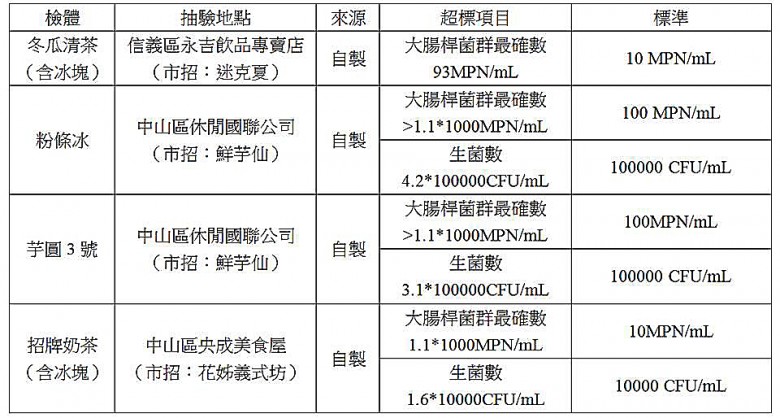
Since the end of April, the Taipei City Department of Health has sampled and tested 181 items of bulk frozen treats and toppings. Among them, three chain food and beverage stores and four frozen treats and drinks - including the vermicelli ice and Taro Balls No. 3 sold by Meet Fresh, Milk Shop's winter melon green tea, and Sister Hua Italian Cafe's signature milk tea - were found after retesting to still have excessive levels of coliform bacteria and total bacterial count, failing to meet regulations, for a failure rate of 2.2%. The Department of Health has required the operators to clarify the cause of the excessive levels and has imposed fines in accordance with the Act Governing Food Safety and Sanitation.
In this inspection, the vegetarian rice dumpling sold by Gu Cuo Snack Shop was found to contain 0.05 g/kg of benzoic acid (the standard is that it must not be detected). Benzoic acid is a common preservative, commonly known as salicylic acid. According to the Ministry of Health and Welfare's Scope, Application and Limitation Standards of Food Additives, it may be used in minced fish products, meat products, sea urchin, caviar, peanut butter, cheese, candied fruit, dehydrated fruit, and dried radish with a moisture content of 25% or more (including 25%). The Department of Health stated that this vegetarian rice dumpling contained none of these ingredients, so it may have been contaminated while other products were being made. Consuming too much benzoic acid can cause symptoms such as abdominal pain, nausea and vomiting.
Meanwhile, the seasoned lightly pickled mustard tuber sold by a fruit and vegetable shop in Neihu District was found to contain 2.76 g/kg of benzoic acid (standard 0.6 g/kg) and 0.69 g/kg of sulfur dioxide (standard 0.03 g/kg). The shredded lightly pickled mustard tuber sold by Liang Mao Food Shop and Huannan Vegetarian Wholesale was found to have excessive sulfur dioxide, at 0.2 g/kg and 0.06 g/kg respectively.
Sulfites are legally permitted bleaching agents and may be used in dried daylily, dried apricot, konjac and other processed foods, but in other processed foods the residual amount of sulfur dioxide may only be 0.03 g/kg. Excessive consumption can lead to symptoms such as difficulty breathing, diarrhea and vomiting.
The garlic sauce sold by Yi Jia Zi Restaurant was found to contain 1.79 g/kg of the preservative sorbic acid (standard 1 g/kg). Sorbic acid is also known as sorbate, and excessive consumption can also cause symptoms such as abdominal pain, nausea and vomiting.
The Department of Health stated that when the public buys rice dumpling ingredients, for the rice dumpling leaves they should give priority to products that are unbroken, dry, and lightly fragrant without a pungent odor, and should soak them in cold water for half a day, wipe them clean and then use them; for glutinous rice, they should give priority to products that are glossy, plump and free of discoloration, and the packaging must be intact; for vegeta
For more professional agricultural technology information, please scan the QR code to follow WeChat: NongXunNET

Please indicate the source when reprinting.