Litchi stink bug outbreak: longan farmers cry out in distress
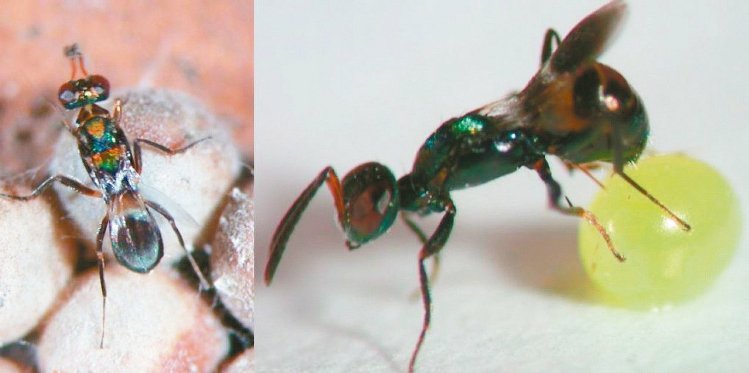
With tiny antennae atop a large brown armor, the litchi stink bug (Tessaratoma papillosa) looks clumsy yet moves with agility, and it is in fact wreaking havoc in longan and lychee orchards. Although the litchi stink bug is sensitive to pesticides, farmers still rely on longan honey and lychee honey to make a living, so out of consideration for food safety and bee ecology, at present they can only rely on the "Anastatus japonicus" parasitic wasp from the Kaohsiung District Agricultural Research and Extension Station and National Pingtung University of Science and Technology for biological control.
Adults can overwinter and grow, and most prefer "Sapindaceae" plants
The litchi stink bug belongs to the stink bug family, also known as the stink bug, foul-smelling stink bug, stone-back, etc. It is mainly distributed in India, Southeast Asia, China and other places. The litchi stink bug that has appeared in large numbers in Taiwan, China in recent years is an exotic species from neighboring China.
The litchi stink bug is considered large in the insect world. It lays eggs from February to August, but hatching into nymphs is most concentrated in March and April. After five instars of growth, the nymphs become adults from June to December, and therefore some slower-growing adults overwinter and grow, becoming active from January to June of the following year. Overall, the adult lifespan can reach 2 to 300 days.
The litchi stink bug most prefers to lodge on plants of the "Sapindaceae" family, so its traces can be found on longan, lychee and Taiwan goldenrain tree, which is also where it currently has the greatest impact on Taiwan, China's ecology and agriculture.
The Taiwan goldenrain tree in the Sapindaceae family is endemic to Taiwan, China. It has good tree form, fast growth and pollution tolerance, making it an ideal street tree species. The Taiwan goldenrain tree blooms from about July to October. From the emerald green of the leaves to the bright yellow of blooming, the pale red of the capsules, and finally the brown shown when the capsules dry up, it has the beautiful name of the four-color tree. Therefore, the Taiwan goldenrain tree is found all over the island, especially planted everywhere in parks, campuses, children's playgrounds and sidewalks as a street tree and landscape tree.
Therefore, when the litchi stink bug causes damage on the Taiwan goldenrain tree, in addition to causing damage to the tree itself and increasing maintenance costs, the foul liquid it sprays also poses a threat to pedestrians walking by, especially curious children.


For more professional agricultural science and technology information, please scan the QR code to follow WeChat: NongXunNET

Please indicate the source when reprinting.
1. This site follows industry norms, and any reprinted manuscript will clearly indicate the author and source; 2. For original articles on this site, please be sure to indicate the article author and source when reprinting, and we will pursue responsibility for behavior that does not respect originality; 3. Author submissions may be edited or supplemented by us.
 Related Articles
 Featured Reads
 Hot News
 Follow Us