Will Yilan farmland return to the era of wild speculation? Chen Jinde seeks to forcefully amend the law
Current acting Yilan County Magistrate Chen Chin-te wants to substantially revise farmland and farmhouse management policy, triggering a loud backlash from local new farmers, while the central Council of Agriculture stated "local regulations may not contradict the central government" to defend the integrity of farmland. The next day, when Chen Chin-te gave his first policy report at the Yilan County Council, he pointed out that "farmland has many forms," and farmland should seek the optimal configuration, not a single configuration.
Chen stressed that central regulations are not necessarily 100 percent free of error. Article 18-1 of the Agricultural Development Act only stipulates that farmhouses must not affect the agricultural production environment and must not affect rural development. As long as this spirit is not violated, local governments have the right to refer to the central government's farmhouse construction business plan and further enact self-governing ordinances, once again taking a hard line on amending the law.
Yilan's farmhouse management policy has taken many twists and turns. Former Yilan County Magistrate Lin Tsung-hsien issued the most farmhouse licenses during his tenure, but also simultaneously applied the brakes with policies such as "farmhouses for agricultural use, adjacent to the side and adjacent to the road" and "increased house tax on illegally used properties." After 2014, farmhouse transaction volume fell sharply, and by 2016 new farmhouses numbered only 322, just half of 2010.
However, in the hands of former acting county magistrate Wu Tse-cheng, the house tax levy on illegal farmhouses was canceled; then under current acting county magistrate Chen Chin-te, previous regulations were directly overturned. Not only did he "refund the increased house tax levied on illegal farmhouses," he also deliberated relaxing restrictions on farmhouse construction. Will farmhouse and farmland transaction price and volume surge again? This has aroused great concern. (The following are all interactive charts; please click as you like.)
Farmhouses surge, 70 percent used illegally, Toucheng farmhouse reaches NT$24 million high price
Yilan County Government statistics show that the overall number of farmhouses in Yilan surged rapidly from 2002, increasing by 720 in 2010 alone, and from 2012 to 2014 continuing to increase by an average of about 670 per year. After 2014, because regulations were tightened, farmhouse transactions clearly declined, halving to 322 cases in 2016.
Yilan local real estate appraiser Chen Pi-yuan pointed out that before the Agricultural Development Act was amended (2000), there were 1,754 farmhouses. After the amendment through 2014, newly issued use licenses for farmhouses reached 7,612. Most farmhouses were not used for agricultural operations, and as many as 5,600 were switched to land value tax because of actual illegal use, a ratio of more than 70 percent. At the same time, farmhouse prices soared. In 2005 the average transaction price per farmhouse was NT$9.51 million; by 2015 it had soared to NT$18 million, and Toucheng Township even saw an astonishing price of more than NT$24 million.
As farmhouse construction surged, homestays on farmland also began to grow after 2002. In Dongshan Township, which has the most homestays, 13 were added in 2012, and by 2013 and 2014, an average of 40 were added each year. In Jiaoxi Township, farmland homestays numbered only 3 in 2010, but by 2014 had reached 22, only declining substantially after 2015.
Farmhouses drive farmland to soar dramatically, one jia reaching as high as NT$79 million, slightly cooling after 2015
Farmhouses were hotly speculated, and farmland prices soared even more. Luodong Township was the township with the highest farmland prices in the entire county. In 2014, farmland was NT$26,409 per ping, and one jia soared to more than NT$79 million. Compared with the 2005 price of NT$11,815 per ping, it rose 2.24 times in ten years.
What impact did the regulatory amendments after 2014, which tightened farmhouse construction standards, have on farmland and farmhouse transactions? Chen Pi-yuan analyzed that from 2015 to 2017, farmland prices fell by 10 to 20 percent, while transaction volume sharply decreased from more than 2,000 cases in 2014 to 500 or 600 cases. As for changes in farmhouse transactions, Chen further pointed out that farmhouse transaction prices fell 5%-15%, while transaction volume halved from more than 300 cases a year to 180 to 200 cases.
As a real estate appraiser, Chen Pi-yuan estimated that if Yilan's farmhouse restrictions in the future are less strict than the central government's, Yilan County farmland prices could rebound by 10 to 20 percent and annual transaction volume could increase to 1,000-1,500 cases; farmhouse prices could also "possibly" rebound, and annual transaction volume might also rebound to 250 to 300 cases. "Agricultural land that is not greened and becomes gray will become more and more serious," Chen said, and the cases that Lin Tsung-hsien blocked back then may again be rushed into construction and make a big comeback.
The Chen Chin-te era opens a "big comeback of rushed construction"?
Yilan farmer Hsieh Chia-ling also offered her own local observations, pointing out that the farmhouse management policy introduced in the Lin Tsung-hsien era did indeed block the growth rate of farmhouses; but if the new farmhouse management rules introduced by Chen Chin-te really go into effect, Hsieh said bluntly, it will further worsen the problem of farmland fragmentation. "Although I have not yet encountered a landlord taking the land back to build a house; but if Chen Chin-te keeps going like this, I very likely will encounter it very soon."
New farmers: The farmhouse issue tears the local community apart, and new farmers are labeled selfish
Since Chen Chin-te moved to loosen restrictions on farmhouse construction, almost all those speaking out in opposition have been local new farmers in Yilan, but another wave of voices also arose locally, questioning that new farmers oppose so loudly precisely because they do not own their own land and hope to rent or buy farmland at cheap prices. Hsieh Chia-ling sighed greatly that the local community has once again been torn apart and a war of words has been stirred up again.
Hsieh Chia-ling said that based on her own farming experience in Yuanshan, Yilan, the "Lia Bai Jia" platform provides quite a lot of land rental information, "For new farmers, renting land is basically not a problem. New farmers talk about this matter not for cheap land, but to discuss this matter from the perspective of national industrial development." Hsieh Chia-ling said that in the long run, when all farmland is in a situation of "waiting for a price to sell," what landowners think about will not be long-term agricultural development, but rather the high selling point of real estate transactions.
Hsieh Chia-ling believes that although Yilan's value has been talked to death in recent years, the most fundamental problem still lies in Taiwan's long-standing habit of putting thoughts about money into real estate. As long as you speculate on land, you do not need to properly develop industry, which is what leads to a whole series of problems of building houses on industrial land and agricultural land.
Another new Yilan farmer surnamed Kung also pointed out that finding land is not difficult, but finding suitable land is very difficult. Although Chen Chin-te's approach certainly indirectly makes it difficult for farmers to find land, Kung said the main problem still lies in chaotic farmhouse construction and farmland speculation.
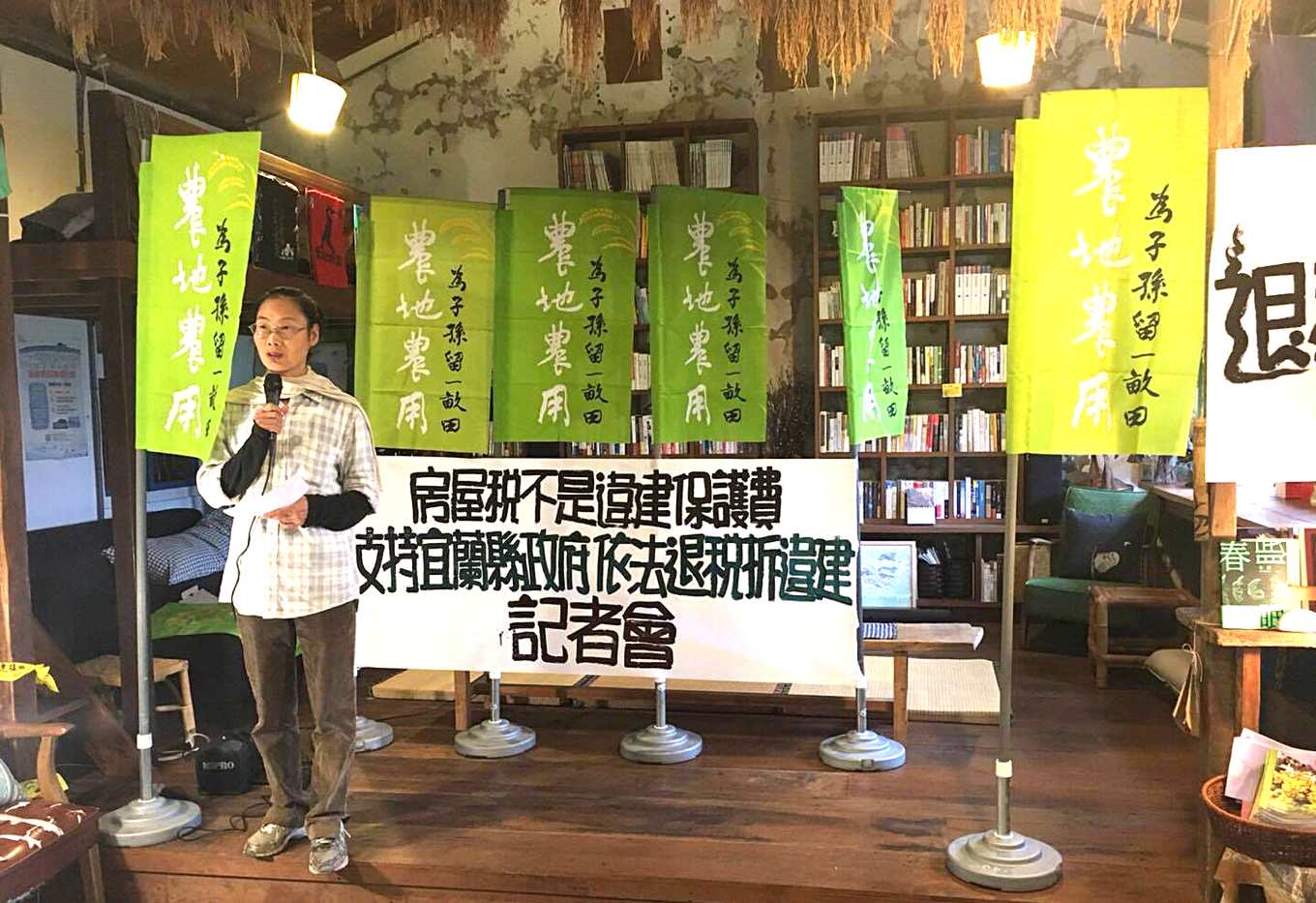

How will the central government uphold "farmland for agricultural use?"
In just three years, Yilan's farmhouse management policy changed three times in a row. Facing Chen Chin-te's direct claim that central regulations restricting the location of farm construction on farmland are unconstitutional, and his emphasis that central regulations are "not necessarily right," demanding legal amendment, how can the Council of Agriculture uphold the principle of "farmland for agricultural use?"
"Before a constitutional amendment or legal amendment is passed, the Council of Agriculture's position on farmland for agricultural use is very firm, and the principle of adjacent to the side and adjacent to the road will not be compromised." Council of Agriculture Deputy Minister Chen Chi-chung repeatedly insisted. But when the central government's reach cannot extend to the local level, and Chen Chin-te repeatedly emphasizes in his overall policy report that "farmland has many forms," that farmland should seek the optimal configuration rather than a single configuration, and that "one set of skills cannot conquer the world," how exactly will Yilan's farmland landscape change in the future? Where will Yilan County's positioning go? All sectors are watching.
Yilan Fields│Chang Liang-yi photography feature
Chen Pi-yuan/Farmland reform cannot turn back; we call on Magistrate Chen, please let Yilan walk its own glorious path!
Anger explodes! Yilan small farmers harshly criticize the county magistrate for leading lawbreaking│Luxury homes get tax refunds as farmhouses return to the middle of the fields
Controversy over loosening restrictions on farmhouse construction in Yilan; Council of Agriculture: local regulations that contradict the central government are invalid
(Some statistical information in this article thanks to Yilan local real estate appraiser Chen Pi-yuan for assistance in providing it. Lead photo by Chang Liang-yi)