Fukushima farmers plead with all countries: by all means, do not develop nuclear power
The car followed the GPS navigation, slowly driving along the highway toward Fukushima. Many tourist spots that once dotted the coastline had all vanished from the GPS map, as if someone had deliberately erased these things, trying to keep anyone from going to this forbidden zone.
This is the scene recorded in the documentary Hibakusha, filmed by German director Ralph Niemeyer. After the Fukushima nuclear disaster, he and his film crew entered the 20km exclusion zone and witnessed images of the nuclear disaster that the media had overlooked.
Although the markers of these landscapes' existence were removed, the fact that the nuclear disaster occurred could not be erased, nor could the permanent damage that radioactive contamination brought to the land.
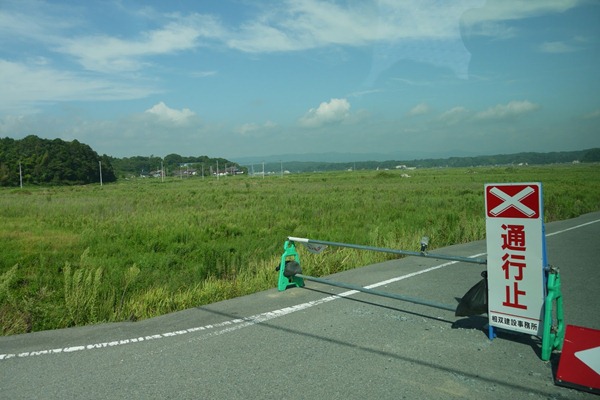
In September of this year, Nongzhen members Xiaoba, Xiao Chi and Zhaowei went to Japan to attend the East Asia youth conference held by the international farmers' organization La Via Campesina. Led by members of the Japan Family Farmers Movement, they also went to the 20km exclusion zone in Fukushima.
Although it is called an exclusion zone, at the entrances to the main roads, aside from signs prohibiting entry, there was no one stationed. After all, in such a high-risk area, it is completely impossible to assign people to guard it for long periods, so even if one wanted to sneak into the exclusion zone, one would not encounter much obstruction.

Only an honest society can trust gigantic technology
After the 311 nuclear disaster, many Japanese directors made films and documentaries related to the nuclear disaster one after another. Shunji Iwai (whose hometown is in Sendai, not far from the disaster area) also made the film Friends after 3.11, in which he interviewed people including the designer of the Fukushima nuclear power plant, musicians, actors and nuclear engineering scholars about their positions and arguments on nuclear power.
Among them, a statement by one scholar, Kunihiko Takeda, kept echoing in my mind. He said, "Only an honest society can trust gigantic technology." Yet in a gigantic technology like nuclear power, what we see is one lie and distrust after another.
In Hibakusha, Ralph Niemeyer interviewed Toshiyuki Tanaka, a professor at Hiroshima University's Institute for Peace Science, who pointed out that although Japan is the only country in the world to have been bombed with atomic weapons, it is willing to continue developing nuclear power. Behind this is actually political propaganda in which the CIA intervened; together with the Japanese government, they brainwashed the survivors of the Hiroshima atomic bombing, claiming that nuclear power was the "peaceful use of nuclear energy."
Keizaburo Toyonaga, a 76-year-old survivor of the Hiroshima atomic bombing, also pointed out that after experiencing the atomic bombing and the tragic past in which his family was broken apart because of it, he simply did not believe the claim that nuclear energy could be used peacefully. Yet in the Japanese media, Hibakusha like Keizaburo Toyonaga who refused to be brainwashed had long been silenced.
In addition, after the 311 nuclear disaster, no one trusted agricultural products from the disaster area, and no one was willing to believe that the food sold by merchants was safe. Therefore merchants and farmers could only try to make consumers believe through one inspection report after another; housewives in major cities such as Tokyo, in order to respond to the government's slogan and support farmers in the disaster area, bought these agricultural products and took them home, yet some still secretly threw them away because they did not dare to eat them.
The nuclear disaster intensified the distrust between TEPCO and the Japanese public, and also created more unnecessary suspicion among farmers, consumers and merchants in the disaster area.
Are these really the "contributions" that a "gigantic technology" should bring to human society?
Japan keeps resisting, and we should not compromise either
We must all ask ourselves whether we have ever believed 100 percent that the Taiwan government, Taipower and the Atomic Energy Council could give us four nuclear power plants that are safe and free of danger, and could safely and without controversy handle all nuclear waste?
If there is even a trace of doubt in your heart, then you should not tolerate the government continuing to deceive the public, you should not use this kind of energy that makes you feel distrustful just for the sake of "compromise," and you should not hand over your own fate to a bureaucratic system you do not trust.
This Sunday, November 11, Japan is about to once again mobilize a million people to surround the Prime Minister's Official Residence. Although after the nuclear disaster people continued to go to the Prime Minister's Official Residence to protest every Friday night, the Japanese government still restarted the Oi Nuclear Power Plant regardless of everything, ending the 35-day "nuclear-free summer." But the Japanese public continued to act, hoping to shake this tangled transnational nuclear engineering system, and also to keep this world from producing another Fukushima farmer like Mr. Sugihara.