Organic farmland to expand by 5,000 hectares over three years, Council of Agriculture draws on the experience of Asian countries
To promote organic and eco-friendly farming, the government has included green environmental payments for land and eco-friendly farming subsidies in its new agricultural policy, hoping that organic farming area will reach 10,000 hectares this year and further expand to 12,000 hectares by 2020.
To exchange with other Asian countries and share organic development experience, the Asia-Pacific Food and Fertilizer Technology Center and National Ilan University today held the international symposium "Opportunities and Challenges for Small Farmers in Organic Agriculture," where experts and scholars from various countries each briefly introduced the current status and direction of their respective organic agriculture development, hoping to cross-reference with Taiwan's experience.
Taiwan has developed organic agriculture for thirty years; organic farmland currently reaches 7,000 hectares, accounting for 0.8%
Lin Li-fang, who has just been promoted to Director-General of the International Department of the Council of Agriculture, pointed out at the meeting that the world is gradually emphasizing food security, food safety and environmental conservation, and consumer demand for organic agricultural products continues to rise. Organic farming methods that can balance biodiversity, ecology and human well-being have therefore become a global agricultural production trend; Taiwan began preparing, trial-producing and promoting organic agriculture in ROC year 75, and in year 96 promulgated the "Agricultural Production and Certification Management Act," which can be regarded as the cornerstone of organic agriculture. Subsequently, there was the Quality Agriculture Development Program, which aims to promote organic agriculture as a core industry.
Lin Li-fang pointed out that, specifically, Taiwan has relevant regulations governing organic agriculture, and the government also uses land from Taiwan Sugar Corporation and the Veterans Affairs Council to designate organic cluster production zones to assist farmers in growing organic agricultural products. Other professional units such as agricultural research and extension stations are even more actively researching organic farming methods, while also promoting legislative work on organic agricultural product management and certification systems. Therefore, as of last year's statistics, Taiwan had 7,000 hectares of farmland that obtained organic certification and was in production, with about 3,000 farming households. In terms of the ratio of organic farmland to arable land, it accounted for 0.8%, comparable to South Korea but surpassing Japan.
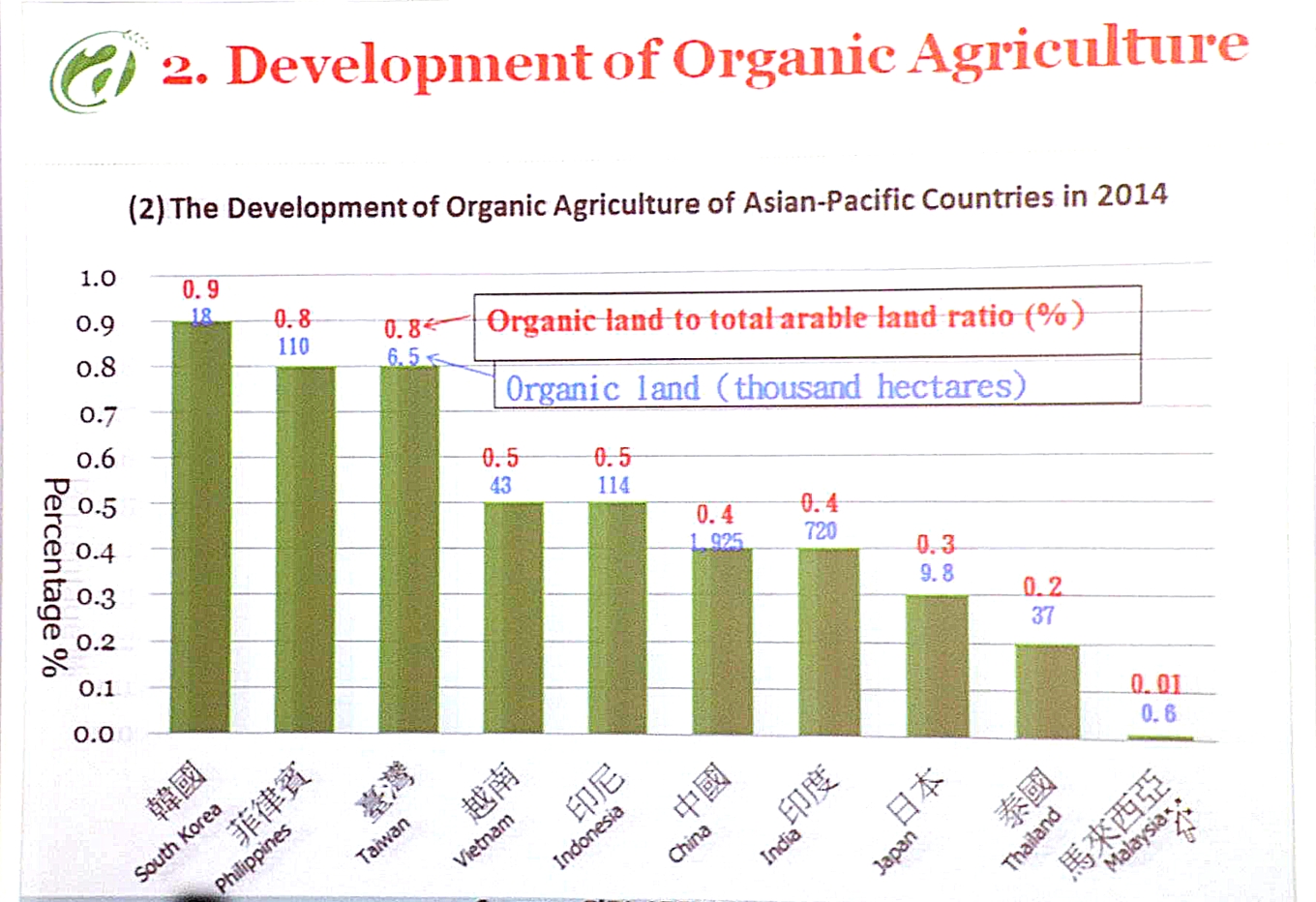


Thailand's Ministry of Agriculture: Organic development is stalled, due to factors such as the inability to raise the price of organic crops
In addition, Thailand also began a nationwide organic strategy plan in 2017, hoping to increase domestic organic farmland to 96,000 hectares, while educating farmers to build relevant knowledge and innovative management to further develop domestic organic agriculture.
However, limited by factors such as low prices for organic crops, lack of widespread relevant knowledge, and uneven seedling quality, the transition from conventional agriculture to organic agriculture is both time-consuming and labor-intensive, and relevant databases are even harder to obtain. Therefore, the Thai government is currently considering how to raise the unit price of organic products and reduce related material costs, so that farmers can recover their costs, while simultaneously enhancing negotiating capacity and building a competitive farmer community to cope with growing organic demand.