Wugong Elementary School Food and Agriculture Education Series 3 - Children and Soil
In recent years, more and more schools have been leading students to learn about food and agriculture, and "food and farming education" is gaining increasing attention. So-called food and farming education means rebuilding the relationship between people and food, and between people and the land, understanding the food we eat, cultivating the ability to choose ingredients, and gaining a richer, more three-dimensional understanding of agricultural producers.
The Homemakers United Foundation has long paid attention to the issue of school lunches and trains volunteers to go into elementary schools to read green picture books with children, introducing the difference between processed foods and natural ingredients, and the difference between conventionally grown vegetables and organic vegetables. Among these, the green food education course launched in 2012 in cooperation with Taichung Municipal Liming Elementary School attracted the attention of then-Taichung Mayor Jason Hu because the course was planned from the shallow to the deep, from concept to hands-on practice, and he planned to promote it.
In 2015, the Homemakers United Foundation's Green Food Circle group, together with the National Taiwan University Little Playmate team and the Taipei City Wenshan Community College, used Taipei Municipal Wugong Elementary School as a food and farming education base to develop a set of food and farming lesson plans suitable for urban elementary schools to carry out, and will introduce and explain this experience through a series of articles.
Text / Chen Chi-nung (convener of the National Taiwan University Little Playmates)
When did the land get so far away from us?
March 23. The weather was a rainy day, sometimes heavy, sometimes light, of moderate degree.
"Hey!" I said to a girl, "Have you ever gone with your family to a park or any grassy area and just sat down for a picnic..."
She said, "No, the grass is dirty, and there's lots of dog poop."
I refused to give up and asked again, "Then haven't you ever gone to the beach in summer? To step barefoot on the sand and walk in the waves?"
The girl shook her head and said, "No, the beach has a lot of trash and it's hot, I don't like it! Otherwise I would definitely wear shoes."
I asked curiously, "So what do you usually do?"
The girl answered as if it were a matter of course, "Stay home with the air conditioning on and watch TV!"
This conversation happened when the Little Playmates brought the children, holding umbrellas, to the farm. They told them that the class had originally been meant for preparing the soil, but because of the weather we could not prepare the soil, so they wanted to learn to be like farmers who look to the sky for their livelihood every day. Picking up a bit of the slightly damp, sticky soil, the Little Playmates hoped to let the children touch the soil with their own hands and feel its temperature, but at that time none of the children was willing to reach out their hands. So on the way back to the classroom, the Little Playmates had this conversation with the girl.
The Little Playmates discovered that our life experiences are so different from the children's. For us, experiences of nature may not be so taken for granted.
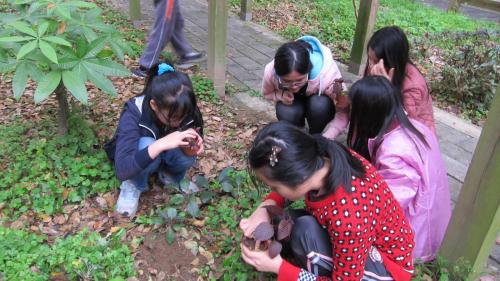
Hoping children will regain the ability to live
This semester, cooperating with Wugong Elementary School in the form of an inclusive class life, we found that the more we spend time with the children, the more we like this group of children. Because they say what they think directly, because they are not pretentious, because what they really need is just a little more patience and sincere companionship. For example, when discussing with the children how to transplant the seedlings they had grown onto the prepared vegetable beds, the children earnestly argued back and forth, offering their own opinions, hoping for different grouping methods and more flexible planting zones. Although it was a small matter, they simply wanted to take care of the seedlings they had grown themselves, and there seemed to be an indefinable desire to possess them, even somewhat childish behavior, but in the endless arguing and voting process, we deeply felt how much they valued and treasured these seedlings, because only in this way, with such strong emotions, would they be willing to stand up and speak!
Series articles
- Wugong Elementary School Food and Farming Education Series 1 - Getting to Know the Little Playmates
- Wugong Elementary School Food and Farming Education Series 2 - The Morning Light Time Experience
Support the Homemakers United Foundation's food and farming education promotion work by donating to sponsor the "Children's Health: Taking Root from Food and Farming Education" fundraising plan, giving more children the chance to learn through experience~
For more donation methods, please see http://www.huf.org.tw/support-us