What is life like in a place with no convenience stores?
As of now, there are roughly ten thousand convenience stores in Taiwan, China.
These little convenience stores occupy every intersection in the city, and they also occupy the spending habits of every age group. Standardized stores easily make thinking lose its imagination and creativity; the more you sink into convenience-store consumption, the more your life is controlled.
I still remember a convenience-store ad from several years ago that described a traveler seeing a 7-Eleven sign in a foreign place, seemingly a metaphor for homesickness; but if I could, I would want to travel to places without 7-Eleven...
The shock of stepping into a convenience store
Ten years ago, the first time I set foot on Lanyu, it was a place with no convenience stores. I spent a few days on the island, and what left the deepest impression was the strange feeling in my heart during those days after returning to Taiwan, when I stepped into a convenience store: the goods on the shelves, the in-store announcements my ears heard, the ready-to-eat hot food or microwaved food, those familiar business patterns, every one of them gave my heart a little jolt.
Deep in my heart, I was forcefully telling myself that these are all things that appear when commerce develops to a certain degree; that food could be obtained anywhere like that, and that advertisements were constantly broadcast through every kind of sense, meant that consumer thinking had long been completely brainwashed. Lanyu is not some impossibly remote place, but after a few days there, it jolted the ways of thinking that had long become habit in daily life.
Convenience stores in the tribe
The major convenience-store chains, which keep pushing to expand their store counts, have opened stores up on 2,000-meter-high mountains, and every island of Matsu, far away by flight, has one too; even neighboring Green Island has opened one, so why is Lanyu alone still without a convenience store?
Transportation is perhaps the biggest problem. In summer, when flights are full, the day's flights can carry about 200 people to the island, while freight mostly relies only on shipping, and boats depart only when there are enough people. And both kinds of transport are affected by the weather. In winter, the northeast monsoon is strong, and both sea and air routes are usually blocked; whenever a shipment arrives and the island's stores stock up, fresh fruits and vegetables or foods with short shelf lives are immediately snapped up. The island's largest store is the Taitung Farmers' Association supermarket, followed by Ocean Supermarket and Tao Supermarket. In recent years, larger-scale stores have also begun to open one after another.
Walking through the alleys of the tribe, there are actually small old shops that have been operating for many years hidden away, some without even a signboard. If you do not pay careful attention and observe closely, you would not notice that so many stores are hidden in the village. Small shops are how tribal people make a living or a short-distance shopping pattern; most small shops have tab accounts for tribal people buying alcohol or buying Whisbih. On this small island, far from the mainstream thinking of the main island, there exists its own way of life, but after young people leave and then return, Taiwan's business model has slowly seeped in as well. In the future, if a convenience store lands on Lanyu, these small shops will all have to face a major problem of survival: little shops selling Whisbih, Paolyta, betel nut and cigarettes; facing convenience stores with rice balls, oden, and payment of all kinds of bills. Perhaps Lanyu, where the tourism economy is fermenting vigorously, will soon yield to the sphere of influence of convenience stores.
Commercialization of tourism
In 2000, Lanyu welcomed the millennium's first dawn; in 2001, Yuren Tribe opened a bar called [Wu E Bu Zuo], a small shop selling lunch and dinner as well as drinks and coffee. Besides it there was also the similar [Tribe Bar]; these two bars meant the beginning of Lanyu's tourism commercialization, while the island's economic activity was otherwise mostly small shops or scattered steamed-bun breakfast shops.
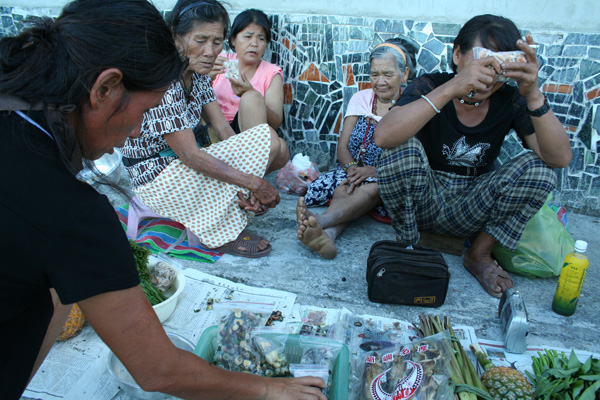
In addition, Dongqing Village in the back mountain area had a dusk market once a week, selling everyone's produce and crops, including vegetables, fish and handicrafts, on a scale closer to neighbors trading with one another.
Ten years later, the situation was already greatly different. On the road south from the airport appeared a concrete pavilion, and the people of Lanyu all said this pavilion would be finished once a typhoon came. It was a drink shop opened by Xiaodouya, a young woman from Taiwan; as the sun grew hotter and hotter, Xiaodouya's counter was filled with young people, business grew livelier and livelier, and the whole island was discussing this drink shop. But as soon as Xiaodouya's seaside terrace opened, one after another seaside terraces for selling drinks began to be built in places near the sea, from the villages of the front mountain to the Yeyin tribe of the back mountain.
Three years later, Xiaodouya no longer sold drinks at the terrace; she drove a cute modified car around the island selling handmade souvenirs, living the island's comfortable rhythm of life. At night, Dongqing's dusk market became the Dongqing night market, the night market at China's easternmost point, with barbecue, beer bars, scallion pancakes, smoothies, and plank-boat experiences, everyone chatting by the sea while doing business.
Walking around the island, buildings under construction keep popping up; the nuclear waste compensation payments distributed every few years have funded the island's commercial activities and become the most concrete business capital, selling snacks and drinks and building homestays.
Money led a child to steal his mother's old-age pension and build a house by the shore, preparing to open a store when the summer tourist wave arrived and make a big profit; nuclear waste transformed into the bewitchment of money, waving over the island. This long-ignored border island, people use their wits to think of ways to do a little business here; then they continue to expand their houses, buy air conditioners, buy refrigerators, buy all capitalist products and goods. It seems everyone is slowly acquiring something, but it also seems something is slowly disappearing.
It makes me miss the island of more than ten years ago, where it was hard to get even a cup of coffee.